
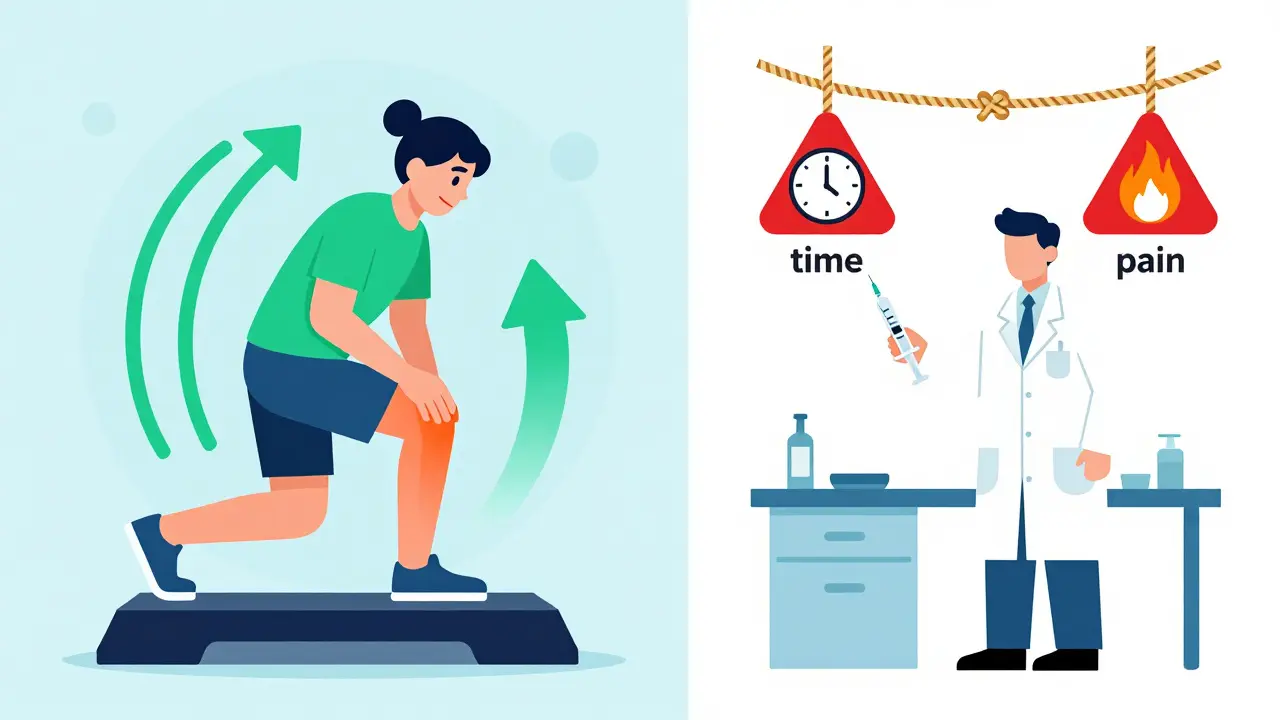
That sharp twinge in your heel or knee when you first stand up in the morning? It’s not just a minor annoyance; it’s likely tendinopathy, a degenerative condition of tendons characterized by pain, swelling, and impaired performance. If you’ve been told to "rest" for months with no improvement, you’re not alone. For decades, rest was the go-to advice, but modern sports medicine has shifted dramatically. Today, the debate isn’t about whether to move-it’s about *how* to move, and whether needles offer a shortcut that actually works.
You are standing at a crossroads between two very different paths: the slow, often painful grind of eccentric training, a rehabilitation method focusing on muscle lengthening under load to stimulate tendon remodeling and the quick fix promise of corticosteroid injections, medical treatments involving anti-inflammatory steroids injected directly into the affected area. One rebuilds tissue from the inside out; the other masks symptoms from the outside in. Understanding which path fits your situation requires looking past the hype and into the biomechanics and clinical data.
The Science Behind Tendon Degeneration
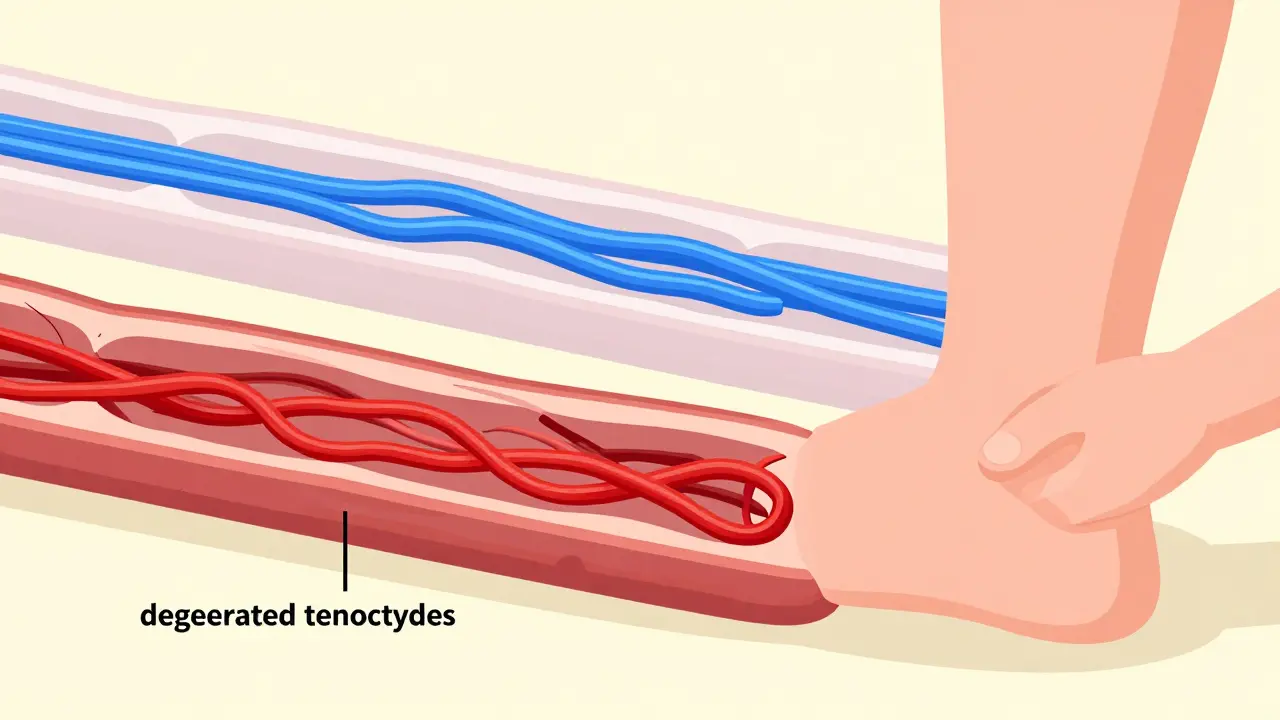
To treat tendinopathy, you have to understand what it actually is. Unlike an acute injury where you tear a fiber, tendinopathy is a failure of the tendon’s repair process. The tendon cells, known as tenocytes, cells responsible for maintaining and repairing tendon tissue, get stuck in a cycle of disorganized collagen production. Think of it like a rope where the fibers have started to fray and tangle rather than align neatly. This disorganization leads to thickening, stiffness, and pain during load-bearing activities.
This condition doesn’t discriminate. Whether you are an elite athlete jumping for a volleyball spike or an office worker who recently started running on weekends, the mechanism is similar. The American College of Sports Medicine notes that roughly 30% of all sports medicine consultations involve some form of tendinopathy. The Achilles and patellar (kneecap) tendons are the most frequent victims because they bear the brunt of our daily mechanical loads. The key takeaway here is simple: inflammation is rarely the main driver. Therefore, anti-inflammatory drugs often miss the mark entirely.
Eccentric Training: The Gold Standard Protocol
If you walk into a physical therapy clinic today, eccentric loading, exercise technique emphasizing the lengthening phase of muscle contraction against resistance will likely be the first prescription you receive. This approach gained prominence after Alfredson et al. published their seminal study in 1998, proving that controlled stress could reverse tendon degeneration. The logic is counterintuitive: to heal a painful tendon, you must load it heavily, specifically during the lowering phase of a movement.
Why does this work? Biomechanical studies using ultrasound tissue characterization show that effective eccentric training increases tendon stiffness by 15-20% and improves collagen alignment. It forces the tenocytes to wake up and start laying down new, organized fibers. But there is a catch: it hurts. A significant 68% of patients report high initial pain levels during the first two weeks. This is the biggest hurdle. You need to distinguish between "acceptable pain" (a 2-5 out of 10 on the visual analog scale during exercise) and "harmful pain" (above 7 out of 10 or lasting more than 24 hours). Most self-managed patients fail because they quit too early or push through harmful pain, causing further damage.
Injection Options: Quick Relief vs. Long-Term Risk
It is tempting to choose the needle. Corticosteroid injections, medical procedures injecting synthetic corticosteroids to reduce inflammation and pain provide undeniable short-term relief. Many patients feel a 30-50% reduction in pain within four weeks. However, this relief comes with a steep long-term cost. Research published in the BMJ by Coombes et al. in 2013 revealed a stark reality: 65% of patients who received steroid injections required additional intervention within six months, compared to only 35% in the exercise group.
Why do steroids fail long-term? While they numb the pain signals, they can weaken the tendon structure. Steroids inhibit collagen synthesis, potentially making the already fragile tendon more prone to rupture. They treat the symptom (pain) but ignore the cause (degeneration). Consequently, many doctors now view them as a last resort or strictly for diagnostic purposes, rather than a primary treatment strategy.
What about Platelet-Rich Plasma (PRP), therapy using concentrated platelets from the patient's own blood to promote healing? PRP has gained massive popularity in recent years. The idea is to inject growth factors directly into the tendon to jumpstart healing. However, a 2020 systematic review in the American Journal of Sports Medicine found only a 15-20% greater improvement over placebo at six months. Given the high cost and invasive nature, most guidelines currently advise against routine use unless conservative measures have completely failed.
| Treatment Type | Mechanism of Action | Short-Term Pain Relief | Long-Term Structural Benefit | Risk Profile |
|---|---|---|---|---|
| Eccentric Training | Stimulates collagen realignment and tenocyte activation | Low (initially increases pain) | High (reverses degeneration) | Low (requires proper technique) |
| Corticosteroid Injection | Reduces inflammation and numbs nerve endings | High (30-50% reduction at 4 weeks) | Low (may weaken tendon structure) | Moderate (rupture risk, recurrence) |
| PRP Injection | Delivers growth factors to injured site | Moderate | Mixed (slightly better than placebo) | Low (minimally invasive) |
| Heavy Slow Resistance (HSR) | Full-range loading to improve tissue capacity | Moderate | High (equivalent to eccentric) | Low (better adherence than eccentric) |
Site-Specific Protocols: Achilles vs. Patellar
Not all tendons respond to the same exercises. The location of your tendinopathy dictates the specific protocol you should follow. Getting this wrong can lead to frustration and lack of progress.
For Achilles tendinopathy, degenerative condition affecting the tendon connecting calf muscles to the heel bone, the gold standard remains the Alfredson heel-drop protocol. This involves performing three sets of 15 repetitions twice daily. Crucially, you must alternate between keeping your knee straight (targeting the gastrocnemius) and bent (targeting the soleus). The lowering phase should take 3-5 seconds. Consistency is key; structural changes visible on ultrasound typically appear after 8-12 weeks of strict adherence.
For Patellar tendinopathy, commonly known as jumper's knee, affecting the tendon below the kneecap, single-leg decline squats are the primary tool. Performed on a 25-degree decline board, these exercises isolate the quadriceps and place controlled stress on the patellar tendon. A 2017 study demonstrated that eccentric training produced significantly greater improvements in VISA-P scores compared to concentric training alone. The pain threshold here is also critical; many athletes struggle with the intensity, leading to poor form. Working with a physical therapist for the first 1-2 sessions can reduce error rates by 40%.
The Rise of Heavy Slow Resistance (HSR)
In recent years, Heavy Slow Resistance (HSR), training method using heavy loads performed slowly through full range of motion has emerged as a strong competitor to traditional eccentric training. Beyer et al.’s 2015 trial found that HSR produced equivalent outcomes to eccentric training for Achilles tendinopathy, with both groups showing 60-65% improvement in VISA-A scores after 12 weeks.
So why switch? Adherence. HSR protocols involve lifting heavier weights (around 70% of your one-repetition maximum) but moving slowly-three seconds up, three seconds down. This generates less initial pain than pure eccentric drops, leading to better compliance. In the same study, 87% of patients adhered to the HSR program versus only 72% for eccentric training. If the thought of doing hundreds of painful heel drops makes you want to quit, HSR might be the more sustainable path for you. It offers the same mechanical stimulus for tendon remodeling but feels less punishing day-to-day.

Navigating Pain and Psychological Barriers
Let’s address the elephant in the room: fear. Fear-avoidance behavior is a major reason tendinopathy becomes chronic. Patients stop moving because it hurts, which causes the tendon to weaken further, which makes it hurt more when they do move. Breaking this cycle requires a shift in mindset. Dr. Jill Cook, a leading expert in tendon health, emphasizes that treatment must be individualized based on the patient’s position on the "tendon continuum."
You need to manage your expectations. There is no magic pill. Even with perfect execution, the minimum duration to achieve significant structural changes is 12 weeks. During this time, you will likely experience fluctuations in pain. A useful strategy recommended by Rio et al. is to precede your loading exercises with isometric contractions. Holding a static position for 45 minutes can provide immediate pain relief (up to 50% reduction), allowing you to perform your eccentric or HSR exercises with less discomfort. This "pain gate" technique can make the difference between sticking to your program and abandoning it.
When Exercise Isn't Enough
Despite best efforts, about 30% of patients are "non-responders" to standard loading protocols. If you have completed 12 weeks of consistent eccentric or HSR training without meaningful improvement, it is time to reconsider your strategy. This doesn’t mean giving up; it means escalating care.
At this stage, a thorough reassessment is needed. Are you missing other contributing factors? Footwear, biomechanics, and overall systemic load management play huge roles. Sometimes, the issue isn’t just the local tendon but how the entire kinetic chain is functioning. If structural deficits persist, interventions like shockwave therapy may be considered before turning to injections. Remember, injections should never be the first line of defense, but they are a valid option when conservative care reaches its limit.
How long does it take for eccentric training to work?
You should expect a minimum of 12 weeks of consistent training to see significant structural changes and pain reduction. While some patients report feeling better within 4-6 weeks, the collagen remodeling process is slow. Ultrasound imaging typically shows measurable improvements in tendon stiffness and alignment after 8-12 weeks of daily adherence.
Is it normal to feel pain during eccentric exercises?
Yes, mild to moderate pain (2-5 out of 10) during the exercise is common and expected, especially in the first few weeks. This indicates the tendon is being loaded sufficiently to stimulate healing. However, pain should not exceed 7 out of 10, nor should it linger for more than 24 hours after exercise. If it does, you are likely progressing too quickly.
Can corticosteroid injections cure tendinopathy?
No, corticosteroid injections do not cure tendinopathy. They provide temporary pain relief by reducing inflammation, but they do not address the underlying degenerative changes in the tendon. In fact, repeated use can weaken the tendon structure and increase the risk of rupture. They are generally reserved for cases where exercise therapy has failed or for short-term functional needs.
What is the difference between eccentric training and HSR?
Eccentric training focuses exclusively on the lowering phase of a movement, often using body weight. Heavy Slow Resistance (HSR) uses heavier external loads and involves both the lifting (concentric) and lowering (eccentric) phases performed slowly. Both methods effectively remodel tendon tissue, but HSR often results in better patient adherence due to lower initial pain levels.
Should I try PRP injections for my tendon pain?
Current evidence suggests PRP injections offer only marginal benefits over placebo for most types of tendinopathy. They are expensive and invasive. Guidelines recommend exhausting conservative options like eccentric training and HSR first. PRP may be considered in refractory cases, but patients should have realistic expectations about the modest potential gains.