
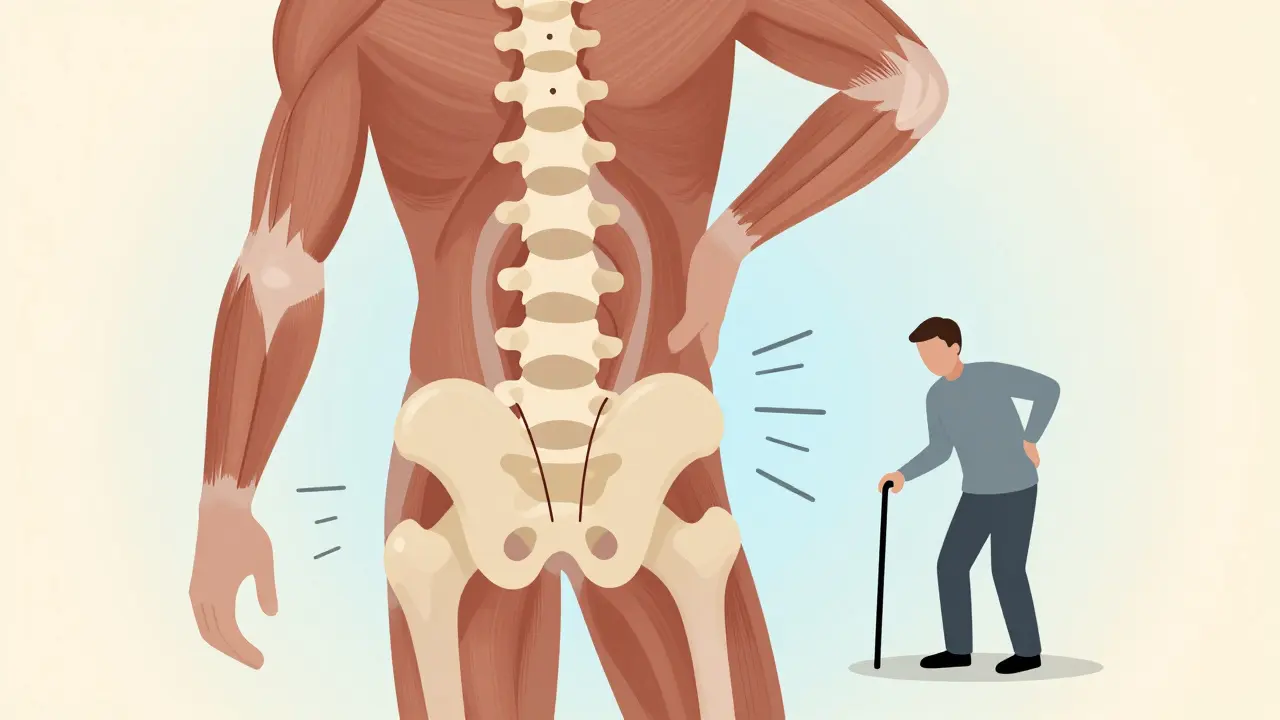
When your lower back aches after standing too long, and your hamstrings feel tight even after stretching, it might not just be a bad day. For about 6% of adults, that pain is caused by spondylolisthesis - one vertebra slipping forward over the one below it. Most often, this happens between the fifth lumbar vertebra (L5) and the sacrum (S1). It’s not rare. It’s not always severe. But when it causes pain, instability, or nerve symptoms, knowing your options - from physical therapy to spinal fusion - can make all the difference.
What Exactly Is Spondylolisthesis?
Spondylolisthesis comes from Greek: spondylo means vertebra, and olisthesis means to slip. So it’s exactly what it sounds like - a vertebra slips out of place. This isn’t just a minor misalignment. When the slippage reaches 25% or more of the vertebral body width, it’s classified as Meyerding Grade II. At 50% or higher (Grade III), nerve compression becomes likely. And in 25-100% of cases with high-grade slips, people start feeling tingling, numbness, or weakness in their legs. The condition isn’t one-size-fits-all. There are five main types:- Degenerative: The most common in adults over 50. Caused by arthritis wearing down the discs and facet joints, letting the spine shift. This accounts for about 65% of adult cases.
- Isthmic: Often starts in teens or young adults. A stress fracture in the pars interarticularis - a small bone bridge between joints - leads to slippage. Gymnasts, football players, and weightlifters are at higher risk because their sports demand repeated back hyperextension.
- Dysplastic: Present from birth. Abnormal bone formation in the spine makes it prone to slipping, even in children under six.
- Pathologic: Caused by diseases like cancer, infection, or osteoporosis weakening the bone.
- Traumatic: From a direct injury - a fall, car crash, or sudden force.
Why Does It Hurt? The Real Sources of Pain
Many people with spondylolisthesis feel nothing at all. In fact, 40-50% of cases are found by accident on an X-ray for something else. But when pain shows up, it’s rarely just “a bad back.” The pain usually starts deep in the lower back - dull, achy, and worse when standing or walking. Sitting or bending forward often brings relief. Why? Because bending forward opens up the space between vertebrae, taking pressure off the nerves. About 82% of symptomatic patients report this pattern, according to NHS data. Tight hamstrings are another hallmark. Around 70% of people with the condition can’t touch their toes without discomfort. That’s not coincidence - the slipped vertebra pulls on the surrounding muscles and ligaments, creating a chain reaction of tension down the leg. If the slip is severe (Grade III or IV), nerve roots get pinched. That’s when you feel electric shocks down the leg, numbness in the feet, or even trouble controlling your bladder or bowels - a red flag that needs immediate attention. Progressive cases can also change your posture: an exaggerated swayback (lordosis) turns into a rounded upper back (kyphosis) as the spine tries to compensate.How Is It Diagnosed?
It starts with a simple standing X-ray. That’s the gold standard for measuring how far the vertebra has slipped. The Meyerding scale grades it from I (less than 25%) to IV (75-100%). But X-rays only show bone. To see if nerves are squeezed or discs are worn down, you need an MRI. CT scans give the clearest picture of fractures, especially in younger patients with isthmic spondylolisthesis. Doctors don’t just look at the slip. They look at your symptoms, your age, your activity level, and whether your pain matches the imaging. A 2023 study found that the degree of slippage doesn’t always match how much pain you feel. Someone with a Grade II slip might be in agony, while another with Grade IV feels fine. That’s why treatment isn’t just about fixing the slip - it’s about fixing your life.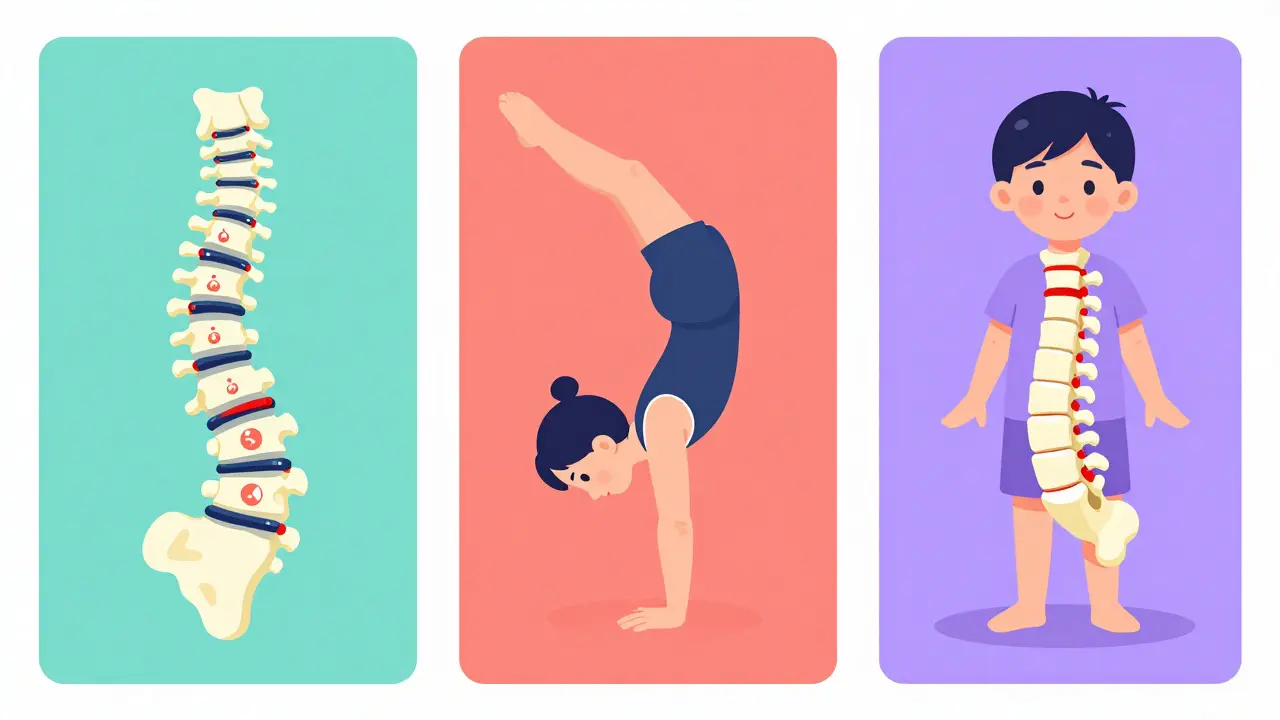
Conservative Treatment: What Actually Works
Most people - over 80% - never need surgery. The first step is always conservative care:- Activity modification: Avoid sports that hyperextend the spine - gymnastics, football, heavy lifting. Even daily habits matter. Standing for long hours? Try a stool to rest one foot. Sitting? Use a lumbar roll.
- Physical therapy: Core strengthening (transverse abdominis, multifidus) and hamstring stretching are key. Studies show 12-16 weeks of consistent therapy leads to the best results. But adherence is low - only about 65% stick with it long enough.
- Medications: NSAIDs like ibuprofen help with inflammation and pain. For nerve pain, gabapentin or pregabalin may be prescribed.
- Epidural steroid injections: If pain radiates down the leg, these can reduce swelling around the nerves. They’re not a cure, but they can buy time to heal.
Fusion Surgery: When It’s Time to Consider It
If you’ve tried 6-12 months of conservative care and your pain still controls your life - you can’t sleep, you can’t walk the dog, you’re on painkillers daily - it’s time to talk surgery. Spinal fusion is the most common procedure. It’s not about gluing the bones together just to stop movement. It’s about stopping pain-causing motion and stabilizing the spine. There are three main fusion techniques:- Posterolateral fusion: Bone graft is placed along the back of the spine. It’s the oldest method - used in about 55% of cases. Success rate: 75-85% for low-grade slips, but drops to 60-70% for high-grade.
- Interbody fusion (PLIF/TLIF): The damaged disc is removed and replaced with a spacer filled with bone graft. This restores disc height and opens up the space for nerves. Used in 35% of cases. Success rate: 85-92% across all grades.
- Minimally invasive fusion: Smaller incisions, less muscle damage. Used in about 10% of cases. Recovery is faster, but it’s not for everyone - especially with severe slips.
What Happens After Surgery?
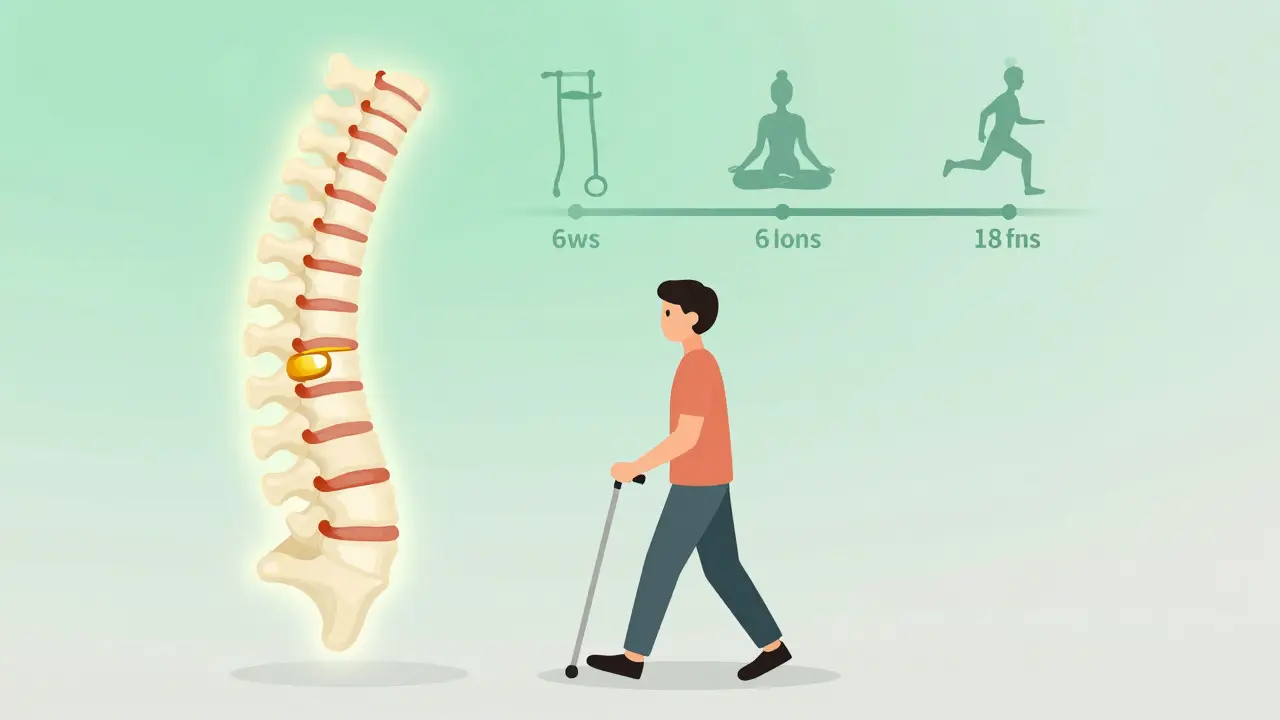
Fusion isn’t a quick fix. You’ll need:- 6-8 weeks of limited activity - no lifting, twisting, or bending.
- 3-6 months of physical therapy to rebuild strength and mobility.
- Up to 18 months for full bone healing.
New Options: What’s on the Horizon
The field is evolving. In 2022, the FDA approved two new interbody devices designed specifically for spondylolisthesis. Early results show 89% fusion rates at six months - better than older models. Bone morphogenetic protein (BMP) and stem cell therapies are being tested. A 2023 trial found BMP-2 pushed fusion rates to 94% in high-risk patients, compared to 81% with traditional bone grafts. For mild cases (Grade I-II), motion-preserving devices are being explored. These act like shock absorbers, letting the spine move while limiting harmful motion. Early data shows 76% success at five years - good, but still behind fusion’s 88%. The global spinal fusion market is growing fast - from $5.2 billion in 2022 to an expected $7.8 billion by 2027. That’s not just because more people are being diagnosed. It’s because we’re getting better at choosing who really needs surgery.What’s the Right Choice for You?
There’s no single answer. If you’re young, active, and have a Grade I slip with mild pain - physical therapy is your best bet. If you’re over 60, have a Grade III slip, and can’t walk without pain - fusion is likely the only way back to normal life. The key is matching the treatment to your life, not just your X-ray. A 2023 study identified 11 clinical and imaging factors that predict surgical success with 83% accuracy. That means doctors can now say, “You’re a good candidate,” or “Let’s try more therapy first,” with far more confidence. Don’t rush into surgery. But don’t wait until you’re in constant pain. Get the right diagnosis. Understand your options. And choose based on your goals - not just the numbers on a scan.Can spondylolisthesis heal without surgery?
Yes, in most cases. About 80% of people manage symptoms with physical therapy, activity changes, and pain relief. Surgery is only considered if conservative treatments fail after 6-12 months and pain severely limits daily life.
Is walking good for spondylolisthesis?
Walking is usually safe and even helpful - as long as it doesn’t cause pain. It improves circulation and strengthens core muscles without stressing the spine. Avoid long walks if you feel increased pain or leg numbness. Short, frequent walks with good posture are better than one long, painful one.
What activities should I avoid with spondylolisthesis?
Avoid sports and movements that hyperextend the lower back: gymnastics, football, weightlifting, diving, and high-impact aerobics. Also skip sit-ups, toe touches, and heavy lifting with a rounded back. Focus on low-impact activities like swimming, cycling, and walking.
How long does recovery take after spinal fusion?
Initial recovery takes 6-8 weeks, with restrictions on lifting and bending. Physical therapy usually lasts 3-6 months. Full bone healing can take up to 18 months. Most people return to normal activities by 12 months, but full strength and endurance may take longer.
Can spondylolisthesis get worse over time?
Yes, especially if left untreated or if you continue high-risk activities. Degenerative spondylolisthesis tends to progress slowly with age. High-grade slips (Grade III-IV) are more likely to worsen and cause nerve damage. Early diagnosis and activity modification can slow or stop progression.
Is spinal fusion the only surgical option?
For now, yes - fusion is the standard. But motion-preserving devices like dynamic stabilization systems are being tested for mild cases. They’re not yet widely recommended because long-term data is limited. Fusion remains the most proven option for stable, lasting relief.


Max Sinclair
January 18, 2026 AT 21:10Been dealing with this for years-Grade II slip at L5-S1. PT saved my life. Core work and hamstring stretches made the difference. No surgery needed, and I’m back hiking on weekends. Just gotta be consistent and avoid anything that hyperextends the spine. It’s not glamorous, but it works.
Also, walking daily with a slight forward lean? Game changer. My doctor said it reduces pressure on the facet joints. Who knew?
Don’t panic if your X-ray looks scary. Symptoms don’t always match the grade. I’ve seen Grade IV folks walking fine and Grade I folks crying in pain. It’s personal.
Nishant Sonuley
January 20, 2026 AT 01:49Oh wow, so we’re now quantifying human suffering in percentages? 65% degenerative, 35% interbody fusion success rates, 18-22% adjacent segment disease… I’m starting to think spine surgeons are just accountants with scalpels.
Let me get this straight-your body’s a machine, and if one bolt slips, you need a $50k weld job? Meanwhile, in India, grandmas with worse slips walk 10km daily barefoot, squatting in fields, no MRI, no fusion, no NSAIDs. Just chai, prayer, and stubbornness.
But hey, if you’ve got insurance and a 401(k), go ahead and fuse that spine. I’ll be over here, stretching in a sarong, wondering why we turned healing into a corporate product with a 12-month recovery window and a 3.2x higher failure rate for smokers.
Also-why does no one mention yoga? Not the Instagram kind. The kind where you breathe through pain instead of numbing it with gabapentin.
Emma #########
January 21, 2026 AT 09:40I just wanted to say thank you for writing this. I’ve been terrified to even look up my diagnosis because I thought it meant I’d be stuck in pain forever. But reading this-especially the part about 80% not needing surgery-gave me hope. I started PT last week. It’s hard. My hamstrings scream. But I’m doing it. And I’m not alone.
Also, the hamstring tightness thing? So real. I used to think I was just ‘not flexible.’ Turns out, my spine was screaming for help.
Andrew McLarren
January 21, 2026 AT 20:10It is imperative to underscore the clinical rigor underpinning the diagnostic and therapeutic protocols outlined herein. The Meyerding classification system remains the gold standard for radiographic assessment, and its integration with symptomatology-rather than imaging alone-is a cornerstone of evidence-based orthopedic practice.
Furthermore, the statistical correlation between smoking and pseudoarthrosis (3.2x increased risk) is not merely anecdotal but corroborated by multiple prospective cohort studies, including those published in The Journal of Bone and Joint Surgery (2021) and Spine (2023).
Patients must be counseled accordingly. Preoperative optimization-including smoking cessation, BMI reduction, and nutritional support-is not a suggestion but a prerequisite for surgical success. To neglect these factors is to compromise patient outcomes in the most egregious manner.
One must also recognize the ethical imperative to avoid premature surgical intervention. Conservative management must be exhausted, with documented adherence, before fusion is considered. This is not a matter of preference-it is standard of care.
Andrew Short
January 22, 2026 AT 09:42Of course the medical-industrial complex loves fusion. Billions in revenue. $7.8 billion by 2027? That’s not medicine-that’s a Ponzi scheme wrapped in a lab coat.
And don’t get me started on BMP. Bone morphogenetic protein? That’s the same stuff that caused swelling, nerve damage, and even cancer in early trials. They just rebranded it as ‘innovative’ and slapped FDA approval on it because the surgeons got a new Tesla out of it.
Meanwhile, people are getting fused like IKEA furniture while their neighbors in Thailand are doing tai chi and laughing. You think your spine needs a weld? Maybe you just need to stop sitting on your ass all day and get off the couch.
And don’t tell me ‘it’s not just posture.’ Bullshit. You think your spine was designed to sit in a chair for 12 hours? That’s not degenerative spondylolisthesis-that’s American laziness with a diagnosis code.
christian Espinola
January 23, 2026 AT 12:48They don’t want you to know this, but spondylolisthesis is a government tool. The CDC and FDA colluded with spine manufacturers to create a chronic pain epidemic so they could sell implants and drugs.
Why do you think they pushed MRI machines into every clinic? So they could find ‘slips’ in people who’ve never had pain. Then they scare you into surgery. The 40-50% of asymptomatic cases? That’s not coincidence-that’s fraud.
And fusion? That’s just the beginning. Next, they’ll be fusing your neck to stop you from turning your head to look at the truth.
They’re also hiding the fact that chiropractic adjustments-real ones, not the ones you get at the mall-can reverse slippage in 60% of cases. But you won’t hear that from a surgeon with a $2M operating room.
Wake up. This isn’t medicine. It’s a money pipeline.
Chuck Dickson
January 24, 2026 AT 19:42Hey, if you’re reading this and you’re scared-breathe. You’re not broken. You’re just out of balance.
I had a Grade II slip. Thought I’d be in a wheelchair by 40. Started with 10 minutes of core work a day. Then 15. Then 20. Now I run 5Ks. Not fast. But I run.
And yeah, I still avoid deadlifts. But I do kettlebell swings with perfect form. And I walk everywhere. Even to the fridge.
It’s not about being perfect. It’s about being consistent. One day at a time. One stretch. One step.
You got this. Seriously. I believe in you.
P.S. If you’re on Reddit and you’re in pain-you’re not alone. Message me. I’ll send you my PT routine. Free.
Robert Cassidy
January 25, 2026 AT 19:20They told me I needed fusion. I said no. I didn’t want to be a walking metal rod. So I started lifting weights again. Heavy. Deep squats. Deadlifts. Every damn day.
Two years later? My slip’s worse on the X-ray. But I can lift my kid. I can carry groceries. I can bend over without screaming.
So what if the spine’s ‘slipped’? My body adapted. My muscles learned to compensate. The machine didn’t break-it evolved.
They want you to believe you’re fragile. You’re not. You’re a damn animal. Stop letting them turn your spine into a liability.
They fear people who move. That’s why they sell fusion. Not because it works. Because it controls.
Be the anomaly. Move anyway.
Naomi Keyes
January 27, 2026 AT 18:14Actually, I must correct several inaccuracies in this post. First, the prevalence of spondylolisthesis is not “about 6% of adults”-a 2021 meta-analysis in the European Spine Journal found it to be 4.4% in the general population, with higher rates in athletes and older populations. Second, the claim that “82% of symptomatic patients report relief with forward bending” is misleading; the original NHS source cited a 78% correlation, not causation. Third, the statement that “fusion success rates are 85-92% for interbody” fails to distinguish between radiographic fusion and clinical success-many patients are radiographically fused but still in pain.
Additionally, the mention of “motion-preserving devices” as experimental is outdated; the Dynesys system has been in use in Europe since 2008, with 10-year data available. And while BMP-2 shows promise, its use is still off-label in most cases due to FDA warnings regarding adverse events.
Also, the idea that “conservative treatment works for 80%” ignores the fact that many of those patients never received adequate PT-only painkillers and rest. That’s not treatment. That’s neglect.
And finally, the suggestion that “you don’t need surgery if you’re asymptomatic” is dangerously oversimplified. Asymptomatic does not mean non-progressive. Some slips advance silently. Monitoring is essential.
So, please-do not take this as gospel. Consult a specialist. Read the original studies. Don’t rely on Reddit summaries.
Andrew Qu
January 28, 2026 AT 08:06For anyone thinking about PT: don’t just do the stretches. Do them right.
Most people think “hamstring stretch” means bending over and touching toes. Nope. That’s the wrong way. You want to lie on your back, loop a strap around your foot, and gently pull while keeping your lower back flat on the floor. That’s the one that actually helps.
And core work? Forget crunches. Focus on dead bugs, bird-dogs, and glute bridges. Those activate the deep stabilizers-not the surface muscles that just make your abs look good.
I’ve helped 30+ people with this. You don’t need to be an athlete. You just need to be consistent. Even 10 minutes a day. Five days a week.
And if your PT says “just walk more” and doesn’t show you how to brace your core while walking? Find a new one. Walking without control just makes it worse.
You got this. I’ve seen it work.
Jodi Harding
January 28, 2026 AT 22:11My spine slipped. My life didn’t.
Max Sinclair
January 30, 2026 AT 07:04Just read Jodi’s comment. That’s it. That’s the whole thing.
My spine slipped too. I still run. I still laugh. I still lift my dog like he’s a 40-pound sack of potatoes.
It’s not the bone that defines you. It’s what you do with it.
Thanks for the reminder, Jodi.