
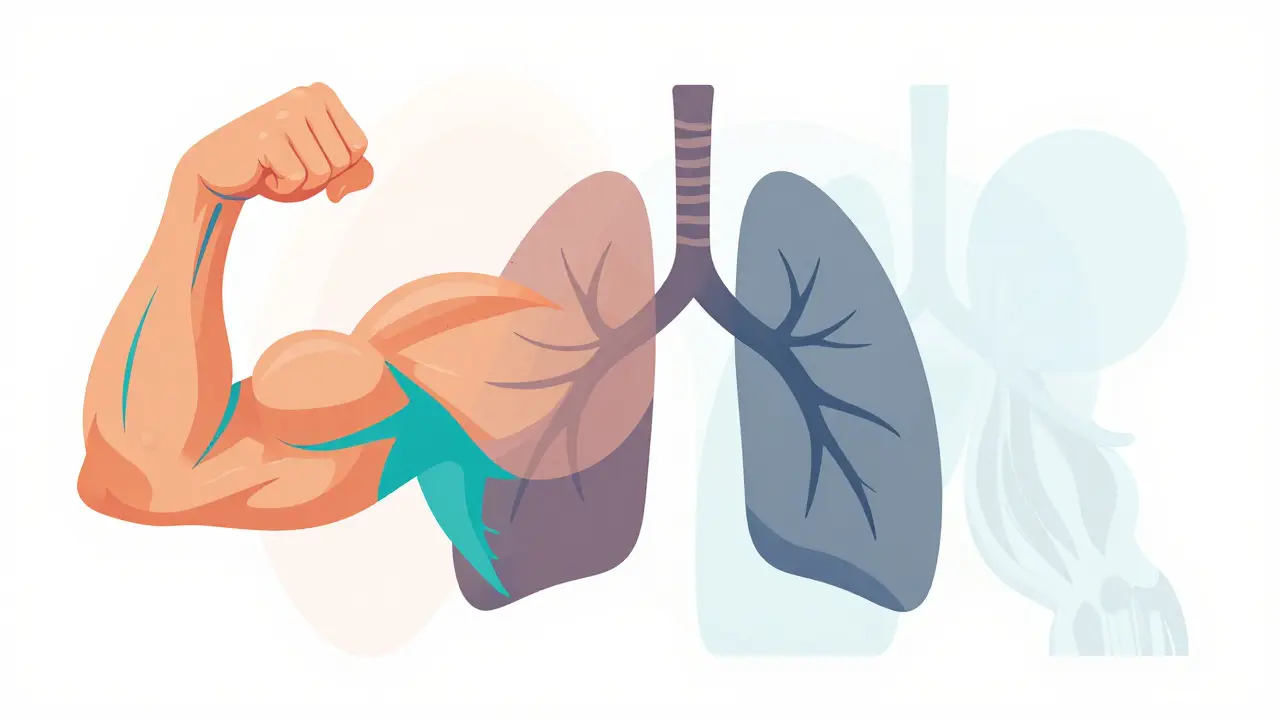
Imagine having a chronic lung condition like Chronic Obstructive Pulmonary Disease (COPD), where every breath feels like a battle. Now, imagine that the very muscles you need to breathe and move are quietly wasting away. This isn't just fatigue; it's sarcopenia, the progressive loss of skeletal muscle mass, strength, and physical performance. For roughly 22% of people living with COPD, this is their daily reality. It’s not an inevitable part of aging or having bad lungs-it’s a treatable complication that significantly impacts survival and quality of life.
If you have been diagnosed with COPD and feel weaker than usual, struggling to climb stairs or carry groceries, you might be dealing with sarcopenia. The good news? You can fight back. By combining specific nutritional strategies with modified resistance training, you can rebuild muscle, improve your breathing capacity, and reduce hospital visits. Let’s break down exactly how to do this safely and effectively.
Understanding Sarcopenia in COPD
Sarcopenia is often misunderstood as simple "getting old." But in the context of COPD, it is a distinct medical issue driven by a "perfect storm" of factors: systemic inflammation, physical inactivity due to breathlessness, nutritional deficits, and low oxygen levels (hypoxemia). According to data from the European Working Group on Sarcopenia in Older People (EWGSOP2), sarcopenia is defined by low muscle strength, reduced muscle quantity or quality, and poor physical performance.
In COPD patients, this process is accelerated. While healthy adults lose about 1-2% of muscle mass annually, those with COPD can lose up to 3.2% per year. A 2024 study in the Annals of the American Thoracic Society highlighted that COPD-related sarcopenia uniquely affects respiratory and upper limb muscles. In fact, 68% of COPD patients show significant atrophy in the pectoralis major muscle compared to only 22% in age-matched controls without COPD. This means the muscles helping you expand your chest are shrinking, making breathing even harder.
The stakes are high. Patients with COPD and sarcopenia face a 20-40% higher mortality rate than those without it. However, addressing it can increase five-year survival probability from 45% to 68% in severe cases. Recognizing the signs early is crucial.
Screening and Diagnosis: Are You at Risk?
You cannot fix what you do not measure. Standard Body Mass Index (BMI) charts often fail COPD patients because they don’t account for muscle loss versus fat retention. Instead, clinicians use more precise tools. The American Thoracic Society recommends routine screening for all COPD patients using two main methods:
- Handgrip Strength: A simple test using a dynamometer. Low strength is defined as less than 27 kg for men and less than 16 kg for women.
- Short Physical Performance Battery (SPPB): An assessment of balance and gait speed. A score of 8 or lower, or a walking speed of less than 0.8 meters per second, indicates impaired performance.
For a definitive diagnosis, imaging plays a key role. Computed Tomography (CT) scans at the third lumbar vertebra (L3) level are now standard for measuring the Skeletal Muscle Index (SMI). In COPD patients, an SMI below 55 cm²/m² for men and 39 cm²/m² for women signals sarcopenia. Another emerging biomarker is the Pectoralis Muscle Index (PMI), which measures chest muscle thickness relative to BMI. A PMI threshold of 1.06 ± 0.33 cm²/BMI has been identified as predictive of sarcopenia in this population.

Nutrition Strategies to Rebuild Muscle
Exercise alone won’t save you if your body lacks the building blocks to repair tissue. Many COPD patients consume only 0.8-1.0 grams of protein per kilogram of body weight per day, which is far too low for muscle maintenance. To combat sarcopenia, you need to shift gears.
Protein Intake Targets Current guidelines suggest aiming for 1.2 to 1.5 grams of protein per kilogram of body weight daily. But timing matters just as much as total amount. Your body synthesizes muscle best when protein is distributed evenly across meals. Aim for four meals containing 0.3 to 0.4 grams of protein per kilogram each. For a 70 kg person, that’s roughly 21-28 grams of protein per meal.
The Role of Leucine Leucine is an essential amino acid that acts as a trigger for muscle protein synthesis. Research published in Clinical Nutrition (2023) shows that supplementing with 2.5 to 3.0 grams of leucine per meal can improve the anabolic response by 37% in sarcopenic COPD patients. If you struggle to eat enough meat or dairy due to early satiety (feeling full quickly), consider whey protein supplements fortified with leucine. Look for products providing at least 10g of leucine per serving.
Caloric Sufficiency
Resistance Training: Safe and Effective Protocols
This is where many patients hesitate. "Will I get winded?" Yes, you might. But avoiding exercise accelerates muscle loss. The key is modification. Standard resistance protocols are unsuitable for most COPD patients without adjustment. Dr. Amy Pastva from Duke University emphasizes starting individualized resistance training at just 30% of your 1-repetition maximum (1-RM).
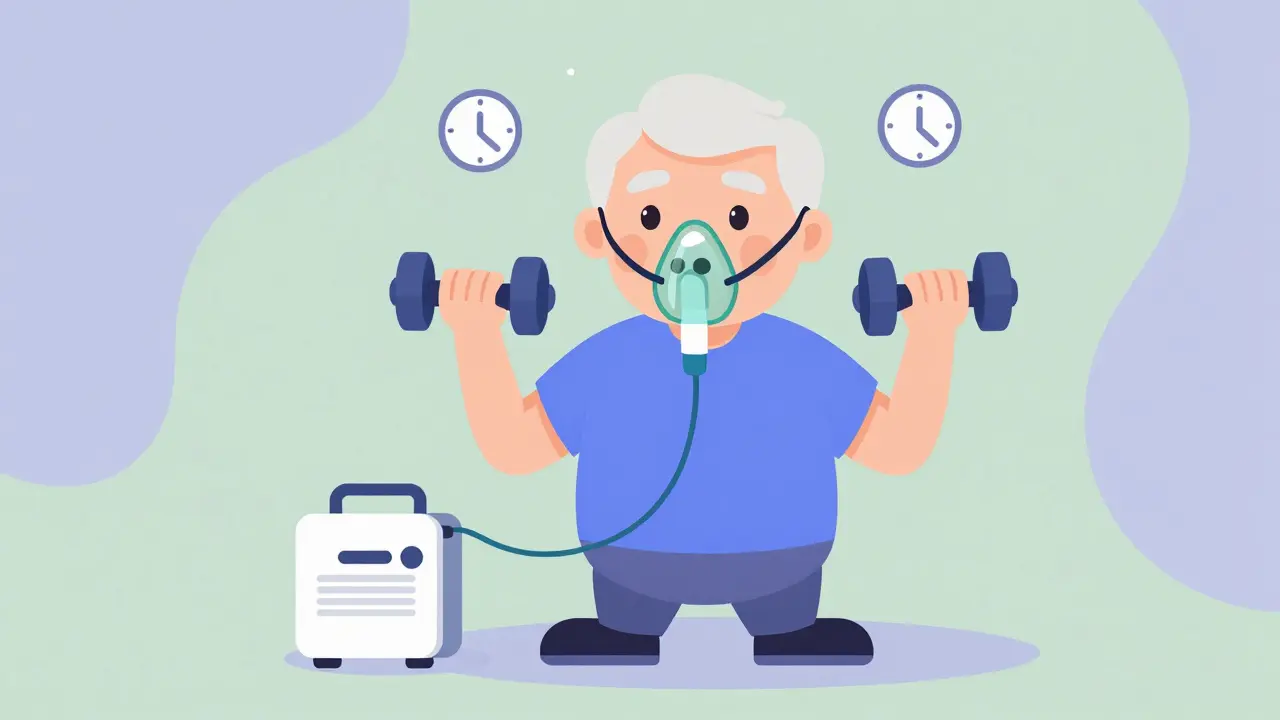
Getting Started Safely Begin with very light resistance-think 1-2 pound weights or light resistance bands. Focus on major muscle groups: legs, chest, back, and arms. Perform these exercises 2-3 times per week. Crucially, incorporate rest periods of 2-3 minutes between sets to allow your heart rate and breathing to recover.
Oxygen Management About 42% of COPD patients require supplemental oxygen during resistance training sessions to prevent dangerous drops in blood oxygen saturation. If you use oxygen at home, wear it during workouts. Monitor your oxygen levels if possible. If your saturation drops below 88%, pause and rest. Nocturnal hypoxemia (low oxygen at night) is also linked to muscle loss, so ensure your nighttime oxygen therapy is optimized.
ProgressionJournal of Cardiopulmonary Rehabilitation and Prevention found that this gradual progression leads to meaningful strength gains without exacerbating symptoms. Don’t rush it. Consistency beats intensity.
| Feature | General Population Sarcopenia | COPD-Specific Sarcopenia |
|---|---|---|
| Primary Muscle Affected | Lower extremities | Respiratory & upper limb muscles (pectoralis) |
| Annual Muscle Loss Rate | 1-2% | Up to 3.2% |
| Key Driver | Aging, sedentary lifestyle | Inflammation, hypoxemia, dyspnea |
| Training Modification | Standard progressive overload | Start at 30% 1-RM, frequent rests, O2 support |
| Protein Requirement | 1.0-1.2 g/kg/day | 1.2-1.5 g/kg/day + Leucine |
Overcoming Common Barriers
We know the theory, but real life is messy. Patient feedback reveals two major hurdles: dyspnea (shortness of breath) during exercise and appetite loss during exacerbations.
Managing Dyspnea If exercise makes you gasp, scale back. Use pursed-lip breathing techniques during lifts. Exhale through pursed lips during the exertion phase of the movement (e.g., pushing the weight up). This helps keep airways open longer. If you still struggle, consult your pulmonologist about adjusting your bronchodilator regimen before exercise.
Maintaining Routine During Flare-Ups 57% of patients abandon exercise programs during symptom flare-ups. Try to maintain light mobility work even when sick, such as gentle stretching or short walks around the house. Complete bed rest accelerates muscle loss rapidly. When you recover, ease back into the program rather than jumping straight to previous intensities.
The Future of Care
The landscape is changing. In 2024, the Global Initiative for Chronic Obstructive Lung Disease (GOLD) released its first COPD-specific sarcopenia management algorithm. This integrates nocturnal oxygen monitoring directly with exercise prescriptions. Early data suggests this approach reduces sarcopenia progression by 29%. Additionally, new pharmaceutical interventions targeting muscle anabolism, such as myostatin inhibitors, are entering clinical trials. While we wait for these advances, the combination of targeted nutrition and smart resistance training remains the gold standard.
How long does it take to see results from sarcopenia treatment in COPD?
Most patients begin to notice improvements in daily functioning, such as carrying groceries or climbing stairs, within 12 weeks of consistent combined nutrition and resistance training. Significant gains in muscle mass and strength typically require 8-12 weeks of progressive resistance training, according to studies in pulmonary rehabilitation journals.
Is it safe to lift weights if I have severe COPD?
Yes, but with modifications. Start with very light weights (1-2 lbs) or resistance bands. Always monitor your oxygen saturation. If you drop below 88%, stop and rest. Using supplemental oxygen during exercise is recommended for many patients to prevent hypoxemia-induced muscle damage. Consult your doctor before starting any new exercise regimen.
What is the best protein source for COPD patients with sarcopenia?
High-quality complete proteins like whey, eggs, fish, and lean poultry are ideal. Whey protein is particularly effective because it is rich in leucine, an amino acid that triggers muscle synthesis. Aim for 0.3-0.4 g/kg of protein per meal, spread across four meals daily. Supplements can help if appetite is low.
Can sarcopenia be reversed in COPD?
While you may not return to the muscle mass of your youth, you can significantly reverse the functional decline associated with sarcopenia. Studies show that combined interventions can improve 6-minute walk distances by 23-28% and reduce hospitalization rates by 32%. The goal is improved function and quality of life, not just muscle size.
Why does COPD cause muscle loss faster than normal aging?
COPD creates a state of chronic systemic inflammation (elevated TNF-α and IL-6) which breaks down muscle tissue. Additionally, the increased work of breathing burns extra calories, leading to a catabolic state. Hypoxemia (low oxygen) further impairs muscle repair. These factors combine to accelerate muscle loss beyond typical age-related changes.



Nivetha Narayanan
May 23, 2026 AT 09:14hey guys! this is super helpful info for my dad who has copd 😭 he always gets so tired just walking to the kitchen. i never knew about the protein timing thing, that makes sense tho. gonna try to get him some whey with leucine. thanks for sharing this!!
Frank Arlyss
May 24, 2026 AT 12:57i feel like you're ignoring the real issue here which is that big pharma wants us weak so we buy more meds. why do they not tell you this in hospitals? it's suspicious.
Tim Reynolds
May 25, 2026 AT 02:53The data presented is flawed; clearly manipulated by corporate interests. The 'studies' cited are likely funded by supplement companies seeking profit margins. One must question the validity of such claims when mainstream medicine ignores them. Furthermore, the emphasis on resistance training overlooks the systemic toxicity of modern environments. We are being gaslit into believing exercise cures what pollution and processed foods cause. Do your own research. Don't trust the narrative. Wake up.
Groman Neta
May 25, 2026 AT 16:15This article is utterly useless for anyone who actually understands physiology. It reduces a complex pathological process to simple calorie counting and lifting weights. The author fails to address the underlying inflammatory cytokines driving muscle catabolism in COPD patients. Without addressing the root cause-chronic inflammation induced by smoking or environmental toxins-protein intake is merely feeding the fire. It is lazy journalism at its finest, offering simplistic solutions to multifaceted medical problems. Readers should be wary of such oversimplification.
Ryan Jones
May 27, 2026 AT 00:38nah i dont think so. everyone says exercise helps but nobody talks about how hard it is to breathe while doing it. feels like they just want you to suffer more. plus all these supplements are probably just sugar coated lies. why would doctors suddenly care about muscle mass now? seems sketchy to me honestly.
Lisa Russo
May 27, 2026 AT 03:41You really think eating more protein fixes lung disease? That's cute. I've seen people lift weights and still die because their lungs were shot. This whole sarcopenia trend is just another way to make people feel guilty for being sick. Stop blaming the victim.
Gareth Tyler
May 27, 2026 AT 22:45interesting read. i started light resistance training last year after my diagnosis. small dumbbells mostly. noticed i could walk further without getting winded. didnt know about the leucine part though. might look into that. good stuff.
Sharon O’Mahonh
May 29, 2026 AT 08:31omg yes!! this is exactly what we need to talk about more. the bioavailability of amino acids is crucial for optimizing anabolic signaling pathways in sarcopenic populations. we have to empower ourselves with knowledge instead of waiting for the medical establishment to save us. let's uplift each other in this journey towards holistic wellness and muscular integrity! 🌟💪
Jonhnnie john13
May 29, 2026 AT 09:13The correlation between hypoxemia and muscle atrophy is well documented yet often ignored by general practitioners. The focus on nutritional intervention is valid but insufficient without concurrent pulmonary rehabilitation protocols. The SMI thresholds mentioned are arbitrary and lack longitudinal validation across diverse ethnic groups. One must consider the confounding variables of comorbidities such as diabetes and cardiovascular disease which exacerbate muscle loss. The proposed protein targets may exceed renal capacity in elderly patients with compromised kidney function. A nuanced approach is required rather than blanket recommendations.
Anthony Padilla
May 30, 2026 AT 23:09Hey there! Great points everyone. In my culture we believe food is medicine too. My grandfather used to say strong muscles mean strong spirit. I try to eat lentils and yogurt daily which has good protein. Maybe combining traditional diets with these new science tips works best? Just a thought!
Elizabeth Fandry
June 1, 2026 AT 06:19It is imperative that we acknowledge the epistemological limitations of current nutritional guidelines. The reductionist view of muscle health as merely a function of protein intake is intellectually bankrupt. True vitality arises from a harmonious alignment of mind, body, and spirit, not from consuming whey powder. One must cultivate an inner resilience that transcends physical metrics. Embrace the chaos of existence and find strength in vulnerability. 🧘♀️✨🕯️
Madeline Petes
June 2, 2026 AT 15:11I love this post!! So many people ignore muscle health. I'm gonna start tracking my handgrip strength. It's scary how fast you lose it if you don't use it. Thanks for the tips on leucine, didn't know that was a thing!
Ramanath Rao
June 3, 2026 AT 08:41Why does western medicine always complicate things? In India we have Ayurveda which balances doshas. Your cortisol levels are high due to stress which eats muscle. You need ashwagandha not just protein. Stop listening to these biased studies funded by US corporations. They want you dependent on pills. Traditional wisdom is superior.