

The Federal Circuit Court doesn’t just hear appeals-it shapes the future of medicine in America. When a drug company files a patent for a new dosage schedule, a generic maker challenges it, and the FDA gets caught in the middle, it’s this one court that decides what happens next. Unlike any other court in the U.S., the Federal Circuit has exclusive power over all patent cases, including the most complex ones involving life-saving drugs. That means every ruling it makes ripples through drug development, pricing, and access for millions.
Why This Court Controls Pharmaceutical Patents
Created in 1982, the U.S. Court of Appeals for the Federal Circuit was designed to fix a broken system. Before then, patent cases were scattered across 12 regional courts, each interpreting the law differently. A patent upheld in Texas might be tossed out in California. That chaos made it impossible for companies to plan. So Congress gave all patent appeals-no matter where they started-to one court: the Federal Circuit. For pharmaceutical companies, this isn’t just convenient-it’s critical. Drug patents are different from other patents. They don’t just protect a chemical formula. They protect how it’s taken, when, and how often. A patent on a pill that’s taken once a day instead of three times can extend a brand drug’s monopoly by years. The Federal Circuit became the only court that understands these nuances.The ANDA Game: Filing a Generic Drug Triggers Nationwide Lawsuits
Here’s how it works in practice. A generic drug maker wants to sell a cheaper version of a brand-name drug. They file an Abbreviated New Drug Application (ANDA) with the FDA. That’s their official notice: “We’re ready to launch.” But under the Hatch-Waxman Act, that filing isn’t just paperwork-it’s a legal trigger. The brand-name company can sue for patent infringement. And here’s the twist: they don’t have to sue where the generic company is based. They can sue anywhere. In 2016, the Federal Circuit ruled in Mylan v. Valeant that filing an ANDA creates personal jurisdiction anywhere in the U.S. Why? Because the generic company intends to sell the drug nationwide. That means a small generic firm in Ohio can be sued in Delaware, where many brand companies are incorporated. The court said: “If you plan to sell everywhere, you accept being sued everywhere.” The result? Over 68% of ANDA lawsuits are now filed in Delaware. That’s up from 42% in the decade before. Generic manufacturers say it’s a tactic-forum shopping-to increase legal costs and delay market entry. Brand companies say it’s just following the law.Orange Book Listings: The Secret Weapon in Patent Battles
The Orange Book isn’t a book anymore-it’s a database. Officially called “Approved Drug Products with Therapeutic Equivalence Evaluations,” it lists every patent tied to a brand drug. If a patent isn’t listed there, a generic company can skip challenging it in court. But here’s the catch: not every patent belongs in the Orange Book. In December 2024, the Federal Circuit ruled in Teva v. Amneal that a patent must actually claim the drug to be listed. Not just related to it. Not just used with it. It must directly describe the drug’s chemical structure or method of use. This decision forced companies to clean up their lists. Many had added patents that covered delivery systems, packaging, or off-label uses. Those are now being removed. The court made it clear: listing a patent just to delay generics is not allowed. Companies now spend weeks mapping each patent to the exact drug component. Legal review time for Orange Book submissions jumped by 17 business days, according to a 2024 survey of top pharmaceutical firms. It’s not just bureaucracy-it’s strategy.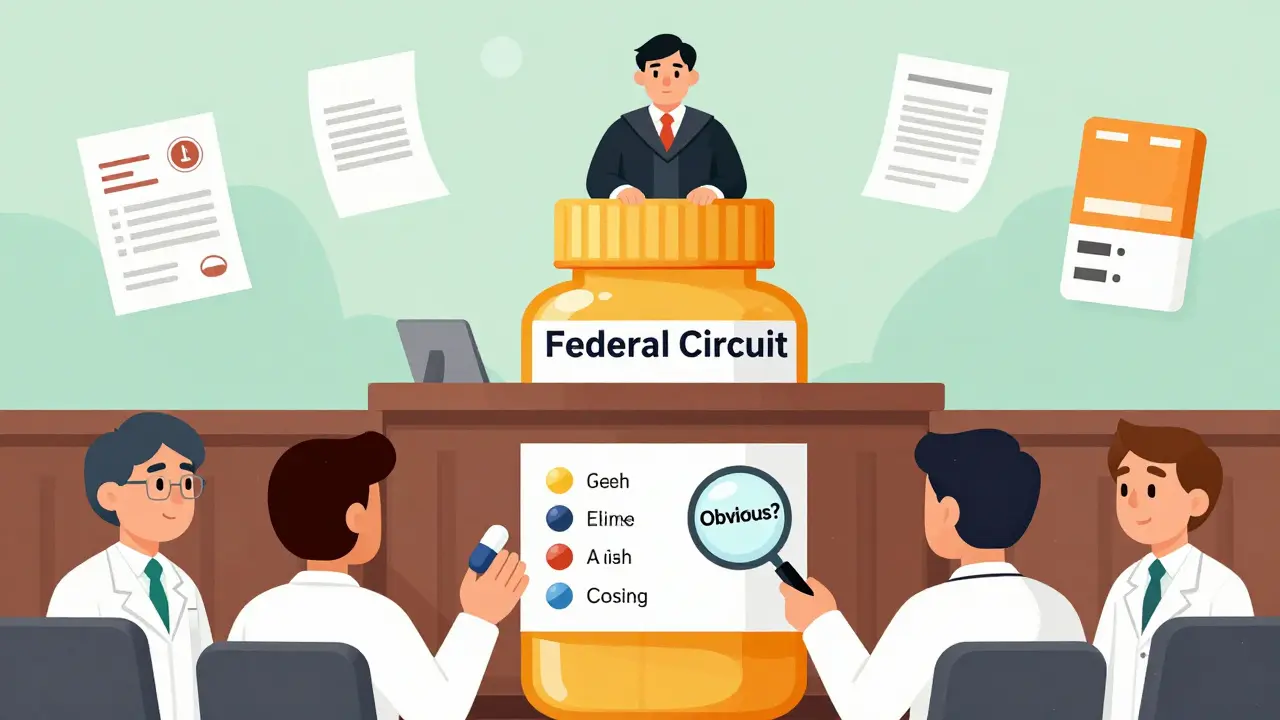
Obviousness and Dosing: Why Your Pill Schedule Can Be Unpatentable
One of the biggest battlegrounds is dosing. Can you patent a drug that’s taken once a day instead of twice? The Federal Circuit says: usually not. In April 2025, the court ruled in ImmunoGen v. Sarepta that changing a dosage schedule isn’t enough to make a patent valid-if the drug itself was already known. The court wrote: “Because both sides admitted that the use of IMGN853 to treat cancer was known in the prior art, the only question to resolve was whether the dosing limitation itself was obvious.” That’s a huge shift. Before, companies could build “secondary patents” around dosing, extending exclusivity without inventing anything new. Now, they must prove the new schedule delivers unexpected results-like fewer side effects or better efficacy-that weren’t predictable from the old one. A 2024 survey by the American Bar Association found 57% of patent attorneys thought this standard was too rigid. But 33% agreed it was necessary. The court’s message is clear: don’t game the system with minor tweaks. The impact? Pharmaceutical companies cut secondary dosing patents by 37% after the ImmunoGen decision. Instead, they’re spending more on real innovation-new molecules, new targets, new delivery methods.Standing: Can You Challenge a Patent Before You Even Start?
Here’s a problem: if you’re developing a generic drug but haven’t filed an ANDA yet, can you sue to knock out a patent that’s blocking you? The Federal Circuit says: not unless you’ve done more than just think about it. In May 2025, in Incyte v. Sun Pharma, the court dismissed a challenge from a company that had only begun early-stage research. The judge wrote: “A mere desire to enter the market doesn’t create a concrete injury.” Now, companies must show “concrete plans”-like Phase I clinical trial data, manufacturing contracts, or FDA pre-submission meetings. Without that, they don’t have legal standing. This has frustrated generic developers. Many spend millions before filing an ANDA, but now they’re stuck. They can’t challenge the patent until they’re ready to launch. That delays competition. And it’s why Senators Tillis and Coons introduced the Patent Quality Act of 2025-to fix this exact problem.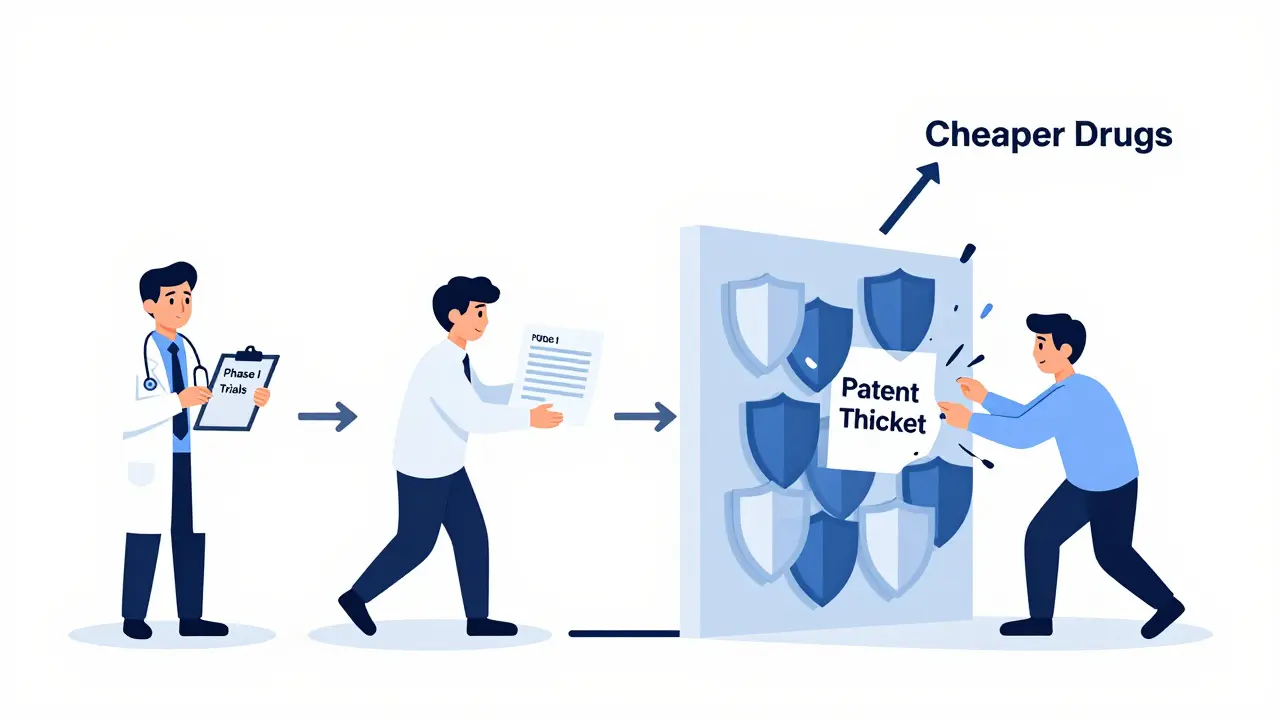
How This Affects You
You might not think about patent law when you pick up a prescription. But here’s what it means for you:- When a brand drug goes off-patent, the wait for generics might be longer than you expect. The Federal Circuit’s rules make it harder and more expensive to challenge patents.
- Some drugs stay expensive longer because companies use “patent thickets”-layers of weak patents-to block competition.
- But when generics do arrive, they’re more reliable. The court’s strict standards mean fewer bad patents slip through.
What’s Next?
The Federal Circuit is still evolving. It recently confirmed that even after a patent expires, the Patent Trial and Appeal Board can still review its validity-just not for damages. That’s important for future challenges. Biosimilars-generic versions of biologic drugs-are now caught in the same web. The court extended its ANDA jurisdiction rules to them in 2020. Biosimilar litigation has jumped 300% since then. And Congress is watching. The Patent Quality Act of 2025 could change standing rules. If it passes, generic companies might get more power to challenge patents earlier. That could speed up access to cheaper drugs. For now, the Federal Circuit remains the most powerful court in U.S. pharmaceutical law. It doesn’t just interpret patents-it decides who gets to make them, who gets to copy them, and who gets to buy them.Why does the Federal Circuit have exclusive jurisdiction over pharmaceutical patent cases?
The Federal Circuit was created by Congress in 1982 to centralize all patent appeals. Before that, different regional courts interpreted patent law differently, creating confusion. By giving all patent cases-whether they involve software, medical devices, or drugs-to one court, the system became more predictable. For pharmaceuticals, where patents often hinge on complex scientific details, this specialization matters. The court has developed deep expertise in drug chemistry, dosing regimens, and FDA regulations that other courts lack.
Can a generic drug company be sued in any state after filing an ANDA?
Yes. The Federal Circuit ruled in 2016 that filing an ANDA with the FDA creates personal jurisdiction nationwide because it shows intent to market the drug across all 50 states. Brand companies can then choose to sue in jurisdictions they favor, like Delaware, where many are incorporated. This has led to over 68% of ANDA lawsuits being filed in Delaware since 2017, up from 42% in the previous decade.
What is the Orange Book, and why does it matter for generic drugs?
The Orange Book is the FDA’s official list of patents linked to brand-name drugs. Generic companies must challenge every listed patent before they can launch. But in 2024, the Federal Circuit ruled that only patents that actually claim the drug’s chemical structure or method of use can be listed. Patents covering packaging, off-label uses, or delivery systems can no longer be included. This forces companies to be more honest about their patents and prevents them from blocking generics with weak claims.
Can you patent a new way to take a drug, like once-a-day instead of three times?
Only if you can prove the new dosing creates unexpected results. The Federal Circuit ruled in 2025 that simply changing the schedule isn’t enough if the drug itself was already known. You need data showing fewer side effects, better absorption, or improved outcomes that weren’t predictable from prior art. Many companies have since stopped filing these types of patents, cutting secondary dosing patents by 37% after the decision.
Why do generic companies need to show "concrete plans" to challenge a patent?
The Federal Circuit requires companies to prove they’re not just thinking about making a generic-they’re actively preparing to. That means having Phase I clinical trial data, manufacturing agreements, or FDA pre-submission meetings. A vague plan or early research isn’t enough. This rule, set in 2025, prevents companies from filing nuisance lawsuits just to pressure patent holders. But critics argue it delays competition by forcing developers to spend millions before they can even challenge a patent.



Kimberly Reker
January 29, 2026 AT 19:17Honestly, I never thought about how one court could control something as huge as drug prices. But reading this made me realize why generics take forever to hit the market. It’s not just big pharma being greedy-it’s the whole legal structure stacked against them.
And the Orange Book thing? Wild. Companies used to throw in every patent they could think of just to delay things. Now they actually have to prove it’s tied to the drug. That’s a win for patients.
Still, the standing rule feels unfair. You gotta spend millions before you can even fight back? That’s like forcing someone to build a house before they can complain about the zoning laws.
Eliana Botelho
January 30, 2026 AT 01:53Okay but let’s be real-this whole Federal Circuit thing is just corporate legal theater. They created it to make patent law predictable? More like they created it so Big Pharma could pick the most friendly judge in the country and just keep extending monopolies forever. Delaware? Really? That’s where half of all corporations are incorporated because of tax loopholes, not because it’s the center of medical innovation. This isn’t justice, it’s a rigged game where the house always wins and the patients pay the tab. And don’t even get me started on how they call these ‘secondary patents’ innovation when they’re literally just changing the time you take a pill. If you’re patenting a schedule, you’re not inventing-you’re gaming. And the court lets you. That’s not expertise, that’s complicity.
Rob Webber
January 31, 2026 AT 11:33This is why America’s healthcare system is broken. One court, one group of judges who’ve never even met a patient, deciding whether millions can afford their meds. And they call this ‘specialization’? It’s monopoly power dressed up as legal precision. The Orange Book? A joke. The ANDA loophole? A scam. And now they want us to believe this is ‘promoting innovation’? Bullshit. They’re just making it harder for generics to enter so brand-name companies can keep charging $1,000 for a pill that costs $2 to make. This isn’t law. It’s extortion with a gavel.
calanha nevin
February 1, 2026 AT 09:51The Federal Circuit’s role in pharmaceutical patent law is critical due to its technical expertise and uniformity of application. Prior to its establishment, inconsistent rulings across regional circuits created uncertainty for innovators and manufacturers alike. The court’s interpretation of the Hatch-Waxman Act and Orange Book requirements has brought necessary clarity. While critics argue that jurisdictional advantages favor brand-name firms, the legal standards established-particularly regarding obviousness in dosing regimens and standing requirements-have raised the bar for patent validity. This shift encourages true innovation over incremental manipulation. The data supporting reduced secondary patent filings post-ImmunoGen suggests a positive industry recalibration. Legislative proposals like the Patent Quality Act should be evaluated on empirical impact rather than emotional appeals.
Systemic reform requires evidence-based policy, not outrage.
Lisa McCluskey
February 2, 2026 AT 14:33I appreciate how this breaks down the legal stuff without turning it into a textbook. The Orange Book cleanup is long overdue. I’ve seen people on forums get angry about drug prices but never realize it’s because of these hidden patent tricks. It’s not just about money-it’s about trust. If companies can’t be honest about what they’re patenting, how can we trust them to put patients first?
Also, the standing rule is rough. You’re basically forced to risk everything before you can even ask if the patent is valid. That’s not fair to small companies trying to do the right thing.
Still, I’m glad the court is pushing for real innovation. We don’t need more pills with different schedules. We need better drugs.
owori patrick
February 2, 2026 AT 19:40This is very interesting. In Nigeria, we don’t have this kind of legal system for patents. When generics come in, they come fast-but often without proper quality checks. Maybe having one court that really understands the science is good, even if it feels slow. But I worry the system is too stacked against small players. If you don’t have lawyers in Delaware, you’re already behind. Still, I’m glad they’re cleaning up the Orange Book. That’s the right direction.
Patients everywhere just want affordable medicine. The law should help, not block.
Claire Wiltshire
February 4, 2026 AT 02:05Thank you for writing such a clear, thoughtful breakdown. I’m a nurse and I see the real-world effects of these rulings every day. When a patient can’t afford their medication because the generic hasn’t hit the market yet, it’s not just a cost issue-it’s a health crisis.
The Federal Circuit’s stance on dosing patents is a breath of fresh air. For years, I watched patients get stuck on expensive brand drugs while the company quietly filed patent after patent on the same pill. Now, at least, they have to prove something new is happening.
That said, the standing requirement is still a barrier. Patients shouldn’t have to wait years because a generic company can’t afford to jump through legal hoops before even starting. We need policy changes that match the court’s good intentions.
Darren Gormley
February 5, 2026 AT 21:39LMAO 😂 this is the most corporate legal fanfic I’ve ever read. ‘The court has developed deep expertise’ 🤡. Yeah, expertise in letting Big Pharma write the rules and then pretending it’s science. The Orange Book? More like the Orange Book of Lies. And Delaware? The court’s personal playground. You think this is about ‘predictability’? Nah. It’s about making sure no one can challenge a $500 pill unless they’ve got a $10M legal budget. The fact that you’re calling this ‘fair’ is why America’s healthcare is a joke. 🤬
Mike Rose
February 6, 2026 AT 03:44so like... this court just makes up rules so big pharma can keep charging crazy prices? and the generic companies gotta fight in delaware? lol. why not just let people buy the cheap stuff? this whole thing is a scam. i dont even get what the orange book is but sounds like a red flag. why cant we just have cheaper drugs already?