

Antihistamine Selection Tool
Find Your Best Antihistamine
Answer 4 quick questions to get a personalized recommendation based on the latest clinical data.
1. How important is staying alert?
2. When do you need symptom relief?
3. Do you take medication with food?
4. Are you pregnant or breastfeeding?
When allergy season hits, choosing the right antihistamine isn’t just about what works-it’s about what you can live with. Two of the most common over-the-counter options, cetirizine (Zyrtec) and fexofenadine (Allegra), both block histamine to stop sneezing, runny nose, and itchy eyes. But if you’ve ever felt sluggish after taking one, you know the real difference isn’t in symptom relief-it’s in how they make you feel.
Why Drowsiness Matters More Than You Think
Cetirizine and fexofenadine were both designed to replace old-school antihistamines like diphenhydramine that knocked people out. But not all "non-drowsy" options are equal. Cetirizine still crosses the blood-brain barrier a little, affecting about 5-10% of users with noticeable drowsiness. Fexofenadine? It barely touches the brain-less than 1-2% penetration. That’s why, in real-world use, fexofenadine causes drowsiness in only 4-6% of people, while cetirizine does so in 10-15%.A 2022 patient survey of nearly 1,900 adults found that 41% stopped taking cetirizine within a month because they felt too tired to drive, work, or even focus on their kids. Only 12% quit fexofenadine for the same reason. If you’re a truck driver, nurse, student, or parent juggling morning routines, that difference isn’t theoretical-it’s life-changing.
Which One Works Faster?
If you’re stuck in a pollen storm and need relief now, cetirizine wins. It hits peak levels in your bloodstream in 30 to 60 minutes. Fexofenadine? It takes 2 to 3 hours. That’s why people who use cetirizine often say things like, “It stopped my sneezing before I even got to the car.”But speed isn’t everything. A 2005 study comparing both drugs head-to-head found cetirizine reduced overall allergy symptoms 14% more than fexofenadine. For runny nose and itchy eyes specifically, the gap was even wider-at 12 hours, cetirizine outperformed by 26%. But here’s the catch: many people don’t notice that difference in daily life. One user on Reddit wrote, “Cetirizine worked better, but I was useless after lunch. I switched to fexofenadine and now I’m functional.”
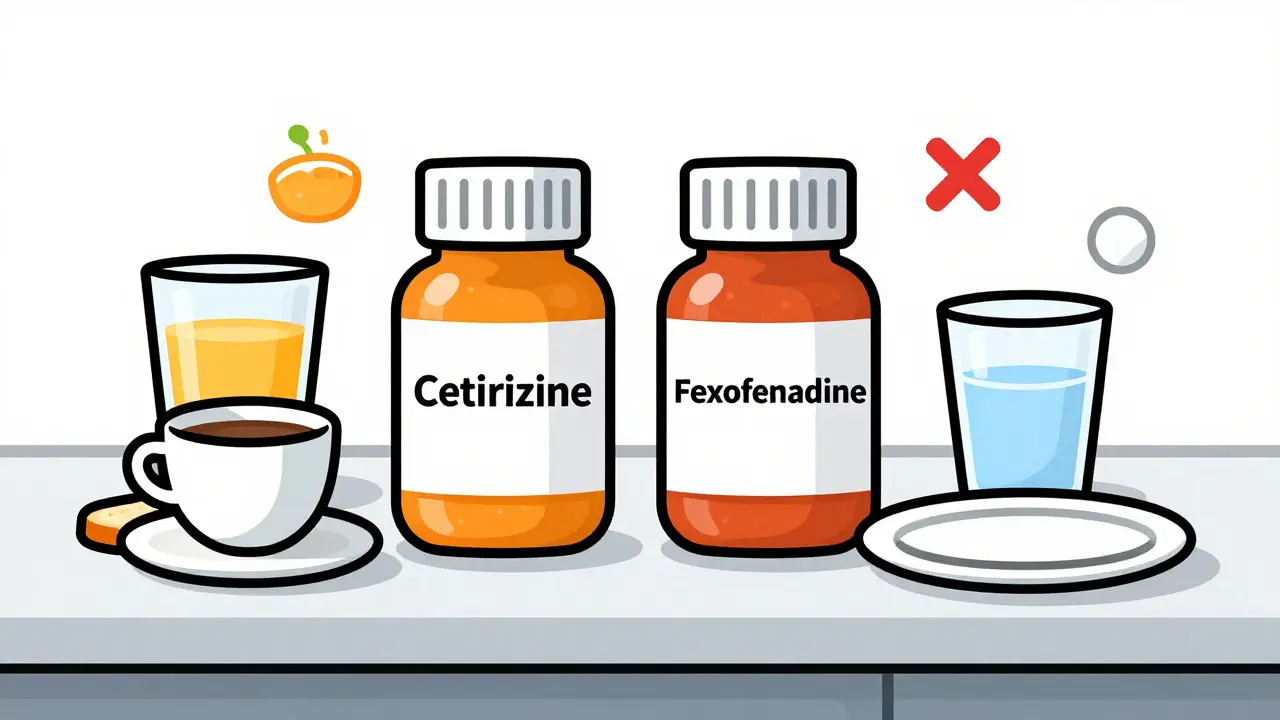
Food, Drinks, and Other Traps
Fexofenadine is picky. Eat a greasy breakfast? Take it with apple juice? You’re cutting its effectiveness by up to 43%. The FDA warns that grapefruit juice, orange juice, and even high-fat meals can reduce absorption. That means if you take it with your morning coffee and toast, you might not get full relief.Cetirizine doesn’t care what you eat. You can take it with food, without food, before bed, or after lunch. No restrictions. That convenience matters. A 2023 survey by Consumer Reports showed 58% of users preferred cetirizine simply because they didn’t have to plan their meals around it.
Another hidden issue: antacids. If you take fexofenadine within two hours of an aluminum- or magnesium-based antacid (like Tums or Maalox), your body absorbs 41% less of it. Cetirizine? No problem. No interactions. Just take it.
Side Effects Beyond Drowsiness
Drowsiness gets all the attention, but both drugs have other side effects.With cetirizine, dry mouth (reported by 18% of users) and headaches (12%) are common. Some people also report nausea or stomach pain. On Drugs.com, nearly a third of negative reviews mention “unacceptable drowsiness,” while 18% say they felt too dry-mouthed to sleep.
Fexofenadine’s biggest complaints? Upset stomach (22%) and occasional dizziness. But here’s something surprising: fewer people report dry mouth with fexofenadine. It’s also less likely to interact with other medications. That’s why doctors often recommend it for older adults on multiple prescriptions.
Who Should Take Which?
Here’s a simple guide based on real-world use:- Choose cetirizine if: You need fast, strong symptom control and don’t mind a little sleepiness. Good for nighttime use, or if you work from home and can nap after lunch.
- Choose fexofenadine if: You drive, operate machinery, study for exams, or work in a job where alertness is non-negotiable. Also better if you take antacids or drink juice regularly.
For kids under 12, cetirizine has more safety data-over 200 published studies on pediatric use. Fexofenadine? Only about 40. So pediatric allergists still lean toward cetirizine for children.
For pregnant women, both are considered safe (Category B), but cetirizine has been studied more extensively. If you’re pregnant and managing allergies, your OB-GYN might recommend cetirizine first.

Cost and Availability
Both are available as generics. As of late 2023, a 30-tablet supply of generic cetirizine costs about $7.50. Generic fexofenadine? Around $6.85. The price difference is tiny. What matters more is whether you’re getting value-not just cost.Market data shows cetirizine (Zyrtec) still leads in sales, but fexofenadine (Allegra) is growing. Why? More people are prioritizing alertness over slight symptom gains. In 2023, 38% of allergy sufferers in a Consumer Reports survey said they’d choose fexofenadine for its side effect profile. Only 43% picked cetirizine for its effectiveness.
What’s New in 2026?
The FDA added new warnings in 2023 for both drugs: rare cases of heart rhythm changes (QT prolongation). The risk is extremely low-less than 1 in 100,000 users-but it’s there. If you have a heart condition or take other drugs that affect your rhythm, talk to your doctor.There’s also a new extended-release version of fexofenadine (Allegra 12 HR), but independent testing shows it doesn’t offer much more relief than the standard 180 mg dose. So unless you’re trying to cut down pills, stick with the classic.
Final Takeaway: It’s Not About Which Is "Better"
Cetirizine isn’t "stronger." Fexofenadine isn’t "weaker." They’re different tools.If you’re the type who needs to be sharp all day, fexofenadine gives you freedom without sacrificing relief. If you’re dealing with severe symptoms and can afford to feel a little tired, cetirizine delivers faster, more complete control.
And here’s the most important thing: try both. Not at the same time. Give each one a full two-week trial. Track how you feel. Note when your symptoms return. See which one lets you live your life without interruption. Your body will tell you which one it prefers.
Can I take cetirizine and fexofenadine together?
No, you shouldn’t take them together. Both are H1 antihistamines with similar mechanisms. Combining them doesn’t improve symptom control but increases your risk of side effects like dizziness, dry mouth, and excessive drowsiness. Stick to one at a time. If one doesn’t work after two weeks, switch to the other.
Is fexofenadine really non-drowsy?
For most people, yes. Clinical studies show only 4-6% of users report drowsiness with fexofenadine, compared to 10-15% with cetirizine. But "non-drowsy" doesn’t mean "no drowsiness." Some individuals are more sensitive. If you’ve never taken it before, avoid driving or operating heavy machinery until you know how your body reacts.
Why does fexofenadine need an empty stomach?
Fruit juices-especially grapefruit, orange, and apple-and high-fat meals can block fexofenadine from being absorbed properly. This can cut its effectiveness by up to 43%. To be safe, take it at least one hour before or two hours after eating. Water is the best way to swallow it.
Which one is safer during pregnancy?
Both are classified as Category B, meaning no proven risk in humans. But cetirizine has been studied in over 200 pregnancy cases, while fexofenadine has only about 40. Most OB-GYNs recommend cetirizine as the first choice during pregnancy simply because there’s more data to support its safety.
Can I drink alcohol with either medication?
It’s not recommended with either, but especially not with cetirizine. Alcohol increases drowsiness, and with cetirizine, that effect can multiply by up to 300%. Even one drink could make you dangerously sleepy. If you’re taking fexofenadine, the risk is lower-but still present. Better to skip alcohol altogether while using either drug.
What if neither works for me?
You’re not alone. About 1 in 5 people don’t respond well to either cetirizine or fexofenadine. Try loratadine (Claritin) or desloratadine (Clarinex)-they’re similar but have different side effect profiles. If allergies still aren’t controlled, talk to an allergist. Nasal sprays like fluticasone or prescription options like montelukast might be more effective for your specific triggers.



Sam Pearlman
February 18, 2026 AT 08:33Look, I took Zyrtec for years until I almost fell asleep at a red light. Fexofenadine? I took it with a burrito and still didn’t feel like a zombie. Why do people act like drowsiness is some kind of personal failure? It’s not weakness-it’s pharmacology. I’m not saying you’re lazy, I’m saying your meds are lazy.
Prateek Nalwaya
February 19, 2026 AT 15:33Bro, this whole thing feels like choosing between a sledgehammer and a scalpel. Cetirizine smashes your allergies into submission, but leaves you half-dead on the couch. Fexofenadine? It’s like a quiet whisper that says, ‘Hey, your nose is still running, but you can at least answer your email.’ I love that you can take it with chai and still function. India taught me that sometimes, the gentle solution wins.
Agnes Miller
February 20, 2026 AT 18:24just wanted to say i switched to fexofenadine after my doc mentioned the juice thing and i was like wait i drink orange juice every morning?? now i take it with water and i swear i feel more awake. also dry mouth is the worst i think. but fexofenadine is better for that. just a tip :)
Geoff Forbes
February 21, 2026 AT 15:21Of course you'd choose fexofenadine if you're a corporate drone who thinks 'alertness' is a personality trait. Cetirizine works. Period. The fact that people are now optimizing their allergy meds for LinkedIn meetings instead of actually living is why America's falling apart. You don't get to trade effectiveness for convenience. That's not progress-that's surrender.
Jonathan Ruth
February 23, 2026 AT 06:16Let me break this down for you people who think science is a suggestion. Cetirizine crosses the BBB. Fexofenadine doesn't. That's not opinion. That's pharmacokinetics. If you're too tired to drive after Zyrtec you're not 'sensitive' you're just bad at chemistry. Stop romanticizing drowsiness. It's not a vibe. It's a side effect. And if you're taking it with grapefruit juice? You're not a health guru-you're a liability.
Philip Blankenship
February 23, 2026 AT 21:59I’ve tried both. I started with cetirizine because it worked like magic-sneezing stopped before I even got out of bed. But then I’d be nodding off during Zoom calls, and my dog started looking at me like I was a confused mailbox. Switched to fexofenadine. Took it with a plain bagel and water. Didn’t feel anything. No drowsiness. No dry mouth. Just… quiet relief. I didn’t even notice it was working until I realized I hadn’t scratched my eyes in three days. It’s not glamorous. But it’s quiet. And honestly? That’s the win.
Liam Earney
February 25, 2026 AT 01:34Now, I must say-with all due respect to the scientific rigor presented here-I find it somewhat troubling that we’ve reduced the complex, deeply personal experience of allergic response to a binary choice between two pharmaceuticals. The body is not a machine. The brain is not a switch. And yet, we treat these drugs like they’re interchangeable components in a toaster. I, for one, have taken cetirizine on Tuesdays, fexofenadine on Thursdays, and occasionally, nothing at all… and I’ve learned more about my own rhythm than any clinical trial could ever capture.
Oliver Calvert
February 26, 2026 AT 13:53For anyone confused about the juice thing-yes, grapefruit juice blocks absorption. Orange juice too. Apple juice? Also bad. Water is your friend. And if you're on statins or other meds? Check interactions. Fexofenadine has fewer, but they exist. Also, antacids are sneaky. I took Tums with my fexofenadine once. Felt nothing. Next day I tried again with water. Boom. Relief. Simple fix. Don't overthink it.
Haley DeWitt
February 27, 2026 AT 00:02thank you for this!! i’ve been on fexofenadine for 2 years now and i didn’t realize how much better i felt until i tried cetirizine again last spring. i was a zombie. like, full-on nap at 3pm. i switched back and now i’m like a new person. also-i drink orange juice every day and i take it 2 hours after breakfast. no issues. :) 🙌
John Haberstroh
February 28, 2026 AT 00:23Here’s the thing nobody talks about: it’s not about the drug. It’s about your schedule. I take cetirizine at night. Fexofenadine in the morning. I rotate them every few weeks. Why? Because my body gets used to things. And allergies? They’re sneaky. Sometimes I need the muscle. Sometimes I need the quiet. The real hack? Listen to your body. Not the ads. Not the Reddit threads. Not even this post. Your nose knows better than any study.
Adam Short
March 1, 2026 AT 08:13UK here. We’ve had fexofenadine available OTC for ages. The fact that Americans are still debating this like it’s a moral choice is hilarious. We don’t have Zyrtec commercials on TV. We have a guy in a suit who says, ‘Take it with water, not juice.’ End of story. Your obsession with ‘optimal performance’ is what’s making you tired. Stop trying to engineer your way out of biology.
Brenda K. Wolfgram Moore
March 3, 2026 AT 00:14I’ve been using cetirizine for 8 years. I know I get drowsy. But I also know my allergies are under control. I don’t care if I nap after lunch. I have a 2-year-old. I need the relief. Fexofenadine didn’t touch my congestion. I’m not going to trade my child’s comfort for my alertness. This isn’t about being productive. It’s about surviving. And sometimes, you need the strong one.
Linda Franchock
March 3, 2026 AT 09:35So you’re telling me the same people who use ‘non-drowsy’ as a selling point are now complaining when the drug doesn’t turn them into a superhero? Like… maybe you’re the problem? I take fexofenadine. I drink apple juice. I take it with food. I’m still fine. Maybe your body just doesn’t like being told what to do? Just a thought.
Tony Shuman
March 5, 2026 AT 01:51Let’s be real. Cetirizine is the OG. The classic. The one your grandpa took. Fexofenadine is the Silicon Valley version-designed by people who think ‘productivity’ is a biological imperative. But here’s the truth: if you’re not feeling the drowsiness, you’re not feeling the medicine. You want a placebo? Take a vitamin. Want real relief? Accept the nap. The system works. The drowsiness means it’s working. Stop trying to optimize your way out of nature.
James Lloyd
March 6, 2026 AT 14:40For pregnant women, cetirizine is still the gold standard. The data is solid. 200+ studies. Fexofenadine? Four dozen. That’s not a tie. That’s a gap. And yes, both are Category B-but if you’re choosing between two safe options, you pick the one with more evidence. That’s not bias. That’s science. If you’re pregnant and allergic, don’t gamble with fewer studies. Go with the one that’s been there.