

Have you ever picked up your prescription and thought, Wait, this pill doesn’t look right? Maybe it’s a different color, shape, or size than last time. You’re not imagining it. And no, it’s not a mistake.
Generic drugs are required by law to look different from their brand-name versions. Not because they’re less effective, but because of trademark rules that have been around for decades. It’s not about safety or quality-it’s about legal boundaries. And if you’ve ever been confused by a pill change, you’re not alone.
What’s Really Inside the Pill?
The active ingredient in a generic drug is identical to the brand-name version. That’s the part that actually treats your condition-whether it’s high blood pressure, diabetes, or an infection. The FDA requires generic manufacturers to prove their drug works the same way, in the same amount of time, and with the same strength as the original. Studies show that absorption differences between generics and brand-name drugs are tiny-usually under 3.5%. That’s well within the FDA’s acceptable range of 80% to 125%.
So why does the pill look different? Because trademark law says it has to.
Trademark Law Isn’t About Branding-It’s About Confusion
Trademarks exist to stop people from being tricked. If you see a Coca-Cola logo, you know what you’re getting. If someone else made a soda that looked exactly like it, you might buy it thinking it’s the real thing. That’s why Coca-Cola owns the shape of its bottle and the color red.
The same logic applies to pills. When a drug company spends millions developing a new medication, they get to protect its unique look-the color, shape, even the imprint on the tablet. That’s their trademark. Once the patent expires, other companies can make the same drug. But they can’t copy the appearance. The FDA makes this clear: “Trademark laws in the United States do not allow a generic drug to look exactly like other drugs already on the market.”
This rule isn’t new. It’s been enforced since the 1980s, after the Hatch-Waxman Act opened the door for generics. The goal? Let competition in, but protect brand identity. So yes, your generic version of a blue oval pill might now be a white round one. That’s not a mistake. That’s the law.
What Exactly Changes? And What Stays the Same?
Here’s what generic drug makers are forced to change:
- Color - The brand might be blue. Your generic could be white, yellow, or even light green.
- Shape - A capsule might become a tablet. An oval might turn into a circle.
- Size - Your pill might be slightly thicker or thinner.
- Imprint - The letters or numbers stamped on the pill will be different.
- Flavor or coating - If it’s a chewable or liquid, the taste might change slightly.
Here’s what stays exactly the same:
- Active ingredient - The medicine that does the work.
- Dosage - Same strength, same way to take it.
- Effectiveness - Works the same way in your body.
- Safety profile - Same risks, same side effects.
The differences in color or shape come from inactive ingredients-things like dyes, fillers, binders, or coatings. These don’t affect how the drug works. But they’re the only things generic makers can change to stay legal.
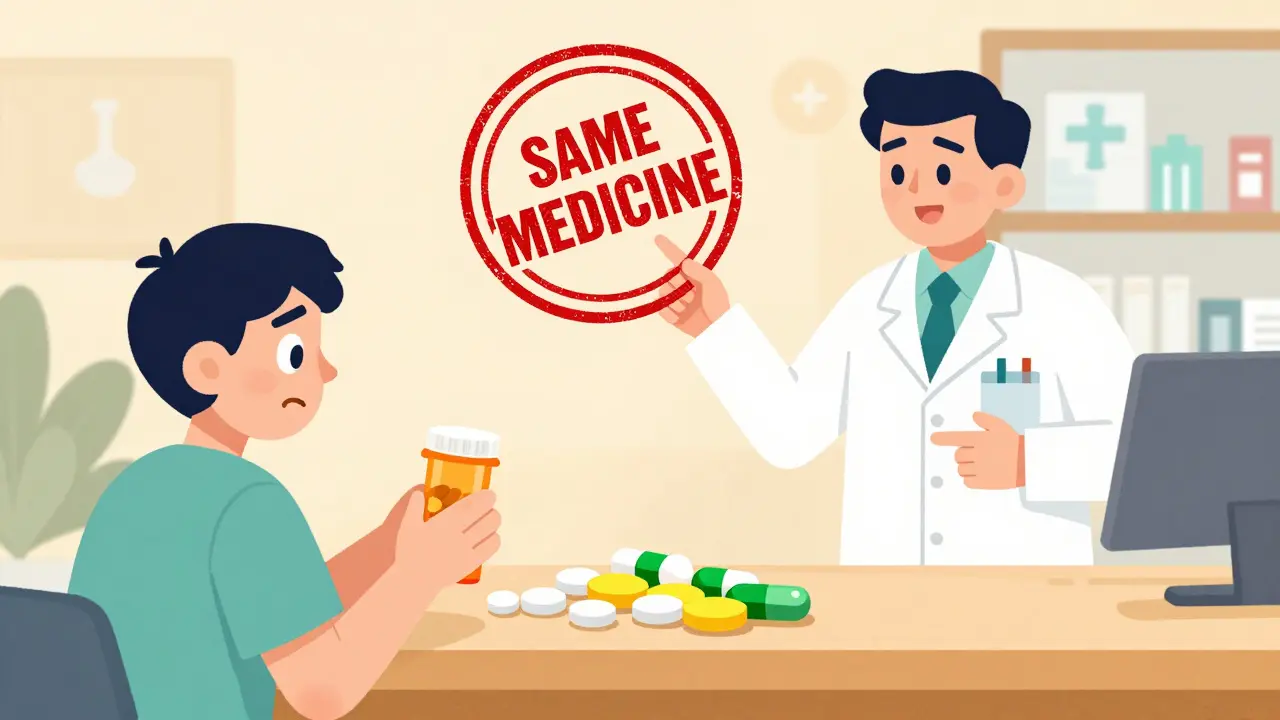
Why Does This Cause Confusion?
Imagine you take a small white pill every morning for your cholesterol. One day, your pharmacy gives you a large blue one. You panic. Did they give you the wrong medicine? Did you get a different drug?
This happens all the time. And it’s not your fault. The FDA admits that appearance changes can lead to medication errors. A 2023 review from UMass Memorial Health found that patients often stop taking their meds because they think the new pill isn’t the same. Some even think they’ve been given a counterfeit.
Pharmacies try to help by adding bold labels to the bottle: “Generic version of Lipitor. Looks different but same medicine.” But not everyone reads those. And if you refill at a different pharmacy, the pill might change again-because different generic manufacturers make it.
There’s no law forcing pharmacies to use the same generic maker every time. So your pill might look different every refill. And that’s normal.
Is It Safe? What Do Experts Say?
Yes, it’s safe. The FDA, the American Medical Association, and the World Health Organization all agree: generic drugs are just as safe and effective as brand-name ones.
Dr. Janet Woodcock, former head of the FDA’s drug review division, said: “Generic drug companies must provide scientific evidence that their active ingredient is the same-and we review every bit of it.”
And the numbers back it up. Over 90% of prescriptions in the U.S. are filled with generics. They make up only 23% of total drug spending. That’s because they cost 80-85% less. For people on long-term meds-like blood pressure or antidepressants-that’s thousands saved every year.
Consumer Reports found that 89% of people who switched to generics saw no difference in how they felt. The medicine worked just as well.
Still, some doctors and pharmacists worry. They’ve seen patients skip doses or stop taking meds entirely because they didn’t recognize the pill. That’s why education matters.
What Should You Do?
If your pill looks different, here’s what to do:
- Don’t panic. It’s probably still the same medicine.
- Check the label. Your pharmacy’s label should say if it’s a generic and what brand it replaces.
- Ask your pharmacist. They can tell you the name of the manufacturer and confirm it’s the right drug.
- Keep your old bottle. Compare the new pill to the old one. If you’re still unsure, call your doctor.
- Don’t stop taking it. Unless your doctor says so, keep taking your medicine-even if it looks different.
Some pharmacies now offer a “medication counseling” service when you pick up a new generic. Take advantage of it. A five-minute chat can prevent a big mistake.
The Bigger Picture
The system isn’t perfect. Trademark laws were never designed with patients in mind. They were built to protect corporate brands. But they’ve become a barrier to clarity.
The FDA has started suggesting that generic makers try to match the size and shape of the brand-name drug as closely as possible-without copying it. That’s a small step toward reducing confusion. But the legal requirement to differ remains.
For now, the trade-off is clear: you get cheaper drugs, but you have to learn to recognize them. And that’s why knowing your meds matters more than ever.
Don’t let the color of a pill scare you. It’s not about branding. It’s about law. And your health? That’s still in good hands.

Becky M.
February 3, 2026 AT 09:43just got my generic blood pressure pill and it’s a tiny green oval now?? i thought i got scammed 😅 turned out it’s the same stuff, just looks like a mint. pharmacy label didn’t even mention the color change. so glad i didn’t toss it.
Hannah Gliane
February 5, 2026 AT 04:04lol so we’re protecting corporate logos by making old ladies panic about their pills? 🤦♀️ next they’ll make the pill shape match the company’s mascot. ‘Here’s your fluoxetine - it’s shaped like a Coca-Cola bottle now.’
Dan Pearson
February 6, 2026 AT 05:19you people are overreacting. this is AMERICA. if you can’t tell the difference between a blue pill and a white one, maybe you shouldn’t be managing your own meds. we got generics so you don’t pay $300 for a bottle of aspirin. stop whining and learn your pills.
Ellie Norris
February 7, 2026 AT 19:59hi! i’m a pharmacist in london and this happens all the time here too. the uk has the same rule - generics can’t copy appearance. patients get confused, but once we show them the active ingredient on the label (same name, same dose) they calm down. always check the label! 💊
Nick Flake
February 8, 2026 AT 22:16think about it - we let corporations own the visual identity of medicine. a color, a shape, a stamp - these are now branded property, even when the science is identical. we’ve turned healing into a marketing war. the pill doesn’t care if it’s blue or white. but we’ve trained ourselves to fear change. maybe the real drug isn’t in the tablet… it’s in our minds.
Chinmoy Kumar
February 10, 2026 AT 01:36in india we have generics everywhere and no one cares about color. people just check the name on the strip. but i get it, in usa people are used to branded stuff. still, saving 80% is huge. i know someone on insulin who switched and saved $1200/year. that’s a laptop. or food for a month. 🙏
Brett MacDonald
February 10, 2026 AT 19:40so trademark law > patient clarity. ironic. we live in a world where a pill’s shape is more protected than your right to know what you’re taking. capitalism: it’s not a bug, it’s a feature.
Sandeep Kumar
February 12, 2026 AT 00:36why do americans make everything a drama? in my country generics are normal. if you cant read the name on the pill you shouldnt be alive. this law is smart. protect brands not weak minds. cheap medicine is good. stop crying
clarissa sulio
February 12, 2026 AT 18:48My dad stopped taking his meds for 3 weeks because his generic was yellow instead of blue. He thought it was a placebo. He’s 72. He’s fine now but we had to go to the pharmacy three times. This isn’t just about confusion - it’s a public health issue.