
Pharmacovigilance Signal Detection Calculator
Drug Safety Monitoring Calculator
Estimate how many people need to report side effects on social media for a reliable signal to be detected. Based on data from the article.
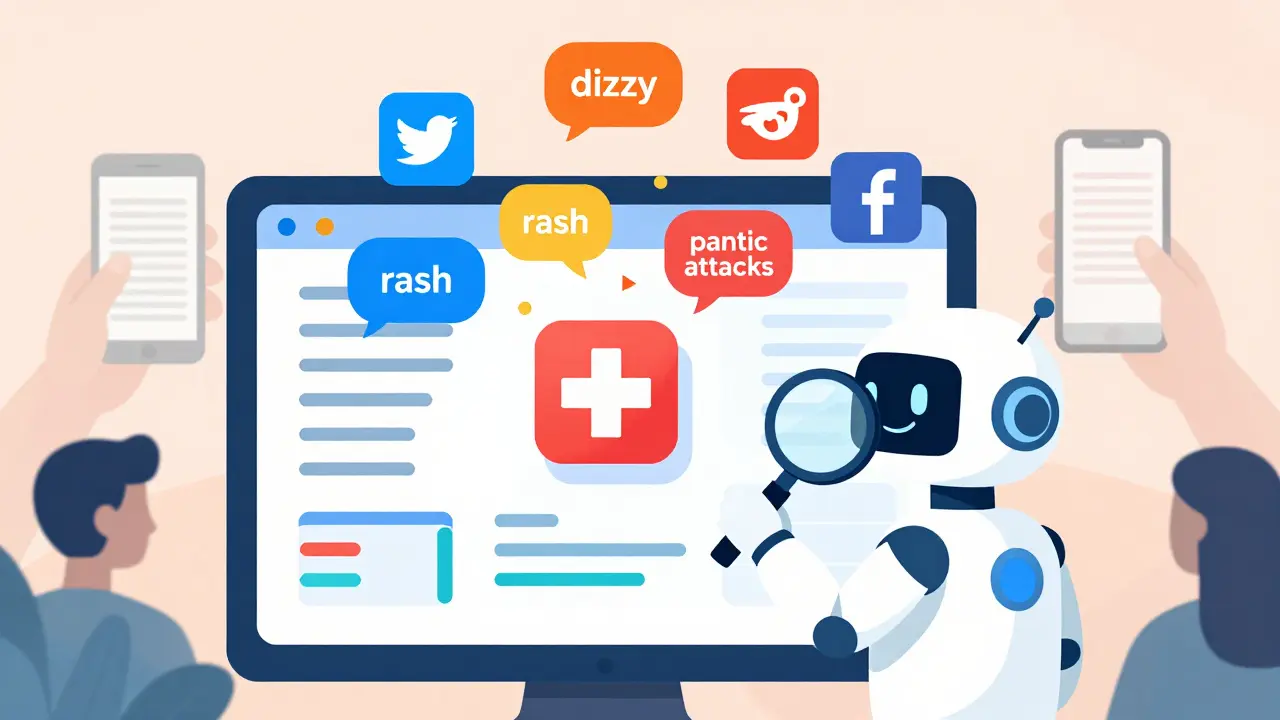
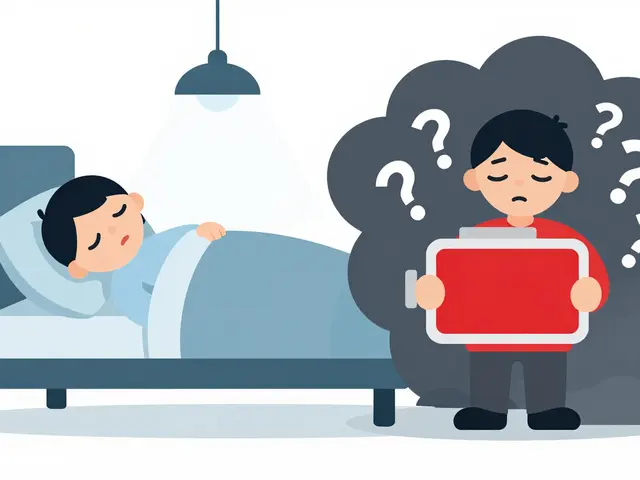
Every year, millions of people take medications that work exactly as intended. But for some, a simple pill triggers something unexpected - a rash, dizziness, nausea, or worse. Most of these reactions never make it into official databases. Traditional reporting systems catch only 5-10% of actual adverse drug reactions. That’s where social media comes in.
People don’t wait for doctors to report side effects. They post about them on Twitter, Reddit, Facebook, and health forums - often within hours of feeling unwell. A woman in Ohio might tweet about her new blood pressure medication making her dizzy. A man in London might describe a strange skin reaction on Instagram. These aren’t clinical reports. They’re raw, real, and unfiltered. And increasingly, pharmaceutical companies and regulators are watching.
How Social Media Is Changing Drug Safety Monitoring
For decades, pharmacovigilance relied on healthcare providers filling out forms, patients calling hotlines, or hospitals submitting reports. It was slow. It was incomplete. And it missed the voices of people who never went to a doctor after a bad reaction.
Since 2014, when the European Medicines Agency and major drugmakers launched the WEB-RADR project, social media has become a serious tool in drug safety. Today, 78% of big pharmaceutical companies use AI to scan platforms like Twitter, Reddit, and health blogs for mentions of medications and side effects. These systems can process up to 15,000 posts per hour, using natural language processing to spot phrases like “I felt sick after taking X” or “this drug gave me panic attacks.”
One real example: A new antidepressant was being tested in 2023. Within weeks, users on Reddit started talking about unusual sleepwalking episodes. Traditional reports hadn’t picked it up yet. Within 47 days, the company flagged the pattern, investigated, and updated its safety profile - months before it would’ve shown up in official databases.
That’s the power: speed. Social media doesn’t wait for bureaucracy. It reacts in real time.
The Dark Side: Noise, Bias, and Privacy
But here’s the problem - most of what’s posted isn’t useful.
Out of every 100 social media posts mentioning a drug, about 68% are false alarms. Someone might be joking. Someone else might have confused two medications. Or they might have taken it with alcohol, a supplement, or another drug - and blame the wrong thing. AI can’t always tell the difference.
Then there’s the data gap. In 92% of social media reports, there’s no medical history. No dosage. No lab results. No doctor’s note. Just a tweet saying, “This drug ruined my life.” That’s not enough to prove causation. Regulators can’t act on emotion alone.
And then there’s privacy. People don’t know their posts are being harvested. A teenager posting about anxiety after starting a new ADHD med might think they’re sharing with friends. They’re not aware that a pharmaceutical company’s algorithm just logged that as a potential safety signal. No consent. No opt-out. That’s ethically messy.
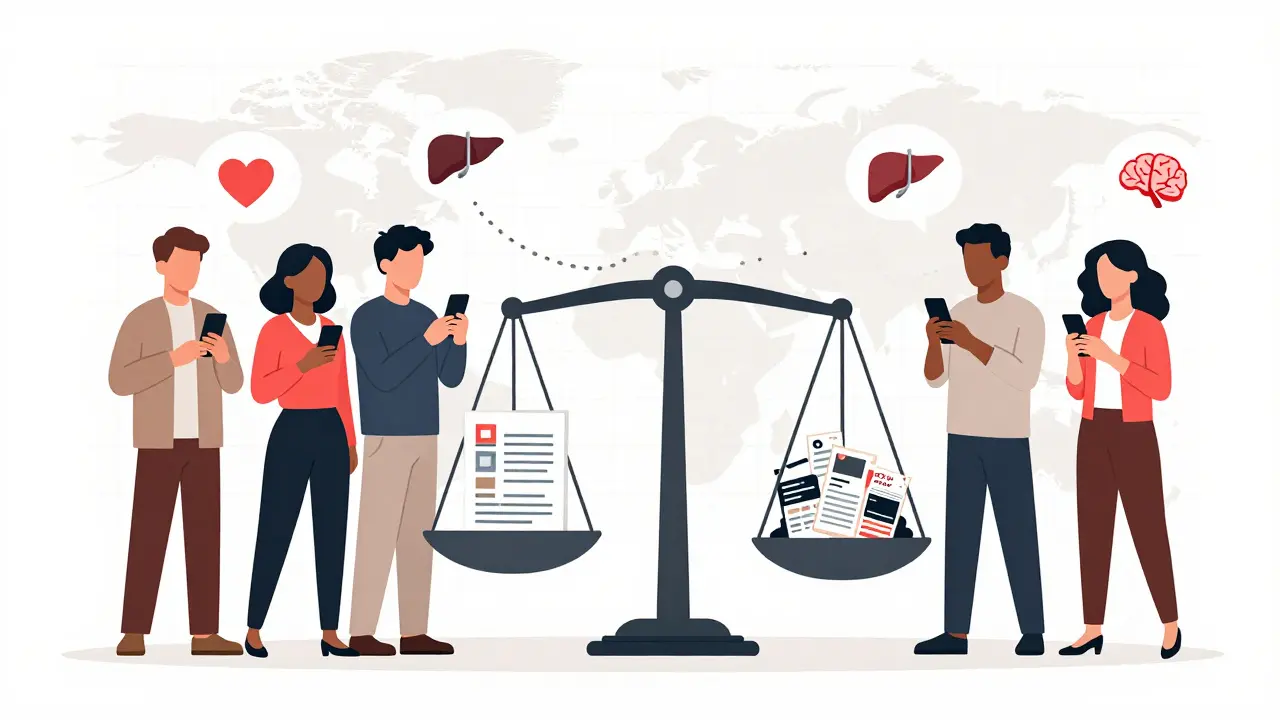
There’s also bias. People who use social media regularly - younger, urban, tech-savvy - are overrepresented. Older adults, rural communities, and non-English speakers are underrepresented. That means the data might miss side effects that affect different groups differently.
What Works - and What Doesn’t
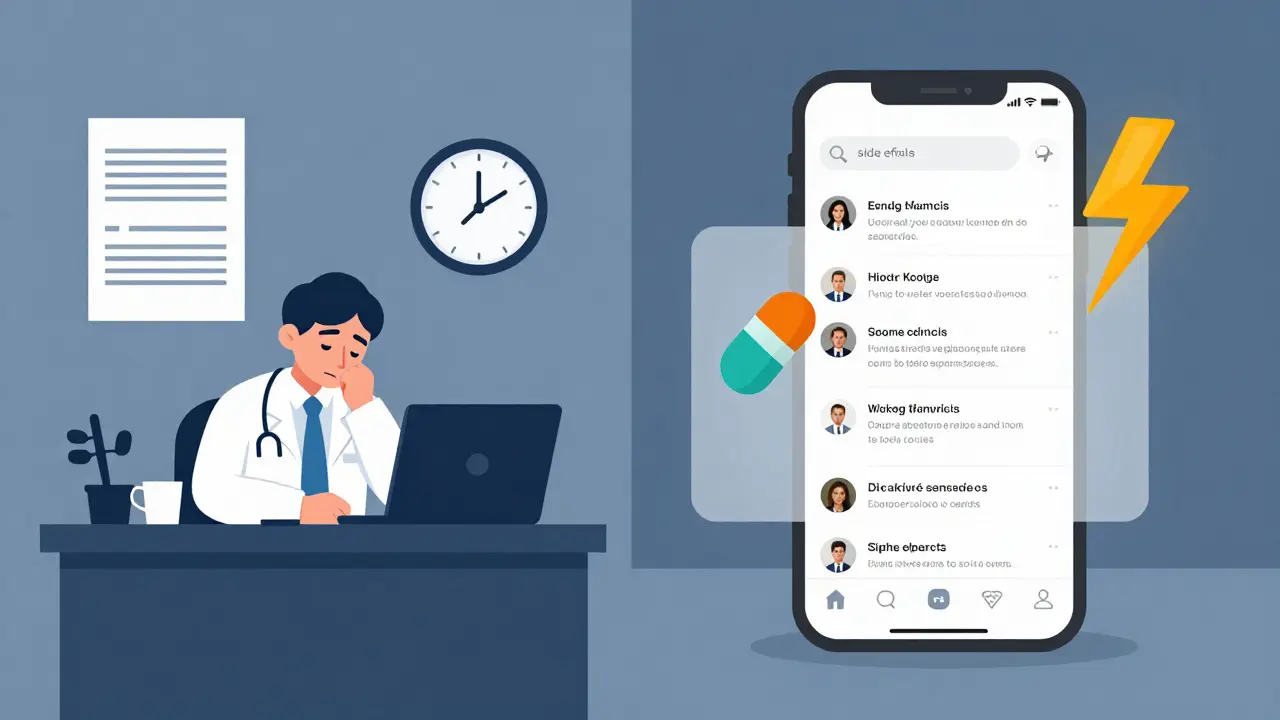
Not all drugs benefit equally from social media monitoring.
For blockbuster medications - like metformin, statins, or popular antidepressants - social media is gold. Millions of users mean enough signals to rise above the noise. Venus Remedies, for example, used social media to catch a rare skin reaction to a new antihistamine. They updated the label 112 days faster than traditional methods would’ve allowed.
But for rare drugs - say, a treatment for a condition affecting fewer than 10,000 people a year - social media fails. The FDA found 97% false positives in these cases. Too few people are talking. Too much noise. It’s like trying to hear a whisper in a hurricane.
Even when a signal is real, validating it takes work. Most companies use a three-stage human review process. First, AI filters. Then, a pharmacovigilance specialist checks for medical plausibility. Finally, a clinician confirms if the reaction makes sense based on known science. That process takes time. And it’s expensive.
Training staff to do this well isn’t easy. On average, pharmacovigilance teams need 87 hours of specialized training just to learn how to spot real adverse events in social media noise.
Regulators Are Catching Up
The FDA and EMA aren’t ignoring this. In 2022, the FDA released formal guidance saying social media data can be used - but only if companies prove their methods are reliable. In 2024, the EMA made it mandatory for companies to document their social media monitoring strategies in their safety reports.
The FDA is now running a pilot program with six drugmakers to test new AI tools that cut false positives below 15%. That’s a big deal. Right now, only 3.2% of social media reports meet the bar for official inclusion in safety databases. If that number can climb, it changes everything.
Meanwhile, companies are partnering with platforms. Facebook and IMS Health teamed up in 2022 to improve duplicate detection. Now, they can identify the same patient posting the same reaction across multiple accounts with 89% accuracy.
The Future: Integration, Not Replacement
Here’s the truth: social media won’t replace traditional pharmacovigilance. It can’t. Clinical trials, hospital reports, and spontaneous reporting systems still provide the structure, verification, and context that social media lacks.
The future isn’t about swapping one system for another. It’s about blending them. Imagine a dashboard where a safety team sees:
- A spike in Twitter mentions of “liver pain” linked to Drug X
- Three formal reports from hospitals with the same symptom
- A lab study showing the drug’s metabolite can affect liver enzymes
That’s when you know it’s real.
AI will keep getting smarter. Natural language processing will improve at understanding slang like “my head’s spinning” or “I can’t get out of bed.” Multilingual models will handle Spanish, Arabic, and Hindi posts better. But the human element - the clinician, the pharmacist, the regulator - will always be the final gatekeeper.
And that’s how it should be. Drugs save lives. But they can also harm. We need every tool we have - but we need to use them wisely.
What This Means for Patients
If you’re taking medication and notice something off - a new headache, mood change, rash - don’t ignore it. Don’t assume it’s “just stress.”
Posting about it online might help someone else. It might even lead to a label change that protects thousands. But be aware: your post could be read by a company’s algorithm. Your name, location, and medical details might be stored. You won’t be asked for permission.
There’s no easy fix. But awareness helps. If you’re concerned about privacy, consider posting anonymously or using pseudonyms. And if you’re a patient advocate, push for clearer disclosures from drugmakers about how they use social media data.
Pharmacovigilance is no longer just about doctors and labs. It’s about people - and the digital trails they leave behind. The question isn’t whether social media belongs in drug safety. It’s how we make sure it’s used ethically, accurately, and fairly.
Can social media replace traditional adverse drug reaction reporting?
No. Social media is a supplement, not a replacement. Traditional systems provide verified medical data, dosage details, and patient history that social media posts rarely include. While social media can detect signals faster, it lacks the rigor needed for regulatory decisions. The most effective systems combine both sources.
How accurate are AI tools in detecting real side effects from social media?
Current AI systems are about 85% accurate at identifying potential adverse event mentions. But that doesn’t mean 85% of those are real. Only around 3.2% of all social media reports meet validation standards for formal pharmacovigilance databases. Most are false positives - jokes, unrelated symptoms, or misinformation. Human review is still essential.
Are patients informed when their social media posts are used for drug safety monitoring?
Generally, no. Most pharmaceutical companies scan public posts without notifying users. This raises ethical concerns about privacy and consent. While the data is public, the intent behind posting (sharing with friends, not reporting to regulators) isn’t the same. Some experts argue this violates the principle of informed consent, and regulatory bodies are beginning to demand transparency.
Why is social media pharmacovigilance more effective for common drugs than rare ones?
It’s a numbers game. Common drugs have millions of users, so even a small percentage of people reporting side effects creates a detectable pattern. Rare drugs have too few users - meaning the signal is drowned out by noise. The FDA found 97% false positive rates for drugs with fewer than 10,000 annual prescriptions. The system isn’t designed for low-volume drugs.
What are the biggest challenges in using social media for pharmacovigilance?
The biggest challenges are: data noise (68% of posts aren’t valid), missing medical context (92% lack dosage or history), privacy concerns, language barriers (63% of companies struggle with non-English posts), and regulatory uncertainty. Plus, there’s the risk of bias - younger, tech-savvy users are overrepresented, while older or marginalized groups are left out.
Is social media pharmacovigilance growing, and where is it being adopted?
Yes. The global market for social media pharmacovigilance is projected to grow from $287 million in 2023 to $892 million by 2028. Adoption is highest in Europe (63% of companies), followed by North America (48%), and lowest in Asia-Pacific (29%). This gap reflects differences in privacy laws, regulatory expectations, and tech infrastructure.
Swapneel Mehta
December 19, 2025 AT 12:58Interesting read. I’ve seen this play out firsthand-my cousin took a new antidepressant and posted about sleep issues on Reddit. Within weeks, the company reached out with a survey. No one told her her post was being monitored, but she was glad it helped others. Still, I wish there was more transparency.
Jon Paramore
December 20, 2025 AT 06:08The 3.2% validation rate is the real bottleneck. AI can flag patterns, but without structured EHR integration, you’re chasing ghosts. We need structured NLP pipelines that pull from clinical notes, not just tweets. Otherwise, it’s signal-to-noise theater.
Stacey Smith
December 20, 2025 AT 19:49So now Big Pharma is spying on us through our anxiety rants? Great. Next they’ll charge us for the privilege of being monitored. America’s healthcare system is a joke.
Meina Taiwo
December 22, 2025 AT 09:02In Nigeria, most people don’t even have internet access to report side effects. Social media pharmacovigilance is a luxury for the urban elite. We need mobile SMS systems for rural communities-not just Twitter bots.
Adrian Thompson
December 23, 2025 AT 20:48Of course they’re watching. The FDA, Big Pharma, and the WHO are all in bed together. They use your posts to justify price hikes, then bury the real dangers. That antidepressant they ‘fixed’? The side effects got worse after the label update. They don’t want you safe-they want you compliant.
Teya Derksen Friesen
December 24, 2025 AT 21:43While I appreciate the innovation in leveraging digital footprints for public health, I must emphasize that the ethical implications are profound. The absence of informed consent in the harvesting of public social media data constitutes a significant breach of autonomy, particularly when such data is used for commercial and regulatory purposes without explicit opt-in mechanisms. The potential for misattribution, bias, and harm to vulnerable populations cannot be overstated.
Sandy Crux
December 25, 2025 AT 20:32Oh, of course-let’s trust algorithms trained on 15-year-olds typing ‘this drug made me cry and my cat died’ as ‘adverse event signals.’ How quaint. The entire system is a statistical farce. You might as well use horoscopes. And please, spare me the ‘human review’ nonsense-it’s just a PR fig leaf for lazy data science.
Ben Warren
December 27, 2025 AT 16:37The fundamental flaw in this entire paradigm is the conflation of anecdotal expression with clinical evidence. Social media is a cacophony of confabulation, misattribution, and emotional venting. To treat it as a legitimate pharmacovigilance channel is to abandon the scientific method in favor of algorithmic populism. The FDA’s 3.2% validation rate is not a bug-it is a feature, exposing the system’s inherent unreliability. Until we enforce strict data provenance, standardized reporting formats, and mandatory medical verification, this entire enterprise remains a dangerous illusion.
Southern NH Pagan Pride
December 29, 2025 AT 09:50theyre watching us through our tweets… and the gov knows. thats why they keep pushing these meds. its all a psyop. the pharma giants are working with the cia to track our moods and manipulate us. dont trust the labels. dont trust the doctors. theyre all in on it. i saw it on a forum in 2021. its not coincidence. its control.
Cameron Hoover
December 31, 2025 AT 04:10I used to think social media was just for memes. Now I see it as a lifeline. My sister had a rare reaction to a generic statin-no doctor believed her until she posted about it. Someone else had the same story. Together, they pushed the issue. It’s not perfect. But it’s the only system that listens when the system ignores you.
Orlando Marquez Jr
January 1, 2026 AT 14:55In many African and Southeast Asian cultures, health discussions are deeply communal and often occur through informal networks. While social media is growing, it remains a minority tool. The assumption that digital platforms represent universal patient voices is not only inaccurate-it is ethically hazardous. Localized, culturally grounded reporting systems remain indispensable.
John Hay
January 3, 2026 AT 13:18This whole thing is a scam. You think a tweet about dizziness means a drug is dangerous? That’s why people die-because regulators panic over noise. If you can’t prove it with a double-blind trial, shut up and stop wasting taxpayer money. We don’t need your TikTok drama to decide what’s safe.
Jackie Be
January 4, 2026 AT 18:32my friend took a new med and got the worst anxiety of her life-posted it on ig and 3 days later someone else had the same thing. now the label says it can cause panic attacks. i dont care if its not sciencey-this stuff saves lives. stop hating on people who speak up