
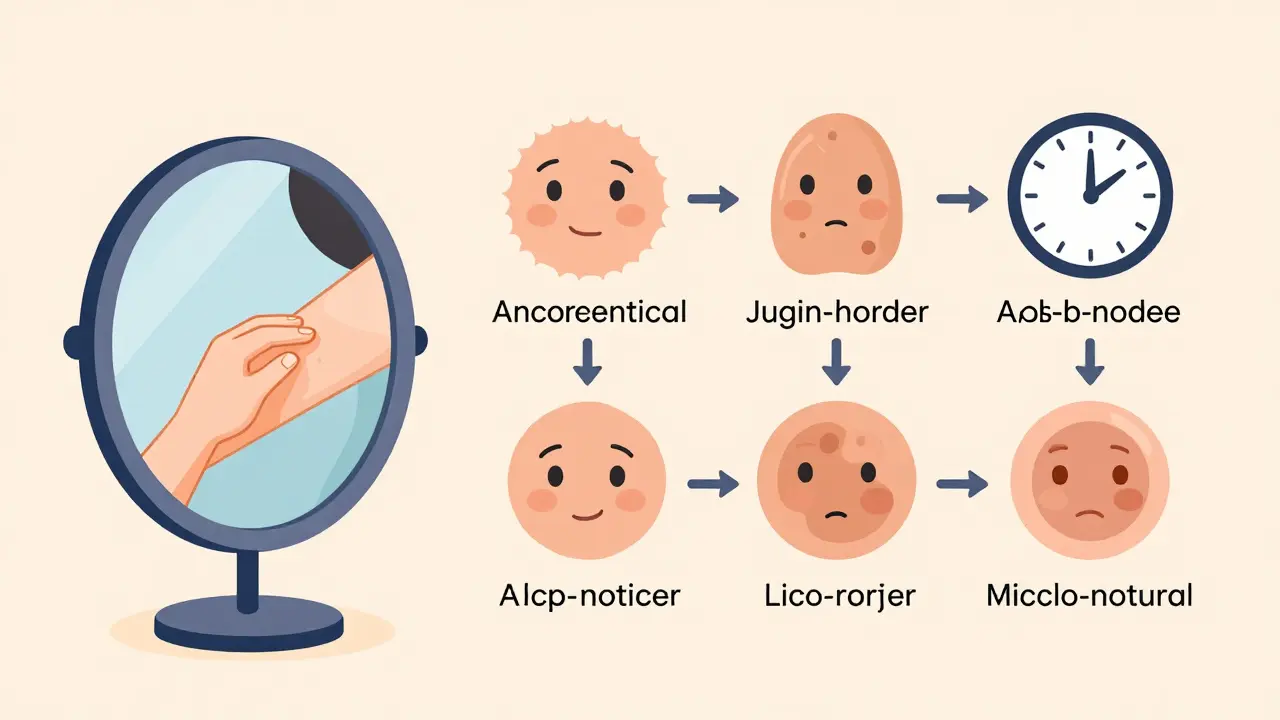
Most people have moles. Some are harmless, others aren’t. The difference can be life-or-death. That’s why the ABCDE rule exists - not to diagnose melanoma, but to catch it early when treatment works best. It’s simple, free, and taught in doctor’s offices, public health campaigns, and even school clinics. But here’s the problem: relying on it alone can miss dangerous skin changes. And that’s where things get complicated.
What the ABCDE Rule Actually Means
The ABCDE rule breaks down warning signs into five easy-to-remember traits. Each letter stands for something specific:- A for Asymmetry: If you draw a line through the middle of the mole, both sides don’t match. A normal mole is usually round or oval and symmetrical.
- B for Border: The edge looks ragged, notched, or blurred. Benign moles have smooth, even borders.
- C for Color: A mole with multiple shades - black, brown, red, white, or blue - is a red flag. Normal moles are usually one even color.
- D for Diameter: Traditionally, anything larger than 6 millimeters (about the size of a pencil eraser) raises concern. But newer guidelines from Phoenix Surgical Dermatology Group say 5 millimeters matters too. And some experts now treat D as Dark - if a mole is darker than others on your body, size doesn’t matter.
- E for Evolving: This is the most important. Any change over weeks or months - growing, itching, bleeding, crusting - should be checked. Even if it looks normal otherwise.
These aren’t just random tips. They’re based on data from thousands of skin biopsies. A 2022 study in PubMed found that lesions with three or more ABCDE features were over four times more likely to be melanoma than those with none. But here’s the catch: not all melanomas follow the rules.
Where the ABCDE Rule Falls Short
A 2022 study reviewed 144 melanoma cases and found that 36% were in situ - the earliest stage. Of those, only 32.7% showed the E sign (evolving), compared to 50% of invasive melanomas. That means more than one in three early melanomas didn’t change visibly before becoming dangerous.Some melanoma types barely fit the ABCDE pattern at all. Desmoplastic melanoma - a rare but aggressive form - shows classic signs in only 15% of cases. Childhood melanoma? Only 18% meet the criteria. And then there’s the patient who posted on Reddit: “My melanoma was perfectly symmetrical, uniform color, and only 3mm. None of the ABCDE criteria applied. It was stage IIB.”
That’s not rare. A 2022 American Academy of Dermatology survey of 1,200 patients found that 42% delayed seeing a doctor because their mole “didn’t meet enough ABCDE criteria.” The average delay? Over seven months.
Even dermatologists admit the rule isn’t perfect. Dr. Allan Halpern of Memorial Sloan Kettering says, “Not all melanomas fit the ABCDE rule.” He’s right. About 20-30% of melanomas lack classic features. The rule was never meant to be a final verdict - just a starting point.
The Ugly Duckling Sign: What the ABCDE Rule Misses
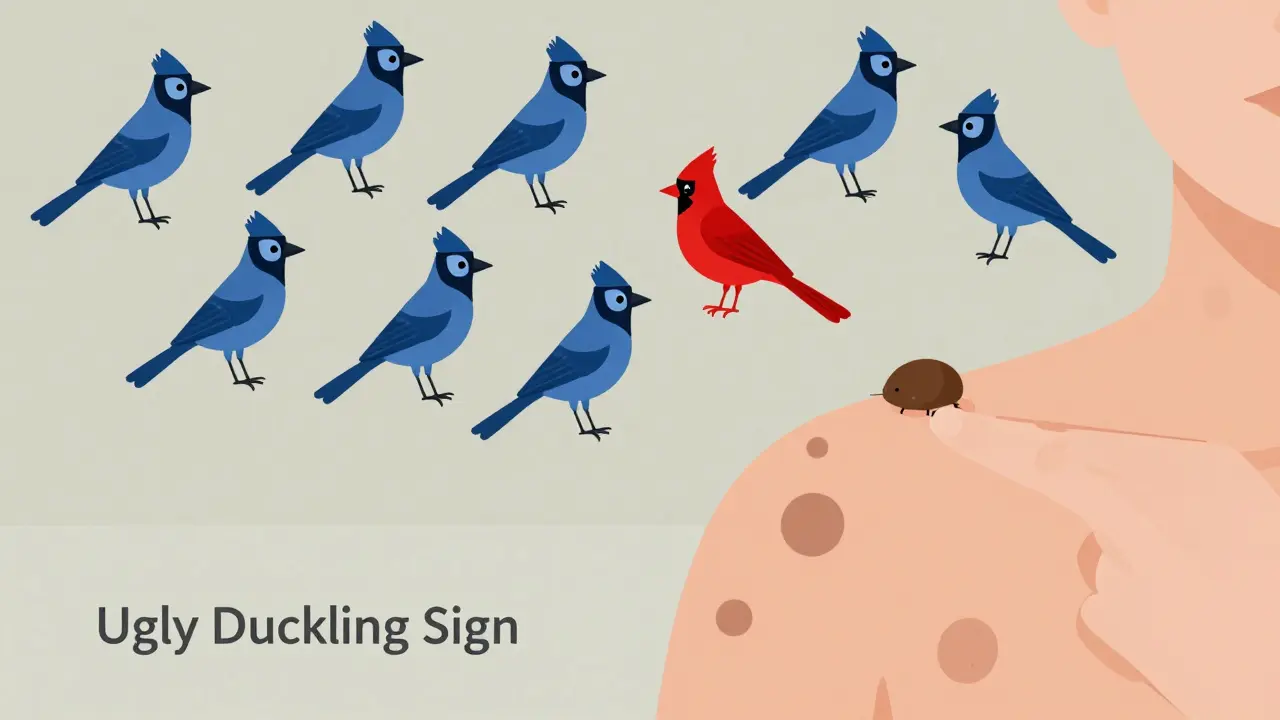
There’s another tool dermatologists use that’s just as important: the ugly duckling sign. It’s simple. Look at all your moles. Is there one that just looks different? Not necessarily bigger, darker, or irregular - just out of place?That’s the ugly duckling. A 2019 study in the British Journal of Dermatology showed this sign caught 73% of melanomas that ABCDE missed. Why? Because melanoma doesn’t always look like the textbook example. It looks like the odd one out.
Think of it like a flock of birds. Most are blue jays. One is a cardinal. You don’t need to know if the cardinal has a jagged beak or uneven wings. You know it doesn’t belong. That’s the power of this sign. It doesn’t rely on measurements or color charts. It relies on familiarity with your own skin.
When Does a Mole Need a Biopsy?
Not every weird-looking mole needs surgery. But when should you act? Dermatologists use three main triggers:- Three or more ABCDE features - sensitivity of 85%, specificity of 72%. If your mole checks three boxes, it’s worth a look.
- Documented change over 3-6 months - even if it’s subtle. A mole that grew 1mm in six months? That’s enough. Sensitivity jumps to 92%.
- The ugly duckling sign - if it stands out from your other moles, get it checked. Sensitivity is 73%.
But here’s the reality: most people don’t have photos of their moles from six months ago. The Skin Cancer Foundation says only 19% of patients bring baseline images to their appointment. That makes spotting change harder.
That’s why digital dermoscopy is becoming standard. Dermatologists use handheld microscopes to capture high-res images of moles. In 85% of U.S. dermatology practices, this is routine. It boosts diagnostic accuracy from 75% to 92%. And it helps avoid unnecessary biopsies - 89% of dermatologists say it reduces them.
But if you’re not seeing a specialist? You’re stuck with your eyes and maybe a ruler. That’s why monthly self-checks matter. The AAD recommends it. Their body mole map app has been downloaded over 1.2 million times in the past year.
The Cost of False Alarms
Every biopsy has a cost - financial, emotional, physical. For every melanoma caught using ABCDE, 4.7 benign moles are removed. That adds up. A 2022 study in JAMA Internal Medicine estimated the U.S. spends $417 million a year on unnecessary biopsies.That’s why newer tools are emerging. The FDA approved SkinVision, an AI app, in March 2022. It uses ABCDE plus extra data points and has 95% sensitivity in trials. It’s not a replacement for a doctor - but it can help decide if you need to go.
Even more advanced: molecular tests like DecisionDx-Melanoma. This 23-gene test analyzes a biopsy sample to predict if a mole is truly dangerous. It’s now used in 68% of academic dermatology centers. Studies show it can cut unnecessary surgeries by 31%.
These aren’t magic. They’re tools. And they’re changing how we think about moles.

What You Should Do Today
You don’t need to be a dermatologist to protect yourself. Here’s what works:- Check your skin monthly. Use a mirror. Take photos if you can. Note any new spots or changes.
- Know your ABCDEs. But don’t wait for all five signs. One is enough if it’s new or changing.
- Look for the ugly duckling. If one mole looks different from the rest, get it checked - even if it’s small.
- Don’t wait for symptoms. Melanoma doesn’t always itch, bleed, or hurt. Sometimes it just looks wrong.
- See a dermatologist if you’re unsure. Not “if it looks bad” - if you have any doubt.
And if you’ve had melanoma before, or have a family history, or have more than 50 moles - you’re higher risk. Annual skin checks aren’t optional. They’re essential.
What’s Next for Melanoma Detection
The ABCDE rule isn’t going away. But it’s evolving. The USPSTF’s upcoming update (expected in mid-2024) will likely emphasize change over time as the #1 red flag. The International Dermoscopy Society launched ABCDE 2.0 in early 2023 - integrating AI analysis of over 12 million skin images.By 2027, experts predict the ABCDE rule will be the starting point, not the finish line. You’ll use it to spot something odd. Then you’ll use a camera, an app, or a dermoscope to dig deeper. And if there’s still doubt? You’ll get a gene test.
The goal isn’t to replace human judgment. It’s to support it. Early detection saves lives. But detection only works if you’re looking - and if you know what to look for.
Can a mole be cancerous even if it’s small?
Yes. While melanomas are often larger than 6mm when found, 30% are detected when smaller than that. Size isn’t the only factor - changes in shape, color, or texture matter more. A 3mm mole that’s evolving or looks different from others should still be checked.
Do I need to biopsy every weird-looking mole?
No. Most moles are harmless. Dermatologists use a combination of ABCDE signs, the ugly duckling sign, and documented changes to decide. If a mole meets three or more ABCDE criteria, has changed over 3-6 months, or stands out from your other moles, a biopsy is usually recommended. But not every odd-looking mole needs removal.
Is the ABCDE rule reliable for children?
Not always. Only about 18% of childhood melanomas show classic ABCDE features. Kids’ moles are often larger, more colorful, and irregular by nature. The ugly duckling sign is more useful here: if one mole looks completely different from the others, get it checked - regardless of ABCDE.
Can I rely on smartphone apps to check my moles?
Apps like SkinVision can help flag potential concerns using AI and ABCDE criteria, with 95% sensitivity in trials. But they’re not diagnostic tools. They’re screening aids. If an app flags a mole, see a dermatologist. Never skip a professional evaluation based on an app result.
How often should I get a professional skin check?
For average-risk adults, annual checks are recommended. If you have a history of melanoma, many moles, or a family history, you should be seen every 6-12 months. High-risk individuals may need more frequent exams. Don’t wait for symptoms - early detection is the best defense.



Jay Ara
December 25, 2025 AT 22:47josue robert figueroa salazar
December 26, 2025 AT 21:29david jackson
December 28, 2025 AT 20:28jesse chen
December 29, 2025 AT 07:08Joanne Smith
December 31, 2025 AT 06:44Prasanthi Kontemukkala
December 31, 2025 AT 07:03Alex Ragen
January 2, 2026 AT 02:04Lori Anne Franklin
January 4, 2026 AT 01:50