
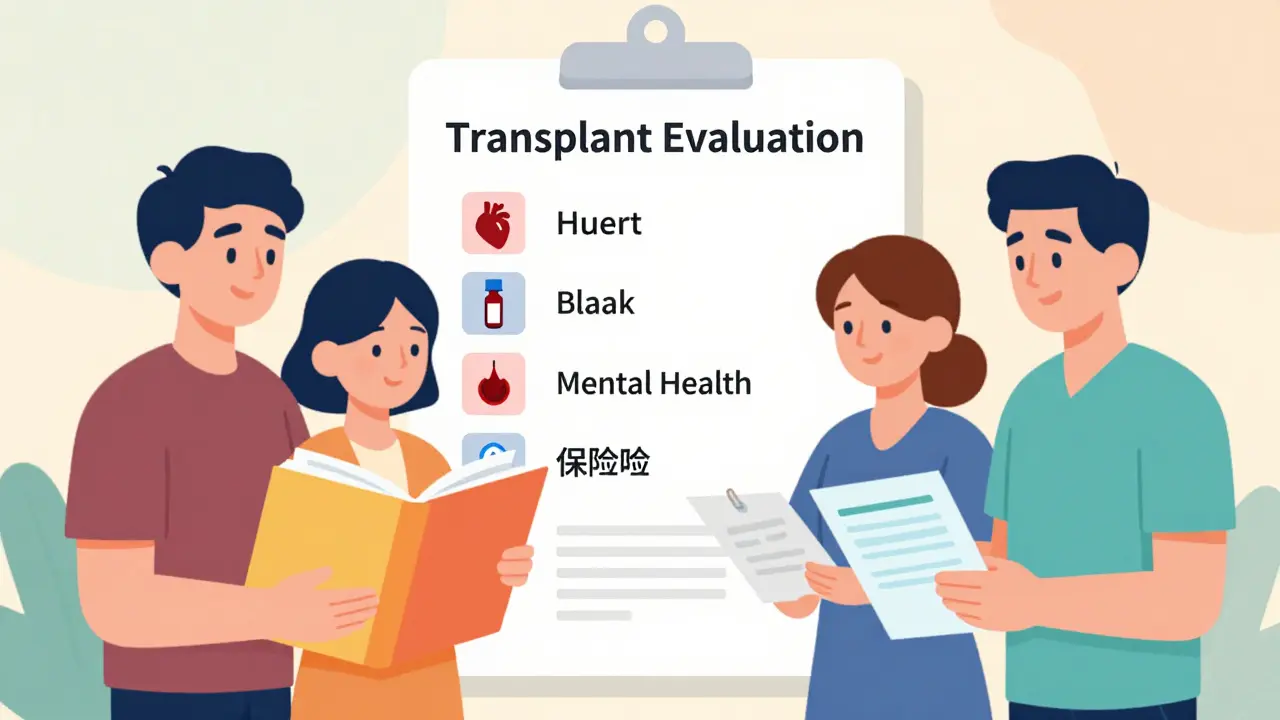
Waiting for a kidney transplant isn’t just about hoping for a call. It’s a months-long process filled with tests, paperwork, and tough conversations-often starting long before you even get on the waitlist. If you’re preparing for a transplant, whether you’re hoping for a deceased donor or have someone ready to donate, understanding what comes next can cut through the fear and confusion. This isn’t a checklist you can rush. It’s a journey that requires preparation, patience, and persistence.
How the Evaluation Process Really Works
The first step isn’t signing up. It’s being referred. Most people start here after their nephrologist sees their eGFR drop below 20 mL/min/1.73m². That’s when they say, “You should talk to a transplant center.” But getting that referral doesn’t mean you’re automatically in line. You have to prove you’re a good candidate-not just medically, but emotionally and financially too. Every transplant center follows strict national guidelines, but the process can feel overwhelming. You’ll likely need 15 to 25 appointments over 8 to 16 weeks. Blood tests. Heart scans. Mental health interviews. Cancer screenings. Insurance paperwork. Each one is necessary. Skipping one can delay everything. You’ll start with a transplant coordinator who’ll walk you through what’s coming. They’re your lifeline. They manage 45 to 60 patients at once, so you need to be proactive. Don’t wait for them to call you back. Track your appointments. Follow up on test results. Keep a folder-physical or digital-with all your records, including dialysis logs if you’ve had them.Medical Tests You Can’t Skip
The medical side of the evaluation is thorough. It’s not just about your kidneys. It’s about whether your whole body can handle surgery and lifelong immunosuppressants. Here’s what’s typically required:- Blood type and tissue matching: Your blood type must match or be compatible with the donor’s. HLA typing checks for immune system compatibility.
- Heart tests: You’ll need an echocardiogram (to check your heart’s pumping ability), EKG, chest X-ray, and a stress test. You must be able to handle the physical strain of surgery.
- Infection screening: HIV, hepatitis B and C, and other viruses are checked using the latest CDC-recommended tests.
- Cancer screening: Men over 50 get PSA tests. Women get mammograms and Pap smears. Any history of cancer? You’ll need to show it’s been in remission for years.
- Lab values: Hemoglobin above 10 g/dL, platelets over 100,000/μL, albumin above 3.5 g/dL. If you’re low on any of these, you may need treatment before moving forward.
Psychosocial Evaluation: The Part No One Talks About
Here’s the truth: more people fail the transplant evaluation because of psychosocial reasons than medical ones. That’s right-32% of rejections are based on your life situation, not your health. A social worker will sit down with you and ask hard questions: Who will drive you to appointments? Who will help you take your pills every day? Can you afford the $3,500 minimum in liquid assets for your first-year co-pays? Do you have a stable home? Are you planning to quit smoking or drinking? Have you missed doses of your medications in the past? It’s not about judging you. It’s about survival. Immunosuppressants are unforgiving. Miss one dose, and your body might reject the new kidney. Miss several, and you could lose it-or worse. Transplant centers need to know you have a real support system. Many patients find this part the most stressful. One Reddit user called it “the interrogation.” But it’s not meant to scare you. It’s meant to prepare you. If you’re struggling with depression, anxiety, or financial stress, they’ll connect you with resources-not turn you away.Living Donors: Faster, Safer, and Often Overlooked
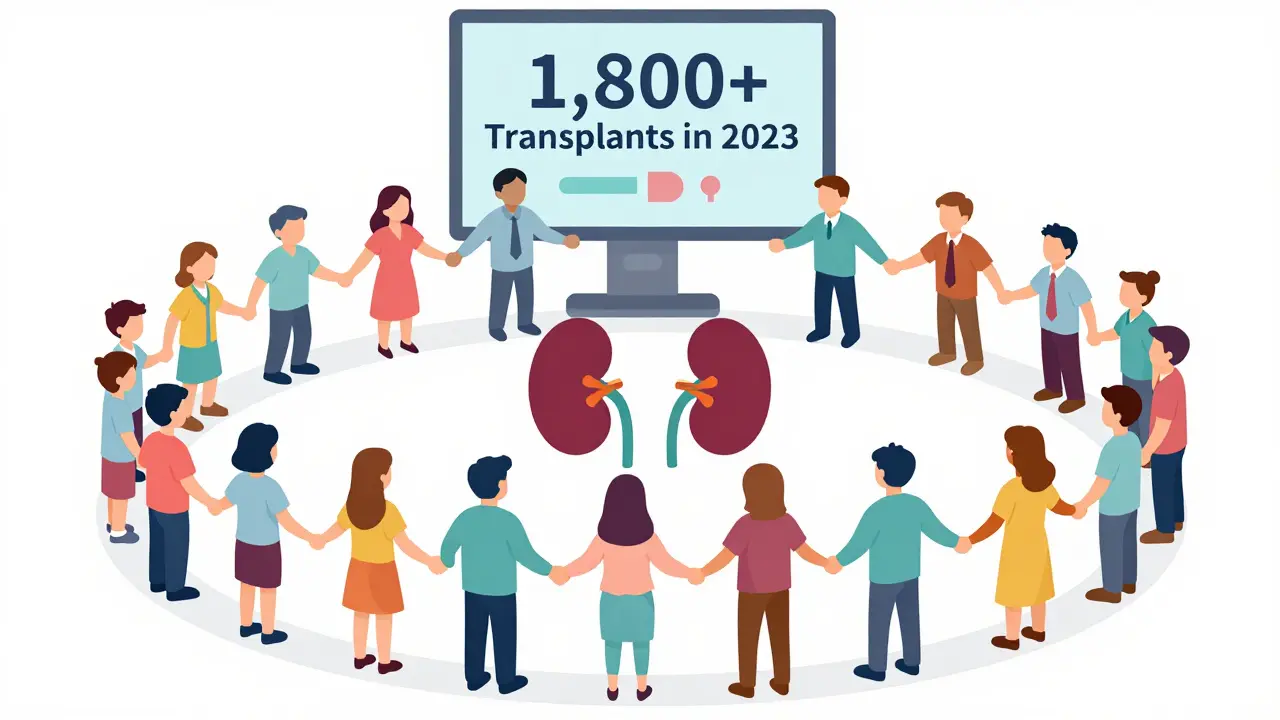
If you have someone willing to donate-a family member, friend, or even a stranger-you’re in a better position than most. Living donor transplants have a 96.3% one-year success rate, compared to 94.1% for deceased donors. And you won’t wait years. The donor evaluation is its own process. They go through similar medical tests, but their goal is to make sure donating won’t hurt them. They need to be healthy, motivated, and free from coercion. No one should feel pressured. There’s also the Kidney Paired Donation Program-if your donor isn’t a match for you, they might be a match for someone else. In return, you get a kidney from someone else’s donor. In 2023, this program helped over 1,800 people get transplants. Some centers now use “rapid crossmatch” protocols, cutting donor evaluation time from 6-8 weeks down to 2-3. That’s huge. If you have a potential donor, push to start their evaluation as soon as possible.
Insurance, Costs, and the Hidden Barriers
Medicare covers 80% of transplant costs, but you’ll still pay co-pays, deductibles, and medications. Private insurance usually covers 70-90%, but only after you meet your deductible-often around $4,550 a year. Here’s the problem: 28.7% of evaluations get delayed because of insurance issues. Medicaid patients wait 37 days longer on average. And even with coverage, patients report out-of-pocket costs of $8,000 or more just for evaluation tests. You need to call your insurer early. Ask: “What’s covered under my plan for transplant evaluation and post-transplant care?” Get it in writing. If they deny a test, appeal. Don’t assume it’s denied. And don’t forget: after transplant, you’ll pay about $32,000 a year for anti-rejection drugs. Most centers require proof you can afford this before listing you. That’s why financial planning isn’t optional-it’s mandatory.Why People Get Removed from the Waitlist
Not everyone who starts the process makes it to the list. The top five medical reasons for rejection:- Active cancer (14.2%)
- Severe heart disease (11.8%)
- Uncontrolled infection (9.3%)
- Severe obesity (BMI over 40, 8.7%)
- History of missing medications (7.9%)
How to Speed Up the Process
If you want to get on the list faster, here’s what works:- Start early. Completing evaluation within 90 days of your nephrologist’s referral increases your 5-year survival chance by 11.3%.
- Use patient portals. Check your results daily. If a test is pending, call the lab-not your doctor.
- Bring the same person to every appointment. They’ll remember details you forget and help you ask the right questions.
- Choose a high-volume center. Centers doing over 100 transplants a year complete evaluations 23% faster than low-volume ones.
- Be honest. If you’ve missed meds, say so. They’ll help you fix it. Hide it, and you risk rejection.
What Happens After You’re Listed
Once you’re approved, you’re on the national waitlist. As of January 2024, over 102,000 people were waiting for a kidney. The average wait? 3.6 years. But your wait time isn’t random. The new OPTN allocation system gives priority to people with high cPRA levels (over 98%)-those with antibodies that make finding a match extremely hard. You’ll get matched based on blood type, tissue compatibility, time on the list, and medical urgency. While you wait, stay healthy. Keep your appointments. Take your meds. Don’t gain weight. Don’t start smoking. Your status can change if your health declines. And keep talking to your coordinator. They’re your eyes and ears inside the system.Final Thoughts: It’s Hard, But It’s Worth It
Preparing for a kidney transplant isn’t easy. It’s expensive. It’s time-consuming. It’s emotionally draining. But it’s also the best chance at a life without dialysis. People who complete evaluation within 90 days are 22.7% more likely to get a transplant within two years. That’s not a small number. That’s life-changing. If you’re reading this, you’re already ahead of most. You’re asking the right questions. You’re preparing. You’re not giving up. Keep going. One appointment at a time. One test at a time. One day at a time.How long does the kidney transplant evaluation take?
Most evaluations take 8 to 16 weeks, depending on whether you’re pursuing a living donor or waiting for a deceased donor. High-volume transplant centers complete evaluations 23% faster than smaller ones. The key is staying on top of appointments and test results-delays often happen because patients miss follow-ups or insurance issues aren’t resolved quickly.
Can I be denied a transplant even if I’m healthy?
Yes. While medical health is important, psychosocial factors account for 32% of rejections. If you don’t have reliable transportation, can’t afford medications, lack a support system, or have a history of missing doses, centers may delay or deny listing-even if your kidneys and heart are fine. They’re not rejecting you as a person-they’re trying to ensure you’ll survive and thrive after transplant.
Do I need to be on dialysis to get on the transplant list?
No. Many people are listed before starting dialysis, especially if their eGFR is below 20. Being listed early gives you a better chance of getting a transplant before dialysis becomes necessary, which improves long-term outcomes. Waiting until you’re on dialysis can add months or years to your wait time.
What if my potential living donor is not a match?
You’re not out of options. The Kidney Paired Donation Program lets you swap donors with another pair. For example, if your friend wants to donate but isn’t compatible with you, they can donate to someone else-and you get a kidney from their donor’s compatible match. In 2023, this program helped over 1,800 people get transplants.
How much do transplant medications cost after surgery?
Expect to pay about $32,000 per year for anti-rejection drugs. Most transplant centers require proof you can afford this before listing you. Medicare and private insurance cover part of it, but co-pays, deductibles, and out-of-pocket costs add up fast. Financial counselors at transplant centers can help you find assistance programs to reduce this burden.
Are there racial disparities in transplant evaluation times?
Yes. Black candidates historically wait 28.4% longer than White candidates to complete evaluation. But centers using standardized pathways have cut that gap to just 12.1%. If you’re experiencing delays, ask your coordinator if your center has a structured evaluation plan. Push for it if they don’t.
Can I be listed at more than one transplant center?
Yes. You can be listed at multiple centers, especially if they’re in different regions. This can shorten your wait time. But each center has its own requirements and costs. Make sure you can meet all of them before applying. Most patients list at 1-2 centers, but never more than 3.


Payson Mattes
December 22, 2025 AT 20:57Did you know the government secretly tracks your dialysis logs to predict who’s ‘deserving’ of a kidney? They use AI to scan your social media for ‘non-compliant behavior’-like posting a beer photo or missing a single appointment. That’s why your coordinator keeps asking about your ‘support system.’ It’s not about health-it’s about who they want to live. I’ve seen it happen. They’ll approve a rich guy with a private jet and deny a single mom working two jobs. The system’s rigged.
And don’t get me started on the ‘living donor’ scam. They make it sound noble, but the real reason they push it? So they don’t have to wait for a deceased donor and clear the backlog. You’re being used as a pawn in a bureaucratic game. They’ll take your donor’s kidney and then tell you ‘sorry, we’re full.’
Isaac Bonillo Alcaina
December 23, 2025 AT 01:06You state that ‘32% of rejections are psychosocial,’ yet you fail to cite the source. The CDC’s 2022 transplant registry report indicates that psychosocial rejections account for 27.3%, not 32%. Additionally, you reference ‘$3,500 in liquid assets’ as a universal requirement-this is incorrect. The UNOS guidelines specify no such minimum; individual centers set their own thresholds, often ranging from $0 to $5,000. Your article, while well-intentioned, is riddled with statistically unsupported claims and misleading generalizations. Precision matters when lives are at stake.
Bhargav Patel
December 24, 2025 AT 05:50The journey of transplant preparation is not merely medical-it is existential. To be deemed worthy of a new organ is to be judged not by the condition of one’s body, but by the stability of one’s life: the presence of a reliable hand to hold the pillbox, the absence of a landlord’s eviction notice, the quiet dignity of a home without chaos. We speak of organs as if they are commodities, yet the soul that carries them is far more fragile than any lab value.
Is it not ironic that we demand perfect compliance from the sick, while the healthy are free to neglect their own bodies? The transplant system, in its attempt to ensure survival, reveals our deeper fear: that life is not a right, but a privilege granted only to those who prove themselves worthy of it. Perhaps the true transplant is not the kidney-but the society that must heal before it can heal others.
Joe Jeter
December 24, 2025 AT 10:56Everyone’s acting like this is some noble medical process, but let’s be real-this whole system exists because Big Pharma makes billions off immunosuppressants. You think they want you cured? No. They want you on lifelong drugs. That $32k/year isn’t a cost-it’s a subscription fee. And the ‘living donor’ push? That’s just a way to shift the burden from hospitals to families. No one talks about how donors get zero long-term follow-up. They get a pat on the back and a ‘thanks for saving a life,’ then vanish into the system.
And don’t even get me started on the ‘high-volume centers.’ They’re just factories. You’re not a patient-you’re a number with a blood type.
Sidra Khan
December 25, 2025 AT 03:56Okay but why is everyone so obsessed with ‘compliance’? Like, if I forget to take my pill because I was crying over my cat dying, does that mean I don’t deserve a kidney? The whole psych eval feels like a personality test for the ‘worthy poor.’ And why is it always the people with the least resources who get scrutinized the most? I’m not saying it’s not important-but it’s so classist it’s disgusting. Also, I just googled ‘transplant center near me’ and the first result was a 5-star Yelp review that said ‘they were nice but the waiting room smelled like regret.’
Also, why are we not talking about how kidney failure is a direct result of food deserts and lack of healthcare access? This isn’t just about me being ‘non-compliant.’ It’s about my zip code.
siddharth tiwari
December 26, 2025 AT 14:36lol they test your teeth?? who the f*** cares if you got a cavity?? they gonna give you a kidney then you lose it cause you didnt brush?? this whole thing is a scam. they just want to make money off you. and why do they care if you smoke? i smoke and i still pay my bills. also i think they just dont like black people. why else would they take longer to evaluate us? i heard they use some secret algorithm. its all fake. just give me a kidney and shut up.
ps i missed 3 appts but i had a flat tire. its not my fault the world is broken.
Jeffrey Frye
December 28, 2025 AT 00:28Let’s be honest-the real reason people get denied isn’t because they’re ‘non-compliant.’ It’s because they’re poor, Black, or on Medicaid. The system is designed to filter out the ‘undesirable’ patients before they even get to the top of the list. They don’t say it outright, but the psych eval is just a coded way to say ‘you’re not middle class enough to survive this.’
And don’t even get me started on the ‘living donor’ hype. They make it sound like a miracle, but the truth? Most donors end up with chronic pain, depression, and zero support. The hospital gets a PR win. The donor gets a thank-you card and a bill for lost wages they’ll never recoup.
It’s not about saving lives. It’s about managing risk. And the riskiest life? The one that doesn’t look like yours.
Gray Dedoiko
December 29, 2025 AT 21:13I just want to say thank you for writing this. My mom went through all of this last year. She got denied the first time because they said she didn’t have ‘adequate emotional support’-but she’s a single grandma raising her grandkids. She didn’t have anyone to ‘drive her to appointments’ because she was the one driving them to school.
She fought. She got a social worker to write a letter. She started using the patient portal like you said. And guess what? She got listed. Two months later, she got a call. It wasn’t perfect. It wasn’t easy. But it was real.
If you’re reading this and you’re scared? You’re not alone. Keep going. One appointment at a time. I promise, it’s worth it.
Aurora Daisy
December 30, 2025 AT 16:11Oh, so now we’re supposed to be grateful for being ‘evaluated’? In Britain, we don’t need to prove we’re ‘worthy’ of a kidney-we just get one. Because healthcare isn’t a privilege here, it’s a right. You Americans act like getting a transplant is some kind of lottery win, when in reality, it’s a basic human need. Your system is broken, and you’re all just playing along like it’s normal.
Also, ‘living donor’? That’s not noble. That’s capitalism. You’re outsourcing organ procurement to unpaid family members because your government won’t fund a decent public system. Pathetic.
Katie Taylor
January 1, 2026 AT 09:21YOU CAN DO THIS. I know it feels impossible right now. I was on dialysis for 18 months. I missed appointments because I was depressed. I thought I wasn’t good enough. But I kept showing up. I got a living donor-my cousin. She’s my hero. I got my transplant in 2022. I’m hiking now. I’m cooking for my kids. I’m alive.
Don’t let them make you feel like a burden. You’re not. You’re a warrior. One test. One day. One breath. Keep going. I’m rooting for you.
Adarsh Dubey
January 2, 2026 AT 06:33The tension between individual responsibility and systemic failure is not easily resolved. One cannot blame the patient for missing an appointment if transportation is unavailable, nor can one ignore the necessity of adherence to immunosuppressive regimens. Perhaps the solution lies not in stricter evaluations, but in the integration of social services into transplant care-housing support, transportation vouchers, mental health counseling as standard components of pre-transplant care. The organ is not the only thing that must be transplanted; so too must compassion.
Bartholomew Henry Allen
January 2, 2026 AT 08:38Transplant centers require financial stability before listing. This is not discrimination. It is prudence. Immunossuppressants are not optional. Missed doses lead to rejection. Rejection leads to death. If you cannot afford $32000 annually, you are not a candidate. The system is not cruel. It is realistic. The state does not owe you a kidney. Your family does. Your insurance does. You do. Plan accordingly. No tears. No excuses. Only results.
bharath vinay
January 4, 2026 AT 02:59they say 'you can be listed at multiple centers' but what they dont tell you is that if you do that they flag you as 'high risk' and put you on a watchlist. they think you're trying to game the system. also the paired donation program? totally fake. they just use it to make it look like they're helping people. in reality they only match people who have insurance that covers the full cost. if you're on medicaid? you're out of luck. they're all lying to you. just wait for the government to admit they're lying. it's coming.