
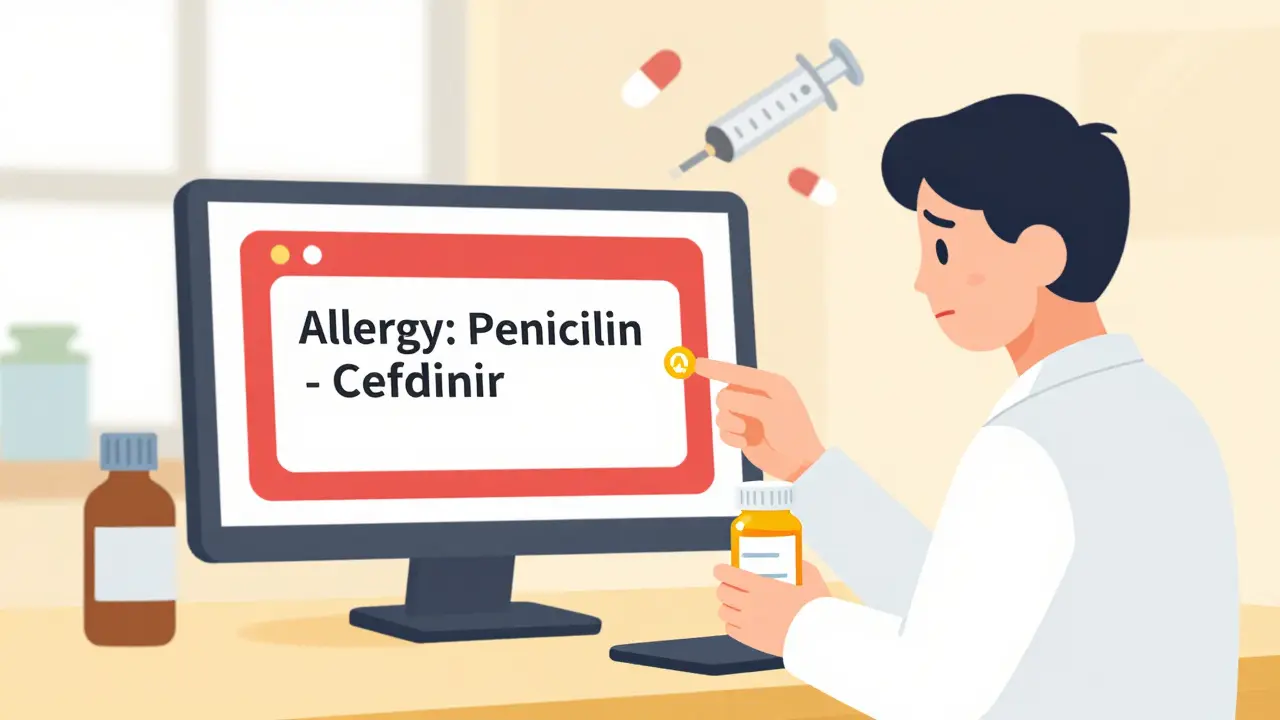
When you pick up a prescription, you might see a red or yellow pop-up on the pharmacist’s screen. It says: "Allergy: Penicillin - Cefdinir". You think, "Wait, I took cefdinir last year and felt fine." But the system still blocks it. What’s going on? Pharmacy allergy alerts aren’t just random warnings-they’re automated safety checks built into the electronic systems that pharmacies and hospitals use. But here’s the problem: most of them are wrong.
What Exactly Is a Pharmacy Allergy Alert?
An allergy alert is a computer-generated warning that pops up when a pharmacist or doctor tries to give you a medication that might interact with a documented allergy in your electronic health record. These systems have been around since the late 1990s, and by 2015, 96% of U.S. hospitals had them. They work by comparing the drug being ordered against your allergy list using a knowledge base like First DataBank. This database doesn’t just look for exact matches-it also flags related drugs based on chemical similarities.
For example, if your record says you’re allergic to penicillin, the system might warn you about amoxicillin (a close cousin) or even cephalosporins like cefdinir-even though the actual risk of cross-reaction is less than 2%. The system doesn’t know if your reaction was real, mild, or even fake. It just sees a keyword and sounds the alarm.
Two Types of Alerts-and Why It Matters
Not all alerts are created equal. There are two main kinds:
- Definite allergy alerts: These trigger when a drug directly matches something on your allergy list-like ordering penicillin for someone who wrote "penicillin rash" in their record.
- Possible allergy alerts: These are the big problem. They happen because of cross-reactivity assumptions. If you’re labeled allergic to penicillin, you might get warned about 10 other drugs-even though only 1 in 50 people with that label actually react to those drugs.
A 2020 study found that 90% of all allergy alerts are this second kind-"possible" reactions. That means nearly every alert you see is based on guesswork, not confirmed risk.
Why So Many Alerts Are Useless (And Dangerous)
Here’s the shocking part: 78% of doctors override these alerts at least several times a week. Some do it daily. Why? Because most of them are noise.
Think about it: If a system flags metformin because you once had nausea, or warns you about ibuprofen because you had a headache after taking it once, those aren’t allergies-they’re side effects. But EHR systems often don’t distinguish between the two. A 2019 study found that only 12% of NSAID allergy alerts reflected real clinical risk. The rest? Just irritation, upset stomach, or random coincidence.
And it gets worse. In one Reddit post, a doctor described getting 17 allergy alerts for a single dose of vancomycin-all because a childhood stomachache was logged as a "penicillin allergy." That’s not safety. That’s chaos.
How EHR Systems Handle Alerts Differently
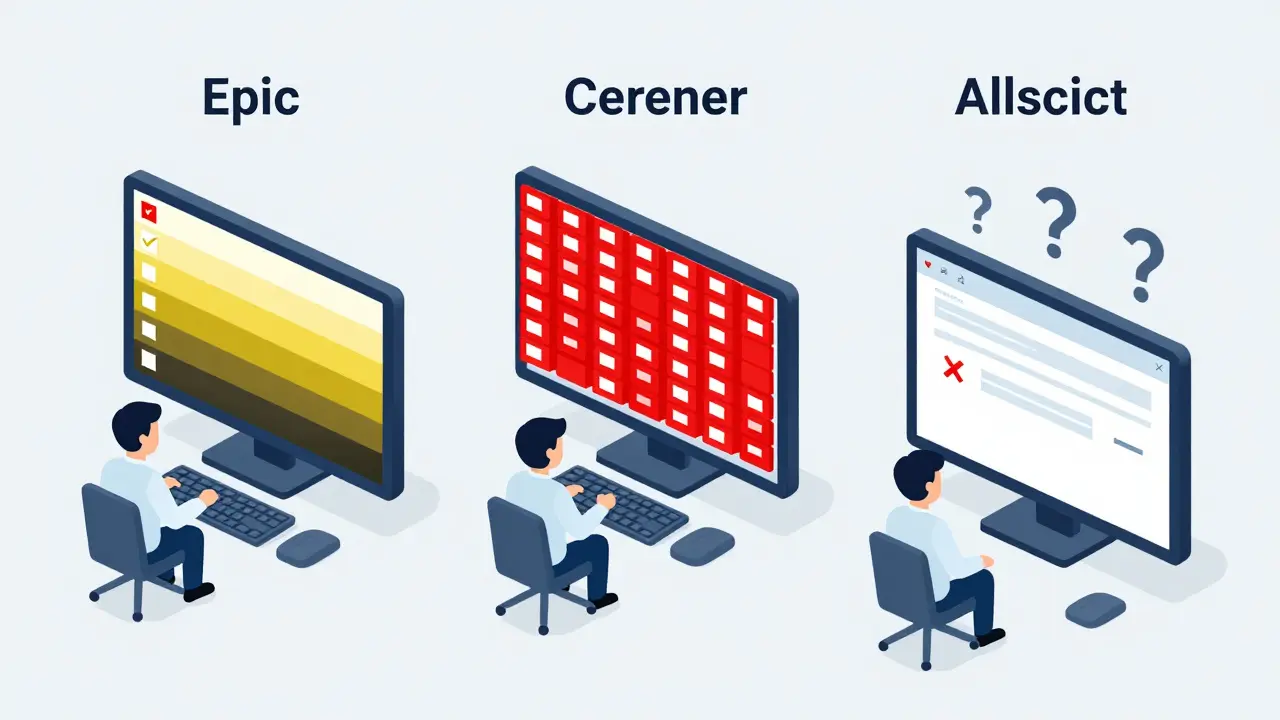
Not all systems are the same. Epic, Cerner, and Allscripts each handle alerts in their own way.
Epic uses a four-tier severity scale: yellow for mild, orange for moderate, red for severe, and black for life-threatening. It also tries to be smarter-when you’re flagged for a cephalosporin, it checks which generation the drug is. Third- and fourth-generation cephalosporins have almost no cross-reactivity with penicillin, so Epic lowers the alert level. Cerner, on the other hand, still uses a blanket rule for all cephalosporins, creating more false alarms.
Here’s the data:
| System | Alerts per 100 Orders | Override Rate | Alert Relevance Rate |
|---|---|---|---|
| Epic | 12.3 | 85% | 38% |
| Cerner | 9.7 | 90% | 29% |
| Allscripts | 10.1 | 67% | 31% |
| McKesson | 11.5 | 92% | 24% |
Notice something? Epic generates more alerts, but a higher percentage are actually meaningful. Allscripts has the lowest override rate-meaning clinicians trust it more. Why? Because it’s better at filtering out nonsense.
What You Should Look for in an Alert
When you see an alert, don’t just click "OK." Ask yourself:
- What was the reaction? Was it a rash? Hives? Swelling? Or just nausea? True allergies involve the immune system. Most reactions don’t.
- When did it happen? If you had a rash 10 years ago and took the same drug five times since without issue, it’s probably not an allergy.
- How severe was it? Anaphylaxis? That’s serious. A stomachache? Not the same.
- Is it a class alert? Are they warning you about a whole group of drugs just because of one drug you supposedly reacted to? That’s outdated science.
A 2021 study found that clinicians correctly interpreted these details only 58% of the time. That means more than half of the time, people are either ignoring real dangers or refusing safe medications because of bad data.
The Big Fix: Better Documentation
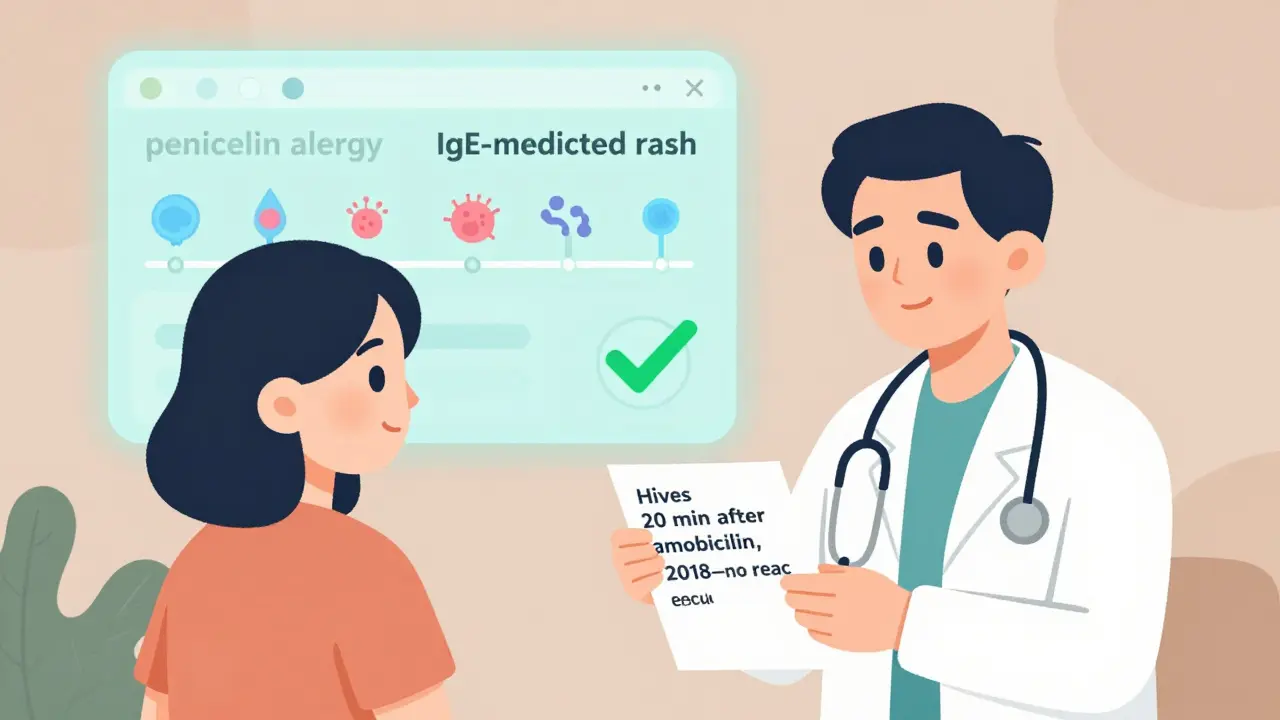
The real solution isn’t smarter software-it’s better input. If your record says "allergy to penicillin," that’s useless. But if it says "hives 30 minutes after penicillin, treated with epinephrine," that’s actionable.
Since January 2023, federal rules require EHRs to support structured allergy documentation. That means systems should now ask: What was the reaction? When? How severe? Was it immune-related?
Some hospitals are already ahead. Mayo Clinic now requires detailed descriptions before an allergy is logged. Johns Hopkins saw accurate allergy documentation jump from 39% to 76% in six months after changing their forms. And at Massachusetts General, a 45-minute training module cut inappropriate overrides by 28%.
What’s Coming Next
By 2026, 70% of major EHR systems are expected to use risk-stratified alerting. That means:
- High-risk alerts (anaphylaxis, swelling, breathing trouble) will be loud and mandatory.
- Low-risk alerts (nausea, headache, mild rash) will be quiet, or even disappear.
- Some systems will check if you’ve had a drug challenge test-where you took the drug under supervision and didn’t react-and automatically remove the alert.
Even better: future systems might use genetic data. If you have the HLA-B*5701 gene, you’re at high risk for a dangerous reaction to abacavir (an HIV drug). Testing for that can prevent death. That’s the future: precision, not guesswork.
What You Can Do Today
You don’t have to wait for the system to fix itself. Here’s how to take control:
- Review your allergy list every time you see a provider. If something doesn’t sound right, say so.
- Be specific. Don’t say "allergic to penicillin." Say "I got hives 20 minutes after taking amoxicillin in 2018. I’ve taken it twice since and had no reaction."
- Ask if you need an allergy test. Many "penicillin allergies" disappear over time. A simple skin test can clear your record.
- If a pharmacist says a drug is contraindicated, ask why. Is it because of a real allergy-or a system glitch?
Medications save lives. But bad alerts can keep you from getting the right treatment. You’re not just a patient-you’re the best source of information about your own body. Use it.
Are all drug allergy alerts accurate?
No. In fact, most aren’t. Studies show that 90% of alerts are triggered by cross-reactivity assumptions, not confirmed allergies. Only about 12% of NSAID alerts and 38% of penicillin-related alerts reflect true clinical risk. Many alerts are based on outdated, vague, or incorrect documentation like "stomach upset" being labeled as an allergy.
What’s the difference between an allergy and an adverse reaction?
An allergy involves your immune system reacting to a drug, often causing hives, swelling, trouble breathing, or anaphylaxis. An adverse reaction is a side effect-like nausea, dizziness, or headache-that doesn’t involve your immune system. Most drug reactions are side effects, not allergies. But EHR systems often treat them the same way.
Why do I get alerts for drugs I’ve taken before without problems?
Because your electronic record might have a vague label like "penicillin allergy" from a childhood event that wasn’t even an allergy. Systems assume cross-reactivity with entire drug classes-even when science says the risk is extremely low. If you’ve taken a drug safely before, the alert is likely a false positive.
Can I get rid of a false allergy alert in my record?
Yes. Talk to your doctor or allergist. You may qualify for a drug challenge test-where you take a small, supervised dose of the drug to confirm you’re not allergic. If you don’t react, your record can be updated. Studies show over 90% of people labeled "penicillin allergic" turn out to not be allergic at all.
What’s the risk of ignoring an allergy alert?
The risk depends on the alert. If it’s for a true IgE-mediated allergy (like anaphylaxis), ignoring it could be life-threatening. But if it’s for a low-risk cross-reaction or a non-allergic side effect, the risk is minimal. The bigger danger is over-reliance on alerts-clinicians may stop trusting them entirely, leading to missed true risks. Always discuss the alert with your provider before deciding to override it.
Final Thought: Don’t Trust the System. Verify.
Pharmacy allergy alerts were designed to save lives. But today, they often cause more harm than good-not because they’re broken, but because they’re built on bad data. The system isn’t your enemy. But if you don’t understand how it works, you’re letting it make decisions for you. Update your record. Ask questions. Push for precision. Your next dose of medicine might depend on it.
Chiruvella Pardha Krishna
February 16, 2026 AT 05:35The system doesn't care about nuance. It sees a keyword and screams. We've outsourced medical judgment to algorithms built by people who've never held a stethoscope. This isn't safety-it's liability insurance masquerading as care. The real tragedy? The people who need these drugs most are the ones denied them because some intern in 2007 wrote 'rash' next to 'penicillin' and called it a day.
Joe Grushkin
February 17, 2026 AT 01:47Of course 90% of alerts are false. You think a computer can distinguish between an immune response and a hangover? The whole thing is a farce. We've turned healthcare into a compliance theater where the only thing being protected is the vendor's liability coverage. And don't get me started on Epic's four-tier system-sounds like a PowerPoint slide from a consultant who never met a patient.
Virginia Kimball
February 17, 2026 AT 11:57Y'all know what's wild? The fact that we're still treating allergies like they're all the same. Imagine if your car's check engine light went off every time you ran out of gas, got a flat tire, or just forgot to put the parking brake on. We'd call it broken. But for humans? We just shrug and say 'oh well, the computer said no.' We need to treat our records like living documents-not digital tombstones. Talk to your doc. Be specific. You've got this.
Betty Kirby
February 19, 2026 AT 00:34Let me guess-you’re one of those people who thinks ‘nausea’ is an allergy? That’s not an allergy, that’s a side effect. And if you can’t tell the difference between an immune reaction and a stomachache, maybe you shouldn’t be making medical decisions. This isn’t a tech problem. It’s a literacy problem. People don’t understand basic immunology. And now the whole system pays for it.
Josiah Demara
February 19, 2026 AT 03:1696% of hospitals have these systems? That’s not progress-that’s institutionalized incompetence. And the override rates? Of course they’re 90%. No sane clinician trusts this garbage. The fact that we’re still debating this in 2024 proves we’ve stopped trying to fix the system and just learned to live with it. The real scandal? Nobody’s问责. No one’s fired. No one’s held accountable. Just more alerts. More noise. More wasted time. Pathetic.
Kaye Alcaraz
February 20, 2026 AT 13:37Thank you for laying this out so clearly. This is exactly why patient advocacy matters. We’re not just passive recipients of care-we’re the experts on our own bodies. If you’ve taken a drug safely before, that’s data. Real data. Not a checkbox from a form you filled out in 2007. Please, if you’re reading this: review your record. Be specific. Your next prescription might depend on it. You’re not being difficult-you’re being responsible.
Charlotte Dacre
February 21, 2026 AT 23:00So what you’re saying is… the system is dumb, but we’re too lazy to fix it? Shocking. Next up: a robot that tells you to drink more water because you sneezed once in 2012. I can’t wait for the AI that diagnoses me based on my Spotify playlist.
Esha Pathak
February 22, 2026 AT 18:59Every time I see an alert, I think of how much of life is just… noise. We’re drowning in signals and starving for meaning. The same thing happens in relationships, in politics, in art. We label everything. We fear everything. And we forget that sometimes, the body knows better than the database. I took amoxicillin after being told I was allergic. No hives. No swelling. Just a better night’s sleep. Maybe the real allergy… is to trusting machines too much.
Mike Hammer
February 23, 2026 AT 06:25my doc said i was allergic to penicillin after i got a rash at 7. i took it again at 22. fine. again at 30. fine. again last year. still fine. so yeah, the system’s wrong. but also… why do we still let kids’ childhood rashes define their meds for life? i mean, come on.
Daniel Dover
February 24, 2026 AT 04:26Simple fix: stop auto-flagging drug classes. If you’re allergic to penicillin, flag penicillin. Not every beta-lactam. That’s like banning all fruit because you’re allergic to one apple variety. The science’s been clear for decades. Why are we still doing this?
Kapil Verma
February 24, 2026 AT 09:52India has better drug safety protocols than this. We don’t need American software to tell us how to treat patients. This is what happens when you outsource healthcare to Silicon Valley startups who think ‘alert’ means ‘profit.’ We need local, context-aware systems-not corporate templates built for liability, not lives.
Mandeep Singh
February 24, 2026 AT 17:48Let me tell you something about these systems-they’re not broken because they’re poorly designed. They’re broken because they’re designed to protect hospitals from lawsuits, not patients from harm. The entire structure is built on fear, not science. And guess who pays the price? The patient. The one who can’t get the antibiotic because some 20-year-old’s vague symptom got logged as an ‘allergy.’ This isn’t healthcare. It’s a legal minefield with a stethoscope attached. And it’s killing people slowly. By design.
Sarah Barrett
February 25, 2026 AT 17:23While the system has significant flaws, the underlying intent remains valid: preventing adverse events. The challenge lies not in eliminating alerts, but in refining the data input. Structured documentation, patient education, and clinician training are not optional enhancements-they are foundational requirements for safe, effective care. The future of medicine depends on precision, not presumption.