

When a pregnant person is using opioids-whether prescribed for pain or misused as part of a substance use disorder-the stakes aren’t just personal. They’re biological, medical, and deeply human. The baby growing inside isn’t just exposed to the drug; their entire nervous system is adapting to it. And when that drug is removed or reduced, the baby doesn’t just cry-they go through withdrawal. This isn’t rare. It’s common. And it’s treatable.
Why Opioids During Pregnancy Are a Medical Issue, Not a Moral One
Opioid use disorder (OUD) in pregnancy isn’t about poor choices. It’s about a brain chemistry that’s been rewired by chronic use, often starting long before pregnancy. People don’t wake up one day and decide to get addicted. Addiction develops slowly, and for many, it’s tied to untreated trauma, chronic pain, or mental health conditions like depression. The CDC reports that between 2010 and 2020, the rate of neonatal abstinence syndrome (NAS)-also called neonatal opioid withdrawal syndrome (NOWS)-rose fivefold in U.S. hospitals. That’s not because more people are using drugs. It’s because we’re finally seeing them. The biggest mistake? Trying to quit cold turkey. Medically supervised withdrawal during pregnancy increases the risk of miscarriage by up to 4%, preterm labor by 10%, and fetal distress by nearly 15%. It also pushes relapse rates to 30-40%. That means a woman might spend weeks in detox, only to return to opioids because the cravings and anxiety are unbearable. And when that happens, the baby is exposed again-this time, to even higher doses.Medication-Assisted Treatment: The Gold Standard
The medical community agrees: the best way to protect both mother and baby is with medication-assisted treatment (MAT). That means using FDA-approved medications like methadone or buprenorphine to stabilize opioid levels without causing highs or withdrawal. These aren’t substitutes-they’re treatments. Think of them like insulin for diabetes. You don’t stop insulin because you’re pregnant. You adjust it. Methadone has been used for decades. It’s taken daily in liquid form under supervision. Doses usually start between 10-20 mg and are slowly increased to 60-120 mg daily. It’s effective at keeping mothers in care-70-80% stay in treatment after six months. But babies born to mothers on methadone often have more severe withdrawal symptoms. On average, they stay in the hospital 17.6 days, and their Finnegan scores (a tool that measures withdrawal severity) average 14.3. Buprenorphine is newer and often preferred. It’s taken as a dissolving tablet under the tongue. Doses typically range from 8-24 mg daily. It’s easier to manage, has fewer side effects for the mother, and results in slightly less severe withdrawal in newborns. Babies stay in the hospital about 12.3 days on average, with Finnegan scores around 11.8. But here’s the catch: only 60-70% of mothers stay in treatment with buprenorphine after six months, compared to 70-80% with methadone. There’s a third option: naltrexone. It’s not an opioid. It blocks opioids from working. Some women use it during pregnancy, and the results are striking. In one 2022 study, none of the babies born to mothers on naltrexone showed signs of withdrawal. They went home after two days. But here’s the trade-off: women on naltrexone often start treatment later-around 28 weeks-compared to 19-20 weeks for those on methadone or buprenorphine. That means less time for the baby to benefit from stable maternal health.What Neonatal Withdrawal Actually Looks Like
When a baby is born after being exposed to opioids, their body doesn’t know how to function without them. Symptoms usually show up 48-72 hours after birth. They’re not just fussy. They’re physiological.- Temperature above 37.2°C
- Respiratory rate over 60 breaths per minute
- More than three loose stools per hour
- Excessive crying that can’t be soothed
- Tremors, seizures, or stiff muscles
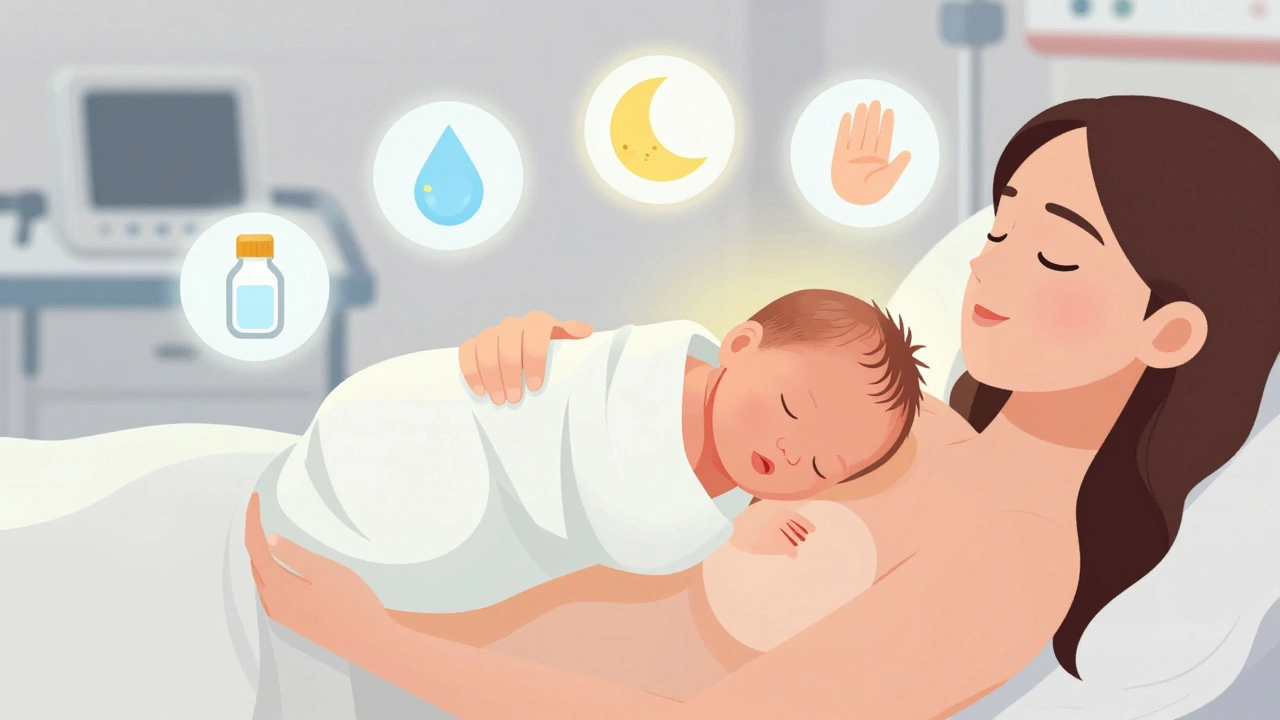
What Happens After Birth?
The work doesn’t stop at delivery. Babies need to be monitored for at least 72 hours. In the first 24 hours, they’re checked every 3-4 hours. After that, every 4-6 hours. If symptoms get worse, they’re started on medication-usually morphine or methadone-and slowly weaned over days or weeks. One mother on Reddit described her baby scoring 12 on the Finnegan scale at 48 hours. “It was terrifying,” she wrote. “They gave him morphine. We held him through the weaning. It took 14 days.” Another shared that her baby needed 19 days of treatment. These aren’t outliers. They’re routine. But not all stories are dark. One woman on a recovery forum said her baby on naltrexone had zero withdrawal symptoms. “We went home after two days. He slept through the night. I breastfed him. It felt normal.”Can You Breastfeed?
Yes. Most women on methadone or buprenorphine can safely breastfeed. The amount of drug that passes into breast milk is tiny-far less than what the baby was exposed to in the womb. The American Academy of Pediatrics says breastfeeding is encouraged, as long as the mother isn’t using other substances, smoking, or has HIV. Breastfeeding can even help with withdrawal. Skin-to-skin contact, feeding on demand, and rhythmic sucking calm the baby’s nervous system. One study found that 83% of mothers on naltrexone successfully breastfed without complications. That number is high because naltrexone doesn’t cross into milk at all. But stigma is real. Many women report being told not to breastfeed, even when it’s safe. Some are even questioned about their parenting skills. That kind of judgment makes recovery harder.
Where Care Falls Short
The science is clear. The guidelines exist. But access? That’s another story. Only 45% of U.S. hospitals have standardized protocols for managing opioid use in pregnancy. In rural areas, that number drops to 28%. Many clinics don’t have addiction specialists on staff. Some don’t even offer buprenorphine. Medicaid covers MAT for pregnant women under the 2020 SUPPORT Act-but only 32 states fully comply. And then there’s the mental health gap. Over 30% of pregnant women in substance use treatment screen positive for moderate to severe depression. More than 40% develop postpartum depression. Without integrated mental health care, recovery is fragile. A woman might stay sober through pregnancy, only to relapse after the baby is born because no one asked how she was feeling.What’s New in 2025?
In 2023, the FDA approved Brixadi, the first extended-release buprenorphine injection for pregnant women. Given once a week, it eliminates the need for daily dosing. Early trials show 89% of women stayed in treatment at 24 weeks, compared to 76% with daily pills. That’s a big win. The NIH’s HEALing Communities Study, running through 2025, is testing full-service care models-where prenatal care, MAT, mental health, housing help, and peer support are all in one place. Early results show a 22% drop in NAS severity when care is coordinated. But the biggest breakthrough isn’t a drug. It’s a shift in thinking. We’re moving from punishment to care. From judgment to support. From seeing addiction as a failure to recognizing it as a medical condition that needs treatment-especially when a baby’s life is on the line.What You Need to Know If You’re Pregnant and Using Opioids
- Don’t stop on your own. Withdrawal is dangerous for you and your baby.
- Ask for MAT. Methadone or buprenorphine are safe and effective.
- Start care as early as possible. First prenatal visit is ideal.
- Ask if your hospital uses the Eat, Sleep, Console method.
- Yes, you can breastfeed. Ask for support.
- Get mental health care. Depression and anxiety don’t disappear after birth.
- You are not alone. Thousands of women have done this. Recovery is possible.
Is it safe to take opioids during pregnancy if they’re prescribed?
Prescribed opioids for acute pain (like after surgery) are generally safe for short-term use under medical supervision. But long-term use-even with a prescription-can lead to dependence. If you’re on opioids for chronic pain and become pregnant, talk to your doctor about switching to a safer option like physical therapy, non-opioid medications, or medication-assisted treatment if dependence has developed.
Can I use naloxone during pregnancy?
Naloxone (Narcan) is used to reverse opioid overdoses and is safe in pregnancy. If someone overdoses, giving naloxone can save both the mother’s and baby’s life. But naloxone is not a treatment for addiction. It doesn’t help with cravings or withdrawal. It’s an emergency tool, not a long-term solution.
Will my baby be taken away if I’m on methadone or buprenorphine?
No. Being on medication-assisted treatment is not grounds for child removal. Child protective services are supposed to support families in recovery, not punish them. If your baby has withdrawal symptoms, that’s a medical issue, not a parenting failure. Hospitals with proper protocols work with social workers to keep families together and connect them with ongoing support.
How long does neonatal withdrawal last?
Symptoms usually peak around day 5-7 after birth and can last from a few days to several weeks. Most babies are treated for 7-14 days with medication, but some need up to 30 days, especially if exposed to long-acting opioids. Non-pharmacological care-like swaddling, quiet rooms, and frequent feeding-can shorten the time needed for medication.
Is naltrexone better than methadone or buprenorphine?
Naltrexone has the advantage of causing no withdrawal in newborns and allowing breastfeeding without concern. But it’s not suitable for everyone. It requires complete detox from opioids first, which can be risky during pregnancy. It’s also less effective at keeping mothers in treatment long-term. For most, methadone or buprenorphine remain the best choices because they prevent withdrawal and reduce relapse.
What if I’m in a rural area with no MAT providers?
Telehealth is changing this. Many states now allow prenatal care providers to prescribe buprenorphine via virtual visits. If your OB doesn’t offer it, ask for a referral to a telehealth addiction specialist. The National Maternal Mental Health Hotline (1-833-943-5746) can connect you to resources. You don’t need to be near a big hospital to get life-saving care.

Declan O Reilly
December 2, 2025 AT 15:59Man, this post hit different. I used to think addiction was just weak willpower until my cousin went through this while pregnant. She was on buprenorphine, and her baby? Zero withdrawal. Just slept, ate, smiled. We thought we’d lose her to the system-but the hospital treated her like a person, not a criminal. That’s the shift we need. Not judgment. Just care.
Conor Forde
December 4, 2025 AT 02:37Let’s be real-this whole ‘opioids are a medical issue’ thing is just woke corporate propaganda dressed up as science. People choose to use drugs. Period. If you can’t control your cravings while carrying a child, maybe you shouldn’t have been pregnant in the first place. And don’t get me started on breastfeeding while on methadone-next thing you know, the baby’s addicted to nipple milk.
patrick sui
December 4, 2025 AT 05:28Interesting breakdown! 🤔 The Eat, Sleep, Console model is a game-changer-so much more humane than counting sneezes. But I wonder: are we measuring success by hospital stay duration or by long-term neurodevelopmental outcomes? Also, naltrexone’s 0% NAS rate is wild… but what about maternal retention? If she relapses at week 30, does the baby benefit? We need longitudinal data. #MaternalHealth #NeonatalCare
Shannon Gabrielle
December 6, 2025 AT 01:30Oh great. Another liberal manifesto disguised as medical advice. Let’s just hand out buprenorphine like candy and call it ‘care.’ Meanwhile, real moms who didn’t use drugs are getting judged for ‘not being supportive enough.’ America’s gone mad. Stop rewarding bad choices with taxpayer-funded medication.
ANN JACOBS
December 7, 2025 AT 21:47It is with profound respect for the sanctity of life and the dignity of maternal health that I offer this reflection: the convergence of neurobiological adaptation, pharmacological intervention, and psychosocial support represents not merely a clinical protocol, but a moral imperative. The infant’s nervous system, developing in utero under the influence of exogenous opioids, requires not punishment, but precision-precision in dosing, precision in monitoring, and above all, precision in compassion. We must not mistake the symptom for the sin.
Nnaemeka Kingsley
December 8, 2025 AT 00:16Man, this is heavy. In Nigeria, no one talks about this. If you pregnant and on drugs, you just get kicked out. No help. No medicine. Just shame. But this post? It shows there’s a way. MAT works. Breastfeeding works. You don’t have to be perfect to be a good mom. Just need someone to help you.
Kshitij Shah
December 9, 2025 AT 07:04So we’re now treating addiction like diabetes? Cool. Next up: prescribing methadone to people who eat too much pizza. At least in India, we don’t have this drama. If you’re high and pregnant, you’re on your own. But hey, at least the baby doesn’t get a 17-day hospital stay. Just a quick ‘sorry, ma’am’ and a slap on the wrist.
Sean McCarthy
December 11, 2025 AT 02:03According to CDC data, 2010-2020: 5x increase in NAS. But what percentage of that increase is due to improved screening? What percentage is due to increased prescribing? What percentage is due to media hype? Where are the control groups? Where’s the peer-reviewed meta-analysis? This article reads like advocacy, not science.
Jaswinder Singh
December 13, 2025 AT 01:43Who the hell wrote this? This is the most honest thing I’ve read all year. I was on methadone for 3 years before I got pregnant. I was terrified. Everyone told me to quit cold turkey. I almost did. But I found a clinic that treated me like a human. My daughter’s 4 now. Zero issues. You don’t have to be clean to be a good mom. You just have to try.
Bee Floyd
December 13, 2025 AT 04:18Just wanted to say: thank you for writing this. I’m a nurse in rural Ohio. We don’t have a pediatric specialist on staff, but we started using Eat, Sleep, Console last year. We’ve cut our morphine use by half. The moms cry when they hear they can hold their babies without being judged. It’s not perfect. But it’s better than it was.
Jeremy Butler
December 14, 2025 AT 06:40It is axiomatic that the ontological status of the neonate, as a sentient being subject to pharmacological modulation in utero, necessitates a hermeneutic approach to therapeutic intervention-one predicated not upon moral calculus, but upon epistemic rigor. The conflation of medical necessity with social permissiveness constitutes a fundamental epistemological error, one which risks the erosion of clinical objectivity in favor of ideological conformity.
Courtney Co
December 15, 2025 AT 21:50But what if the baby is taken away anyway? What if the social worker says, ‘We can’t risk it’ even if you’re on MAT? I’ve seen it. I’ve been there. You’re told you’re doing everything right… and then they take the baby anyway because your ex told them you ‘used last year.’ This isn’t care. It’s a minefield. And no one tells you how to survive it.
Shashank Vira
December 17, 2025 AT 02:49One must question the very epistemological framework underpinning this discourse. The elevation of buprenorphine to ‘gold standard’ status is not a triumph of medicine-it is the capitulation of Western biomedicine to the hegemony of pharmaceutical capitalism. Naltrexone, though underutilized, is the only intervention that truly restores agency. Why are we medicating the mother to preserve the fetus, rather than empowering the mother to transcend dependency?
Eric Vlach
December 17, 2025 AT 07:14My sister did this. Buprenorphine. Breastfed. Baby went home in 5 days. No meds. Just skin to skin. People told her she was crazy. She didn’t care. She’s a teacher now. Her kid’s in kindergarten. Perfect attendance. No issues. Just a mom who got help. That’s all.
Souvik Datta
December 18, 2025 AT 00:02This is the kind of post that gives me hope. I’m from a village in West Bengal where women still get ostracized for being ‘drug addicts.’ But if we can spread this info-simple, clear, compassionate-we can change minds. MAT isn’t weakness. It’s wisdom. And breastfeeding? That’s love in its purest form. You don’t need a PhD to know that.