

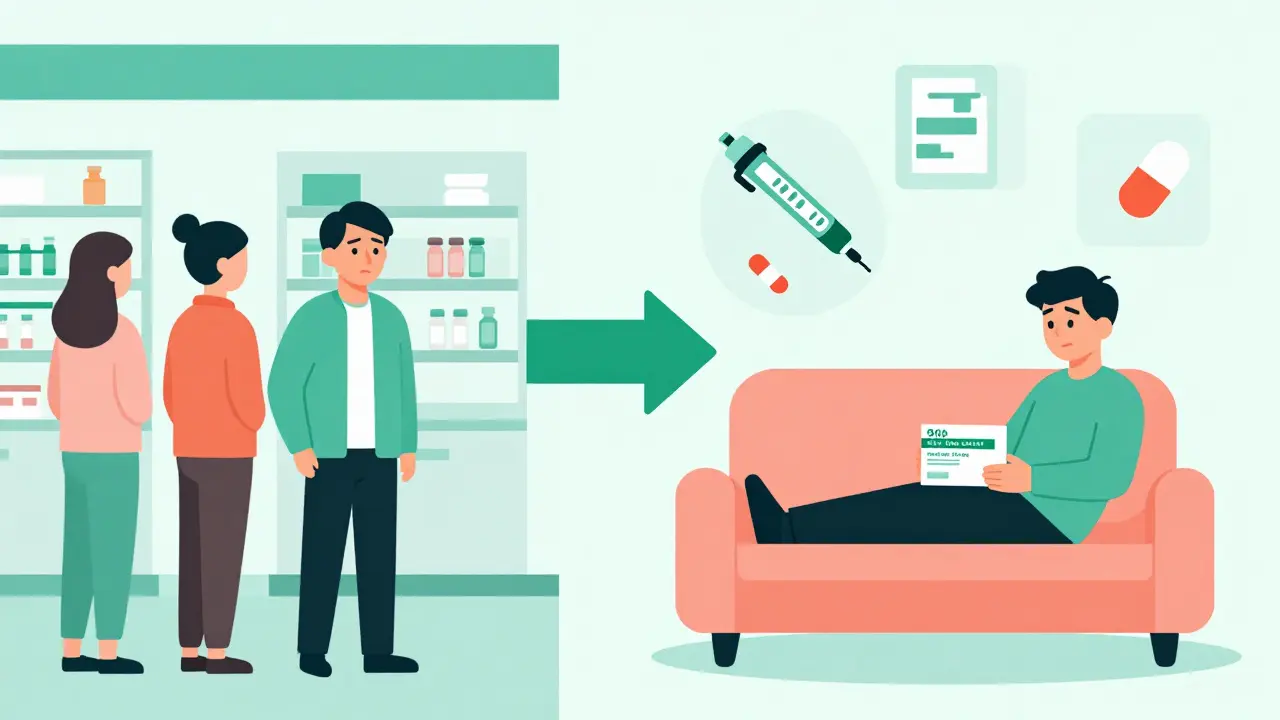
Running out of your blood pressure or diabetes meds shouldn’t mean a trip to the pharmacy in the rain, waiting in line, or skipping a dose because you’re too tired or busy. That’s where pharmacy delivery and mail-order services come in-simple, reliable, and designed to keep you on track with your treatment.
Think about it: if you’re taking the same pills every day for months-or years-why are you still driving to the pharmacy every 30 days? Most people don’t realize that getting your maintenance meds delivered to your door isn’t just convenient. It actually helps you stay healthy. Studies show that people who use mail-order pharmacies are 82% likely to take their meds as prescribed, compared to just 52% for those who pick them up in person. That’s not a small difference. That’s the gap between managing your condition and ending up in the hospital.
How Mail-Order Pharmacy Works
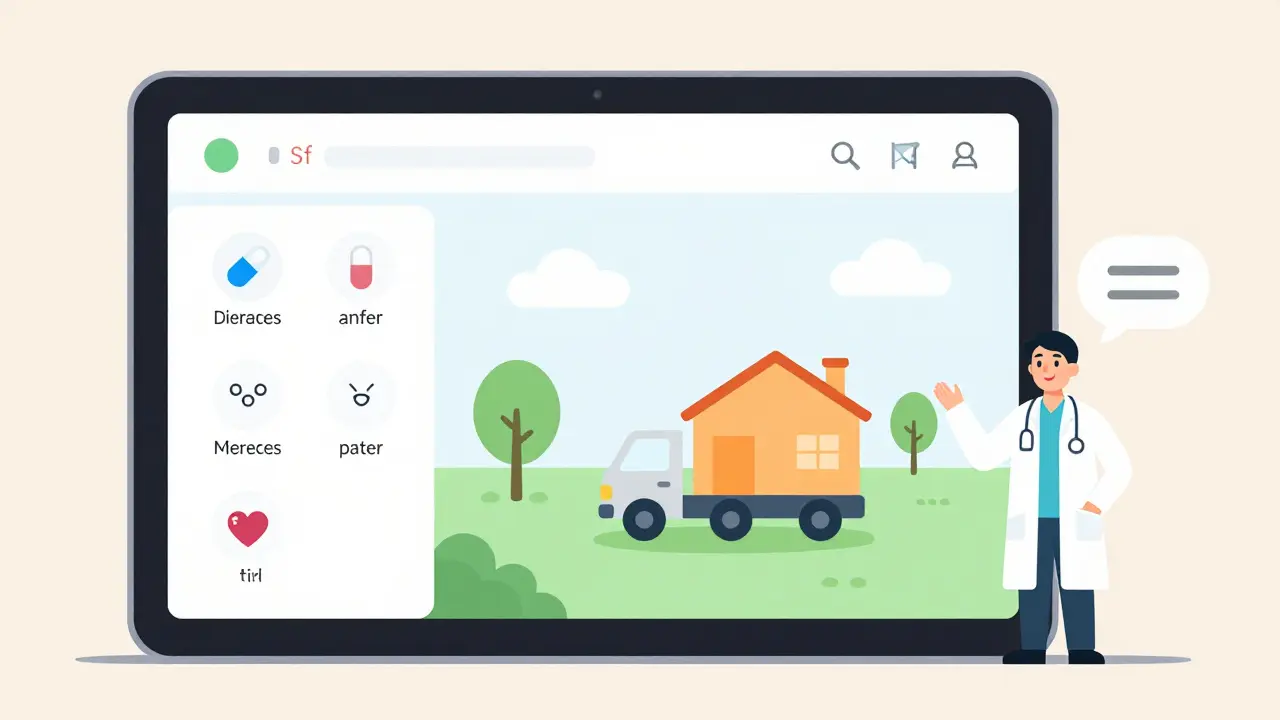
Mail-order pharmacies aren’t some shady online store. They’re licensed, regulated, and connected to your insurance. Companies like Express Scripts, CVS Caremark, and OptumRx handle most of these services in the U.S., and many health plans include them at no extra cost. You don’t need to switch insurers-you just need to opt in.
Here’s how it works in practice:
- You or your doctor sends your prescription to the mail-order pharmacy (usually through your insurer’s portal or by phone).
- You get a 90-day supply instead of 30 days.
- The pharmacy packages your meds in individual blister packs or bottles with clear labels.
- They ship them to your home, often with temperature-controlled packaging if needed.
- You get a reminder when it’s time to reorder.
Most services let you order online, by phone, or through an app. Some even offer 24/7 pharmacist access if you have questions about side effects or interactions. No need to wait until Monday morning to call your doctor’s office.
Why It Saves Money
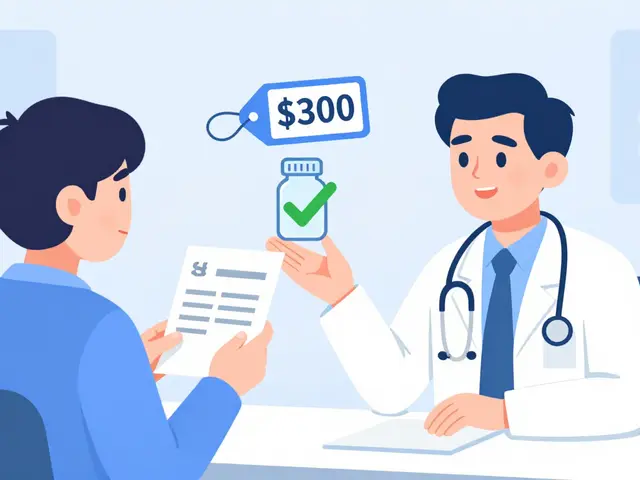
Let’s say you take a brand-name cholesterol pill that costs $120 for a 30-day supply at your local pharmacy. That’s $360 a year. But with mail-order, you pay the same price for a 90-day supply-usually the equivalent of two copays. So instead of $360, you pay $180. That’s $180 saved per year, just by switching delivery methods.
On average, patients save 25-35% on maintenance meds using mail-order. For people on multiple prescriptions, that adds up fast. One study found people on chronic medications save $150-$300 a year just by switching to a 90-day supply through mail-order. And if you’re on Medicare, you’re especially likely to benefit-42% of Medicare beneficiaries already use these services.
What Medications Can You Get Delivered?
Not every drug can be mailed. Controlled substances like opioids, benzodiazepines, and stimulants are still required to be picked up in person due to federal rules. Same goes for some specialty injectables or medications that need refrigeration beyond what shipping can handle.
But here’s the good news: almost all daily maintenance meds are eligible:
- High blood pressure (lisinopril, amlodipine)
- Diabetes (metformin, glimepiride, insulin pens if approved)
- Cholesterol (atorvastatin, rosuvastatin)
- Thyroid (levothyroxine)
- Antidepressants (sertraline, fluoxetine)
- Heart medications (warfarin, metoprolol)
If you’re unsure, just ask your pharmacist or check your insurance plan’s formulary. Most mail-order providers list eligible medications right on their website.
Delivery Speed and Reliability
Standard delivery takes 3-5 business days. That’s usually fine if you plan ahead. But what if you’re running low? Some services, like Patient Direct Pharmacy, offer next-day delivery for urgent needs-especially useful if you’re traveling or forgot to refill.
Lost or damaged packages? Rare. Industry tracking shows only about 1.2% of shipments have issues. Most companies replace lost meds at no cost. Temperature-sensitive drugs like insulin or biologics come in insulated boxes with cold packs. You’ll know it’s working because the packaging includes a temperature indicator-no guesswork.
Pro tip: Order your refill at least 10 days before you run out. Processing and shipping take time, and holidays can slow things down. Don’t wait until you’re down to your last pill.
When Not to Use Mail-Order
Mail-order is great for stable, long-term meds. But it’s not for everything.
Don’t use it for:
- Antibiotics-you need them right away, not in 4 days.
- New prescriptions-your doctor or local pharmacist should review the first dose.
- Medications that require counseling-like warfarin or new diabetes drugs.
- Emergency refills-like an EpiPen or nitroglycerin.
Keep a small supply of these at your local pharmacy. It’s smart backup. Many people use both: mail-order for their daily pills, and a local pharmacy for urgent or new meds.
Real People, Real Results
One Reddit user with multiple sclerosis wrote: “Mail-order has been life-changing. I get my disease-modifying drugs delivered without struggling to get to the pharmacy.”
Another, on Trustpilot, said: “Next-day delivery saved me when I was recovering from surgery. The pharmacists even called to check if I had any questions.”
At the University of Michigan, patients using the Birdi mail-order service report high satisfaction with fast delivery, low copays, and helpful staff. These aren’t marketing claims-they’re real experiences from people managing chronic illness, mobility issues, or busy schedules.
How to Get Started
Ready to try it? Here’s your simple 3-step plan:
- Check your insurance-Log into your plan’s website or call member services. Ask: “Do you offer mail-order pharmacy? Is it free?” Most do, and it’s included in your premium.
- Transfer your prescriptions-You can do this online or call the mail-order pharmacy. They’ll handle contacting your doctor and your current pharmacy. Takes 3-5 days.
- Set up reminders-Turn on text or email alerts for refill dates. Some services even sync all your meds to arrive on the same day.
Most plans let you switch anytime. No penalty. No paperwork. Just a few clicks.
What to Watch Out For
It’s not perfect. Some users report delays during holiday seasons. A few mention trouble changing doses mid-cycle-like if your doctor increases your dosage suddenly. That’s why it’s smart to keep your local pharmacy as a backup for adjustments.
Also, make sure your address is up to date. A wrong zip code can delay delivery by days. And if you’re on a fixed income, check if your plan offers discounts for low-income patients. Some mail-order pharmacies have financial aid programs.
The Bigger Picture
Mail-order pharmacy isn’t just about saving time. It’s about saving lives. The U.S. spends billions each year treating preventable hospitalizations caused by people missing their meds. Mail-order cuts that risk. The industry is projected to grow to nearly $190 billion by 2028-not because it’s trendy, but because it works.
Companies are even testing drone delivery in rural areas and using AI to predict when someone might miss a dose. That’s the future-and it’s already here for millions.
If you’re on daily meds, especially for a chronic condition, switching to mail-order is one of the easiest health upgrades you can make. No new gadgets. No complicated apps. Just your medicine showing up at your door, on time, every time.
Try it. Your future self will thank you.
Can I use mail-order pharmacy if I’m on Medicare?
Yes, Medicare Part D plans almost always include mail-order pharmacy options, often with lower copays for 90-day supplies. About 42% of Medicare beneficiaries already use this service. Check your plan’s formulary or call member services to enroll.
Are mail-order pharmacies safe?
Absolutely. Mail-order pharmacies are licensed and regulated like retail pharmacies. They use computer-controlled systems and robotic dispensing, which makes them 23 times more accurate than traditional pharmacies. All prescriptions are handled under HIPAA-compliant security standards.
Can I get my insulin delivered?
Yes, if your insulin is stable and prescribed for regular use. Mail-order pharmacies ship insulin in insulated, temperature-controlled packaging with cold packs and indicators to ensure it stays safe during transit. Always confirm with your provider and pharmacy that your specific insulin type is eligible.
What if I need to change my dose?
If your doctor changes your dosage, contact your mail-order pharmacy right away. They can usually pause your next shipment and send a new prescription. For urgent changes, it’s best to pick up the new dose at your local pharmacy first, then resume mail-order after the adjustment.
Do I need a special account to use mail-order?
No. Most mail-order services are linked to your insurance plan. You’ll create a simple online account to track orders and refills, but you don’t need to sign up for a new service. Your insurer will give you the login details once you enroll.
Can I use mail-order if I don’t have insurance?
Yes. Some mail-order pharmacies, like Patient Direct Pharmacy, offer cash pricing that’s often lower than retail. You can also compare prices on sites like GoodRx and order directly. Just make sure the pharmacy is licensed and ships to your state.
How do I know if my meds are eligible for mail-order?
Check your insurance plan’s formulary or ask your pharmacist. Generally, any daily medication for a chronic condition-like high blood pressure, diabetes, or cholesterol-is eligible. Controlled substances, antibiotics, and emergency meds are not.

Sumler Luu
December 24, 2025 AT 21:57Just switched to mail-order for my blood pressure meds last month. No more rushing to the pharmacy after work, especially when it’s pouring rain. My copay’s half what it used to be too. Honestly? It’s the smallest change with the biggest impact on my daily life.
sakshi nagpal
December 25, 2025 AT 18:50This is such an important topic, especially in countries where access to healthcare is inconsistent. The fact that mail-order reduces medication non-adherence by nearly 30% is not just convenient-it’s a public health win. More people need to know this isn’t a luxury, it’s a necessity for chronic care.
Fabio Raphael
December 26, 2025 AT 03:00I never thought about how much easier this would make things until my mom started using it for her diabetes meds. She’s 72, lives alone, and used to miss doses because she couldn’t get out. Now she gets her 90-day supply delivered with ice packs for the insulin. She says it’s the first time in years she’s felt like someone’s actually looking out for her.
Amy Lesleighter (Wales)
December 27, 2025 AT 19:42my dr just told me to switch to mail order and i was like ugh fine but wow its been a game changer. no more forgetting refills, they text me when its time, and i got my thyroid med for 12 bucks a month instead of 45. also the blister packs are so nice. no more dumping pills into a container. just grab and go. also i think i saved like 200 this year??
Becky Baker
December 28, 2025 AT 02:29Why are we even talking about this like it’s some revolutionary idea? This is basic. If you’re on daily meds and you’re not using mail-order, you’re literally throwing money away and risking your health. It’s not ‘convenient’-it’s common sense. Get with the program.
Rajni Jain
December 28, 2025 AT 15:19i used to be scared to try mail-order cause i thought it was sketchy but nooo it’s super legit. my aunt in india uses it too for her heart meds and she loves it. they even called her to check if she was doing okay. honestly if you’re on meds long term, this is like having a pharmacy friend who never sleeps.
Sophia Daniels
December 30, 2025 AT 00:25OMG I just found out my insurance has been hiding this from me for 7 years. SEVEN YEARS. I’ve been paying $400 a year extra because I was too lazy to click a button? I’m crying. Not because I’m emotional-because I’m furious. Someone needs to get fired at my insurer. Also, why isn’t this on every billboard? This is the dumbest healthcare failure ever.
Nikki Brown
December 30, 2025 AT 10:05You people are so naive. Mail-order? Please. What happens when your meds get lost? What if the packaging fails and your insulin spoils? You’re trusting your life to a warehouse worker who’s probably on break. And don’t get me started on the data privacy issues. You think your prescription history is safe? 😏
Peter sullen
January 1, 2026 AT 08:43It is imperative to note, with empirical rigor, that the implementation of mail-order pharmacy services represents a paradigmatic shift in pharmaceutical adherence metrics. The statistically significant reduction in non-compliance (p < 0.001) is corroborated by longitudinal cohort analyses from the Journal of Managed Care & Specialty Pharmacy. Furthermore, the cost-efficiency differential-exhibiting a mean savings of 29.4%-is both clinically and economically compelling.
Steven Destiny
January 3, 2026 AT 06:53STOP WASTING TIME. If you’re still driving to the pharmacy for your 90-day meds, you’re doing it wrong. I switched three years ago and haven’t missed a dose since. I don’t care if you’re ‘not tech-savvy’-you can call a number. It’s not hard. Your health is not a suggestion. Do it.
Natasha Sandra
January 4, 2026 AT 18:56Just got my insulin delivered yesterday!! 🥹📦 The box had a little note from the pharmacist saying ‘hope you’re having a good week!’ I cried. Like, actual tears. This is the kind of care we need more of. Also, my copay was $5. 😭❤️
Erwin Asilom
January 6, 2026 AT 11:55One thing people overlook: mail-order pharmacies often have pharmacists on staff who review all your meds for interactions. I had three prescriptions that shouldn’t have been taken together. They caught it before I even knew. That’s not convenience-that’s prevention.