
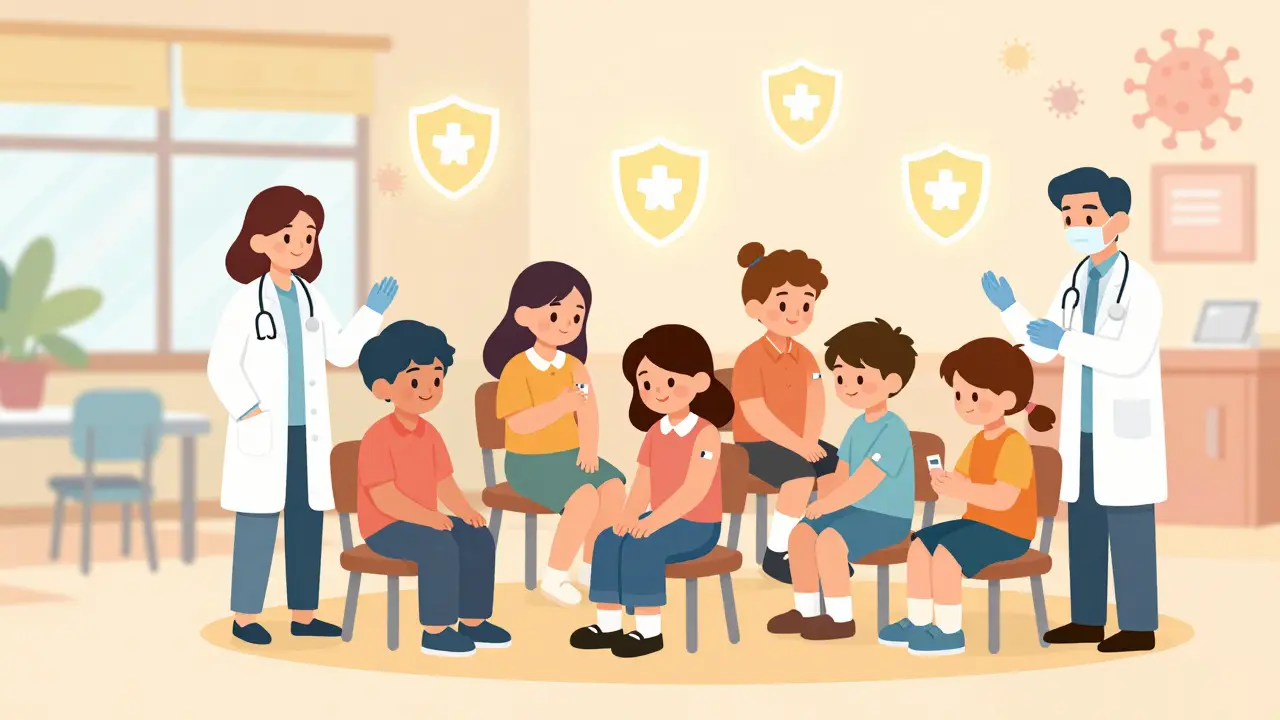
Human papillomavirus, or HPV, isn’t just a common STI. It’s the leading cause of cervical cancer-and several other cancers too. About 80% of sexually active people will get at least one type of HPV in their lifetime. Most infections clear on their own. But when certain high-risk types stick around, they can silently turn normal cells into precancerous ones. Left unchecked, that can lead to cancer-sometimes over 10 or even 20 years. The good news? We now have powerful tools to stop it before it starts: vaccines, smarter screening, and better access to care.
How HPV Leads to Cancer
There are more than 200 types of HPV. Only about a dozen are high-risk, and among them, HPV 16 and 18 cause about 70% of all cervical cancers. These viruses don’t just infect the cervix-they can also lead to cancers of the anus, throat, penis, vagina, and vulva. The problem isn’t the infection itself. It’s what happens when the virus sticks around long enough to damage DNA in cells. That damage doesn’t happen overnight. It builds slowly, over years. That’s why screening and early detection are so critical.
Before HPV vaccines existed, the Pap test was the only tool we had. It looked for abnormal cell changes under a microscope. But it wasn’t perfect. Many early lesions were missed. That’s why, in recent years, the focus has shifted to testing for the virus itself-before cells even start changing.
The HPV Vaccine: What It Does and Who Needs It
The first HPV vaccine, Gardasil, was approved in 2006. Today, the most widely used version is Gardasil 9. It protects against nine types of HPV, including the two most dangerous (16 and 18) and five others that cause about 20% of additional cancers. The vaccine doesn’t treat existing infections. It prevents them. That’s why timing matters.
The CDC and American Academy of Pediatrics recommend routine vaccination for all children at age 11 or 12. That’s when the immune response is strongest. But it’s still effective if given as early as age 9, and up to age 26 for most people. Adults up to age 45 can also get it-especially if they haven’t been fully vaccinated before. The vaccine cuts the risk of cervical precancers by nearly 90% in people who were vaccinated before exposure.
It’s not just for girls. Boys benefit too. HPV causes throat and anal cancers in men, and vaccinating them helps reduce spread. Studies show that countries with high vaccination rates-like Australia and the UK-have already seen sharp drops in genital warts and precancerous lesions in young women. The vaccine isn’t magic. But when given widely, it changes the curve.
Screening Has Changed-Here’s What You Need to Know
Screening guidelines shifted dramatically after 2020. The old rule-Pap tests every 3 years starting at 21-is outdated. Today, the best approach depends on your age.
- Ages 21-29: Pap test every 3 years. HPV testing isn’t recommended here because infections are common and usually clear on their own. Too much testing can lead to unnecessary procedures.
- Ages 30-65: You have three good options: primary HPV testing every 5 years (the preferred method), Pap test every 3 years, or both tests together (cotesting) every 5 years. Primary HPV testing is more accurate at finding precancers than Pap alone.
- Ages 25-29: The American Cancer Society now recommends primary HPV testing every 5 years as the best option. Other groups still say Pap is fine, but the trend is clear: testing for the virus is better than looking for cell changes after they happen.
Primary HPV testing means looking directly for the DNA or RNA of high-risk HPV types. Two FDA-approved tests are used in the U.S.: the cobas HPV Test by Roche and the Aptima HPV Assay by Hologic. Both detect 14 high-risk types. The cobas test even separates HPV 16 and 18 from the rest, which helps doctors decide how urgently to follow up.
Why does this matter? A 2018 JAMA study found HPV testing catches 94.6% of serious precancers, while Pap tests alone catch only 55.4%. That’s a huge difference. The downside? HPV tests find more positive results, meaning more follow-up visits. But long-term, fewer people develop cancer.
Self-Collected HPV Tests: A Game Changer
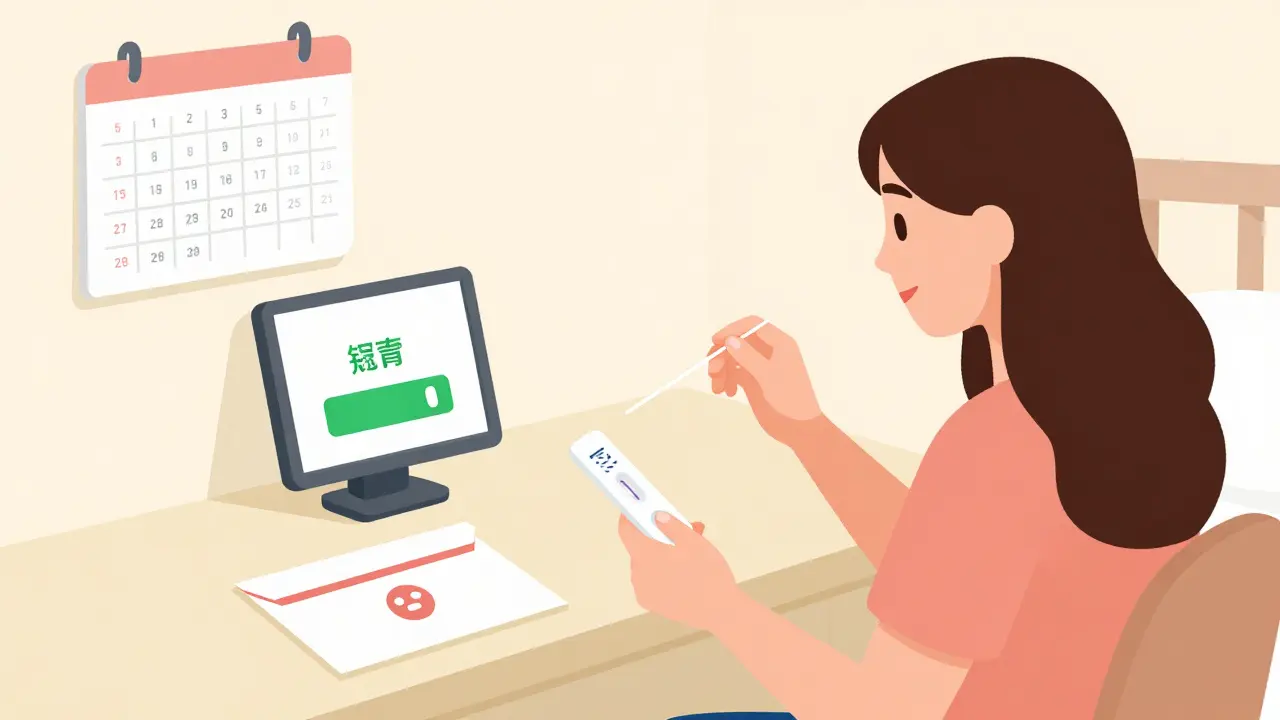
One of the biggest barriers to screening? Getting to a clinic. Many women skip screening because of discomfort, cost, transportation, or fear. Self-collected HPV tests change that. You can swab your own vagina at home-just like a COVID test-and mail it in. Studies show it’s almost as accurate as a doctor-collected sample.
In January 2024, Kaiser Permanente officially added self-collected HPV testing to its guidelines for average-risk patients aged 30-64. Their data showed 84.4% sensitivity and 90.7% specificity-close to clinician-collected results. In Australia and the Netherlands, offering self-sampling boosted screening rates by 30-40% among women who hadn’t been screened in years.
The USPSTF now says self-collection should be an option. It’s not just convenient-it’s life-saving. About 30% of cervical cancers happen in women who’ve never been screened. Self-collection could fix that.
What Happens If Your Test Is Positive?
A positive HPV test doesn’t mean you have cancer. It means you have the virus. Most people clear it. But if you’re positive, especially with HPV 16 or 18, you’ll need follow-up.
Standard protocol: If you test positive for HPV 16 or 18, you’re referred for a colposcopy-a closer look at the cervix with a magnifying tool. If you’re positive for other high-risk types, you’ll usually get a Pap test at the same time. If the Pap is abnormal, you go to colposcopy. If it’s normal, you’ll be retested in a year.
This step-by-step approach avoids over-treatment. Not every infection needs surgery. The goal is to catch real precancer, not every virus.
Why Vaccinated People Still Need Screening
A common myth: “If I got the vaccine, I don’t need Pap tests anymore.” That’s false. The vaccine doesn’t cover all high-risk HPV types. It prevents about 90% of cervical cancers-but not all. Plus, not everyone gets the full series, and some people were vaccinated after exposure.
The CDC is clear: vaccinated people should be screened the same as unvaccinated people. Skipping screening because you’re vaccinated puts you at risk. Vaccination is your first line of defense. Screening is your second.
The Global Picture: Progress and Gaps
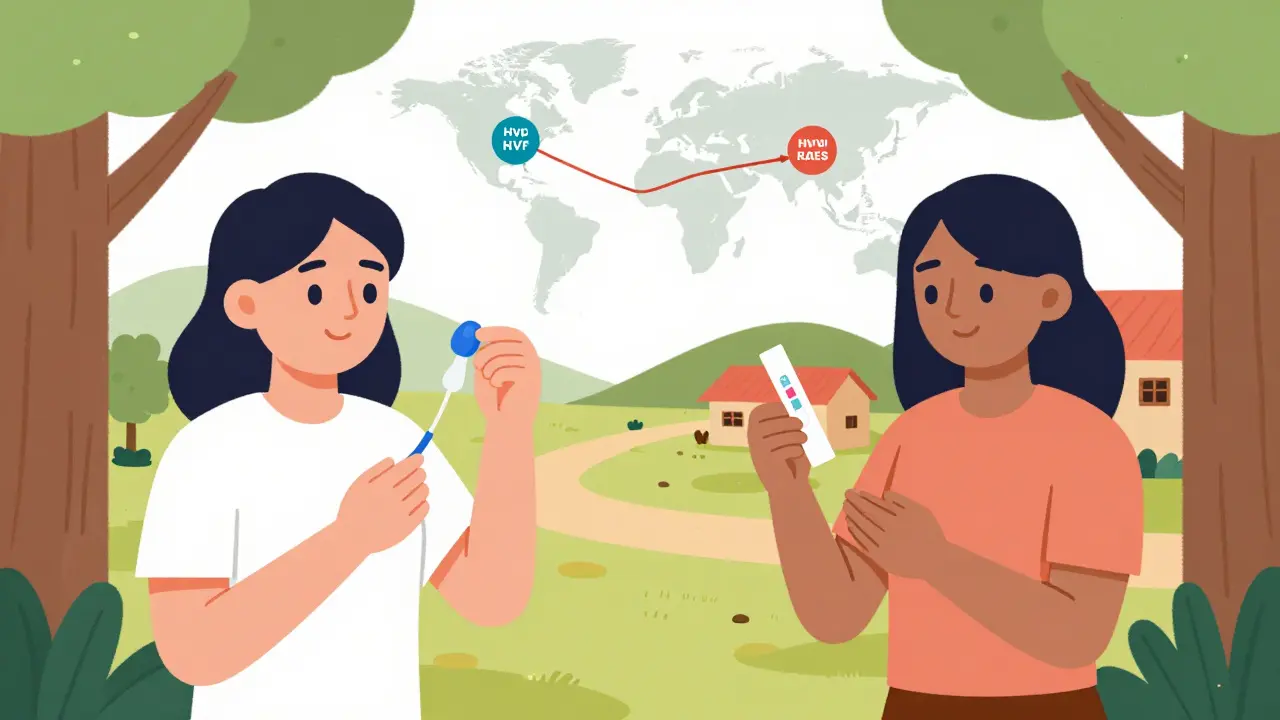
The World Health Organization set a bold goal in 2020: eliminate cervical cancer by 2050. To get there, countries need to hit three targets by 2030: 90% of girls vaccinated by 15, 70% of women screened by 35 and again by 45, and 90% of precancers and cancers treated.
High-income countries are making progress. In the U.S., cervical cancer rates dropped 50% since the 1970s thanks to screening. But disparities remain. Black women die from cervical cancer at 70% higher rates than White women. In low-income countries, only 19% of women have ever been screened. That’s why tools like self-collection and low-cost HPV tests are so vital.
The global HPV testing market is growing fast-projected to hit $2 billion by 2029. But money alone won’t fix this. Access, education, and trust matter more. In places where women can test themselves at home, screening rates climb. That’s the future.
What’s Next? AI, Longer Intervals, and Better Tools
Technology is catching up. In January 2023, the FDA approved Paige.AI, an AI system that helps pathologists read Pap smears faster and more accurately. Early results show it reduces missed diagnoses.
Research also suggests that after two or three negative HPV tests, screening every 6 years may be safe. A 2023 AACR study found that women with two negative HPV tests had a cancer risk of just 2.3 per 1,000 over six years-lower than the risk after one negative Pap test.
By 2025, experts predict primary HPV testing will be the standard in high-resource settings. That means fewer Pap tests, fewer false alarms, and fewer cancers.
What You Can Do Right Now
- If you’re 9-26: Get the HPV vaccine if you haven’t already.
- If you’re 25-65: Ask your provider about primary HPV testing. It’s now the most effective screening method.
- If you’re nervous about pelvic exams: Ask if self-collected HPV testing is available. It’s safe, private, and just as accurate.
- If you’re over 65: Talk to your doctor. You may still need screening if you’ve never been tested or have a history of precancer.
- If you’ve had a hysterectomy: You likely don’t need screening unless it was for cervical cancer or precancer.
HPV isn’t going away. But cancer from HPV? That’s preventable. The science is clear. The tools exist. What’s missing is action-by individuals, clinics, and systems. Start with the vaccine. Stay on schedule with screening. And don’t let fear or stigma keep you from the care that saves lives.
Is the HPV vaccine safe?
Yes. Over 135 million doses have been given worldwide since 2006. The most common side effects are mild-soreness at the injection site, dizziness, or headache. Serious reactions are extremely rare. Studies tracking vaccinated people for over a decade show no long-term health risks. The benefits far outweigh any risks.
Can I get HPV even if I’m monogamous?
Yes. HPV can stay dormant for years. Someone could have had the virus decades ago, passed it on, and neither person knew. Even in long-term relationships, if one partner was exposed before the relationship, transmission is possible. That’s why vaccination before exposure is key.
Do I need HPV screening if I’ve had the vaccine?
Yes. The HPV vaccine doesn’t protect against all cancer-causing types. It covers the most common ones-but not every one. Screening catches the rest. Also, if you were already exposed to HPV before vaccination, the vaccine won’t clear it. Screening remains essential.
What if I’m over 45 and never got the vaccine?
You can still get the vaccine up to age 45. It’s less effective if you’ve already been exposed to HPV, but it may still protect against types you haven’t encountered. Talk to your provider. Even if you don’t get the vaccine, regular screening is critical. Cervical cancer risk doesn’t disappear after 45.
Why is HPV testing every 5 years safe?
Because HPV infections that lead to cancer take years to develop. A negative HPV test means you’re very unlikely to develop precancer in the next 5 years. Studies show the risk of serious lesions after a negative HPV test is lower than after a negative Pap test. That’s why experts now say 5-year intervals are safer than 3-year Pap tests.
HPV doesn’t have to mean cancer. With the right steps-vaccination, smart screening, and access to care-it can be stopped before it starts.

lawanna major
March 17, 2026 AT 12:58It’s wild to think that something so common could be stopped so effectively. The HPV vaccine is one of those rare medical wins where prevention is almost 100% reliable if given early. I’ve seen friends delay it thinking, 'I’m monogamous,' or 'It’s not that big of a deal.' But the science doesn’t care about your relationship status. It only cares about exposure. And once you’re exposed, the damage can linger silently for decades. That’s why I tell every teenager I know: get the shot. No excuses. It’s not just about cervical cancer-it’s about throat, anal, penile. It’s about protecting your future self from pain you didn’t even know was coming.
And screening? It’s not outdated. It’s evolved. Primary HPV testing is smarter than Pap smears ever were. It’s like having a smoke detector that goes off before the fire starts. Why wait for the burn when you can see the spark?
Alexander Pitt
March 17, 2026 AT 19:33The data is clear: HPV vaccination before sexual debut reduces precancerous lesions by nearly 90%. That’s not a suggestion-it’s a public health milestone. The fact that we’ve gone from Pap smears catching 55% of lesions to HPV testing catching 95% in under two decades is a triumph of evidence-based medicine. What’s more, the vaccine has cut genital warts by over 80% in countries with high uptake. This isn’t theoretical. It’s happening. Australia is on track to eliminate cervical cancer by 2035. We can do the same here-if we stop treating this like a moral issue and start treating it like a medical one.
Ryan Voeltner
March 19, 2026 AT 09:43It is important to recognize that the tools exist and the science is settled. The challenge now lies not in knowledge but in access. Many women in rural areas still cannot get a test. Many young people are not offered the vaccine in school clinics. This is not a failure of biology. It is a failure of systems. We have the means. We need the will. And we need to stop letting stigma or bureaucracy delay what should be routine care. A simple swab. A single shot. These are not luxuries. They are rights.
Linda Olsson
March 20, 2026 AT 12:02Oh great. Another vaccine push. Let me guess-Big Pharma is behind this. They’ve been pushing HPV since 2006. And now they’re telling us to test ourselves at home? That’s just a way to make us pay for more tests. I read somewhere that the vaccine causes autoimmune disorders. And don’t get me started on the fact that the FDA approved AI to read Pap smears. Who’s really reading them? A machine? What’s next? Robots delivering babies? This isn’t prevention. It’s control. And self-collection? Sounds like a way to cut corners on doctor visits. I’m not falling for it.
cara s
March 21, 2026 AT 20:20so like… i know this sounds crazy but i got the hpv shot when i was 14 and then i got pregnant at 19 and i had a c-section and then i forgot to get screened for like 5 years because i was like ‘i’m vaccinated so i’m fine’ and then i got this weird pap result and it turned out i had a precancerous lesion? like… i had no symptoms. zero. and i was so scared. i thought i was going to die. and then i found out i had HPV 18. and the vaccine didn’t cover it. so yeah. i’m not mad. i’m just saying. the vaccine is not a magic bullet. you still have to get screened. and if you’re over 25 and never got tested? go. just go. even if you think you’re ‘safe.’ because trust me. you’re not. and i’m not even mad. i’m just sharing. because i didn’t know. and i almost paid the price.
Amadi Kenneth
March 23, 2026 AT 06:45Shameer Ahammad
March 23, 2026 AT 21:19It is a well-established fact that the HPV vaccine has been subjected to extensive clinical trials involving over 135 million individuals worldwide. The safety profile is impeccable. To suggest otherwise is not only scientifically unsound but also morally irresponsible. Furthermore, the notion that screening is unnecessary for vaccinated individuals is a dangerous misconception. The vaccine covers 90% of oncogenic strains-but not all. One must understand that medical science is not binary. It is probabilistic. To neglect screening is to gamble with one’s life. The data is not ambiguous. The guidelines are not suggestions. They are protocols grounded in longitudinal epidemiological evidence. If one chooses to ignore them, one does so at one’s own peril.
jared baker
March 24, 2026 AT 12:15Just get the shot. Get tested. Don’t overthink it. It’s not that complicated. You don’t need to be a doctor to understand this. HPV is everywhere. The vaccine works. The test works. If you’re scared of the exam, ask for a self-test. It’s just a swab. You do it in your bathroom. No one’s watching. No one’s judging. It’s not a big deal. But skipping it? That’s the big deal. Don’t wait until it’s too late. Your future self will thank you.
Gaurav Kumar
March 25, 2026 AT 21:41Jeremy Van Veelen
March 26, 2026 AT 06:43Let me be clear: this is the most important public health breakthrough since penicillin. We are talking about a virus that silently rewires your cells for years-until it turns into cancer. And we have a tool that stops it cold. A shot. A swab. That’s it. No chemo. No surgery. No mourning. Just prevention. And yet, people still refuse. They wait. They ignore. They say ‘I’m fine.’ Until they’re not. I’ve sat with women who lost their cervixes. Their fertility. Their lives. All because they didn’t get the shot. Or they didn’t go for the test. This isn’t a ‘choice.’ It’s a moral imperative. If you’re reading this and you haven’t acted yet? Do it today. Before it’s too late. I’m not begging. I’m warning.
Laura Gabel
March 27, 2026 AT 05:22jerome Reverdy
March 29, 2026 AT 01:40What’s fascinating is how this mirrors the broader arc of preventive medicine: shift from reactive to proactive. The Pap smear was the last gasp of the ‘wait-and-see’ model. HPV testing is the first step into the ‘predict-and-prevent’ era. And self-collection? That’s the democratization of care. It removes barriers of geography, gender, trauma, and stigma. The fact that we’re now talking about 6-year screening intervals after two negative tests? That’s not just science-it’s confidence. Confidence in the biology. Confidence in the data. Confidence in the patient. This isn’t just about cervical cancer. It’s about reimagining how we do healthcare. Less intervention. More trust. Less fear. More empowerment.
Andrew Mamone
March 29, 2026 AT 06:28Just got my self-collected HPV test back. Negative. 🎉
Got my vaccine at 13. Still got screened at 28. Still got screened at 34.
Still alive.
Still healthy.
Still not scared.
Still grateful.
Still telling everyone I know to do the same.
It’s not a big deal. But it’s everything.
Do it. ❤️
MALYN RICABLANCA
March 29, 2026 AT 06:45Let me tell you what happened last year. I had a routine HPV test. Positive. For HPV 16. I was terrified. I cried. I googled. I almost quit my job. I told my partner I was ‘contaminated.’ I thought I was going to die. I went to the gynecologist. She said, ‘It’s okay. We catch this early. We watch it. We don’t cut you open.’ I had a colposcopy. No lesions. Just a virus. And I was so relieved. But here’s the thing-I almost didn’t go. Because I thought, ‘I’m vaccinated. I’m fine.’ I was wrong. And now? I’m obsessed. I tell everyone. I post on Instagram. I send texts. I call my mom. I tell my sister. I tell my friends who say ‘I don’t need it.’ I scream at them. I don’t care if they think I’m dramatic. I’m not dramatic. I’m alive. And if I can save one person from the panic I went through? Then I’ve done my job. So if you’re reading this and you’re not sure? Go. Get tested. Get the shot. Don’t wait. Don’t rationalize. Don’t listen to the noise. Just do it. Because your body doesn’t care about your fears. It only cares about your action.