

When you look at the prescription information for a medication, you might spot a bold-bordered box near the top. It looks stark against the white page, often containing serious alerts. This is what we call a Boxed Warning, also known as a black box warning. It represents the strongest safety signal the U.S. Food and Drug Administration (FDA) can place on a drug. These warnings aren't static; they evolve. Sometimes a word changes, sometimes the scope expands to new populations. Understanding these shifts helps anyone-from a pharmacist to a patient-grasp exactly how safe a drug really is right now compared to when it first hit the market.
The story behind these labels is actually a continuous conversation between regulators and reality. When a drug gets approved, it usually hasn't been tested on millions of people yet. We rely on clinical trials, but once the drug is in hands across the country, the real picture emerges. If patients start reporting severe issues, the agency steps in to update the label. As of 2026, we know these updates happen roughly 25 to 30 times a year. That is a high volume for such critical alerts, meaning staying current matters.
The Mechanics of Label Evolution
Why does a warning change? Usually, it comes down to new data. In the early days of a drug, a manufacturer knows the common side effects. But rare events take years to surface. This process is called post-marketing surveillance. Think of it as keeping watch over a drug after it leaves the lab. For decades, the median time from a drug’s approval to its first boxed warning was seven years. By 2009, that stretched to eleven years. Why the delay? Often, it takes longer to confirm a link between the medicine and a specific harm.
We see a clear shift in specificity over the last twenty years. Back in the 1980s and 1990s, these warnings were often broad statements like "risk of liver damage." Today, they look very different. They might specify the exact rate of occurrence or list precise symptoms to watch for. Take the antipsychotic Clozaril (clozapine). A major update covered in mid-2025 highlighted a risk of myocarditis with a specific statistic: 0.84 cases per 1,000 patient-years. That number gives a doctor concrete math to work with, rather than just a vague fear. Another example involves Unituxin. In 2017, the label changed the term "neuropathy" to "neurotoxicity." To the average person, these sound similar. To a specialist, it marks a significant distinction in how the drug damages nerves versus broader nerve function loss.
Tracing the History of Specific Drugs
Some stories illustrate just how dynamic these labels are. You cannot fully trust your memory from five years ago because the rules may have shifted entirely. Let's look at Avandia (rosiglitazone). Back in November 2007, it received a warning regarding heart failure risks. Years later, Europe pulled the drug, though it stayed in the U.S. with strict restrictions. Contrast that with Chantix (varenicline). It got a warning in 2009 about depression and suicidal thoughts. However, updated evidence in 2016 involving over 8,000 participants showed no significant difference compared to placebo. Consequently, the FDA removed the warning in 2016. The box disappeared. If you checked the file in 2011, you saw a danger. In 2017, that danger was gone.
| Drug Name | Original Issue Date | Warning Focus | Status Change |
|---|---|---|---|
| Avandia (rosiglitazone) | Nov 2007 | Heart Failure/Risk of Heart Attack | Maintained in US with restrictions |
| Chantix (varenicline) | July 2009 | Depression/Suicidal Thoughts | Removed in 2016 |
| Unituxin (dinutuximab) | Updated 2017 | Neurotoxicity | Terminology refined from neuropathy |
| Clozaril (clozapine) | Updated 2025 | Myocarditis Risk | New incidence statistics added |
This table shows you that stability isn't guaranteed. A drug might lose a warning, gain one, or get a stricter definition of the problem. The key takeaway is that you must check the date on the prescribing information. Relying on old files means relying on potentially outdated safety advice.
Where to Find the Latest Updates
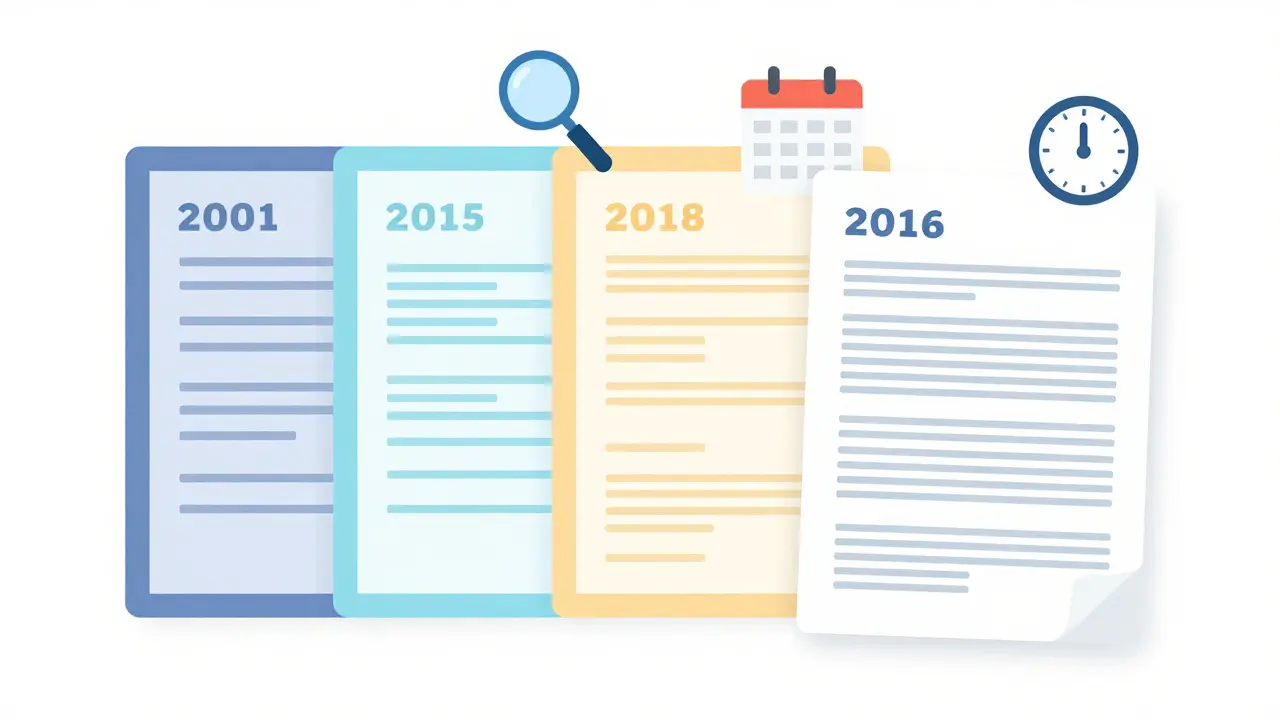
You probably shouldn't rely on just checking the physical pill bottle leaflet alone. That version could be lagging by months. To find the definitive record, you need to access government resources directly. The FDA maintains a database specifically for this called the Drug Safety-related Labeling Changes (SrLC) database. It covers changes going back to January 2016. If you go to their website and search this tool, you can download updates quarterly. As of early 2026, the database includes reports from late 2025 showing revisions to nearly two dozen medications.
For older history, before 2016, the MedWatch archive is your source. It acts as a library for medical product safety information. If you are researching a drug approved in 2005, you won't find its early warnings in the new SrLC portal. You have to cross-reference both systems. Many healthcare professionals subscribe to newsletters from journals like the American Journal of Health-System Pharmacy. They publish summaries every quarter detailing the changes. In the second quarter of 2025 alone, they documented seventeen specific boxed warning updates. Knowing these sources saves hours of searching.
Reading Between the Lines
Even when you have the document, reading it requires care. Manufacturers try to comply with FDA formatting requirements, but sometimes the language gets complex. You should look for the term "Risk Evaluation and Mitigation Strategies" (REMS). When a warning appears, it sometimes forces a REMS program. This means the drug can only be prescribed under specific conditions, like mandatory blood tests. The warning itself tells you *what* the risk is. The REMS tells you *how* to manage it. For instance, with Clozaril, the warning highlights agranulocytosis (a drop in white blood cells). The practical requirement is regular blood testing. If you miss the connection between the warning and the testing protocol, you miss the safety net.
Avoid getting lost in "warning fatigue." Clinicians often receive dozens of these alerts. Studies show that about 61% of these warnings result in actual changes to how doctors prescribe. That leaves 40% where the behavior stays the same. Why? Because sometimes the warning seems less actionable than others. A warning about a rare event that happens once in ten thousand patients might not change how you treat a patient compared to a warning about a common issue like dizziness. However, ignoring the alert because it feels minor can be dangerous. Always verify if the warning triggers a contraindication (a reason not to use the drug) rather than just a precaution.

The Human Element in Safety Signals
Surveillance relies heavily on people. If patients do not report problems, the box might never change. The FDA’s MedWatch program receives about 1.2 million reports annually. A large portion comes from healthcare providers, but patients contribute too. Consider the antidepressant warning from 2004. Originally, it focused on children and adolescents. By May 2006, data showed young adults aged 18-24 were also at risk. The label expanded because more reports came in linking the age group to suicidality. This proves that vigilance drives the label evolution.
Despite the importance, confusion remains widespread. Surveys from physician networks indicate that nearly 70% of doctors experience some confusion about when exactly to apply specific criteria in a warning. Specialists generally handle this better than general practitioners, likely due to seeing the specific conditions more often. This gap suggests that understanding the label is a skill that improves with training. For patients, it reinforces why you ask questions. Does this warning apply to my age? Do I have the other conditions listed?
Looking Ahead to 2030
The landscape is shifting toward faster updates. The FDA’s modernization efforts suggest that by 2030, about 40% of marketed drugs might carry a boxed warning, up from 32% in 2020. New laws like the Modernization Act 2.0 mandate collecting "real-world evidence" much sooner. Instead of waiting for a decade-long trend to emerge, electronic health records might flag risks in weeks. Imagine a scenario where a safety signal is detected, verified, and sent to your doctor's computer system automatically. Pilot programs in 2025 are already testing "dynamic warning systems." They aim to cut the 18-month lag between finding a safety issue and updating the official paper label. While we still rely on the printed documents today, the future points toward digital integration where the warning lives inside the doctor's electronic decision support tool.
Can a drug lose a boxed warning over time?
Yes, absolutely. If new data proves the risk was overstated or does not exist, the FDA can remove it. For example, the warning regarding suicidal thoughts for the drug Chantix was removed in 2016 after larger studies showed no higher risk than placebo.
How often does the FDA update these safety labels?
Updates happen frequently. Historically, the average time from approval to a new warning was around 7 to 11 years, but recent years see 25 to 30 new warnings issued annually. Additionally, small wording adjustments or clarifications occur even more often within existing warnings.
What is the difference between a warning and a contraindication?
A boxed warning advises caution regarding serious risks. A contraindication explicitly states the drug must not be used in certain situations. A boxed warning implies you can use it if the benefits outweigh the risks, whereas a contraindication means you generally should not use it at all for that patient.
Where can I find the history of a specific drug's label changes?
You can check the FDA's Drug Safety-related Labeling Changes (SrLC) database for updates since January 2016. For older changes prior to 2016, the MedWatch Medical Product Safety Information archive provides the necessary historical data.
Do all boxed warnings require extra testing or monitoring?
Not always, but many do trigger Risk Evaluation and Mitigation Strategies (REMS). For example, clozapine requires mandatory blood monitoring because of the boxed warning for low white blood cell counts, ensuring patients are screened for the specific danger described in the warning.

Dan Stoof
March 31, 2026 AT 21:22This information is incredibly vital!! Everyone should pay close attention;;; the changes matter so much more than people think!! The safety of patients depends on keeping up!
Ruth Wambui
April 2, 2026 AT 16:57It feels like the corporations hold the keys to our safety. We trust them blindly while they tweak the labels behind closed doors. The statistics look good on paper but reality is messy. They update the text when the lawsuits pile up. Seven years is way too long to wait for a warning. Patients die during those silent years of ignorance. The MedWatch system works but mostly relies on doctors reporting things. Patients rarely file reports unless someone pushes them. Information stays locked away in fancy databases like SrLC. Ordinary people cannot access the raw numbers easily. It creates a gap between the experts and the public. We see warnings vanish from drugs like Chantix. Then later we find risks were actually present. The cycle repeats itself with different medications. Trust becomes impossible when the rules keep changing.
Christopher Curcio
April 2, 2026 AT 17:27The pharmacovigilance landscape shifts constantly due to real-world data inputs. Adverse event reporting drives the risk evaluation strategies we see today. Clinicians face confusion regarding contraindications versus precautions frequently.
Calvin H
April 2, 2026 AT 23:24Nobody actually reads these boring legal texts anyway.
Debbie Fradin
April 3, 2026 AT 19:22Funny how warnings disappear when studies finally clear the name completely. One day you have a boxed warning and the next it is gone because of placebo comparisons. Progress is nice even if it takes a decade to confirm basic facts.
Angel Ahumada
April 4, 2026 AT 05:58most people do not understand the complexity behind label revisions they simply see the box and panic without knowing the difference between neurotoxicity and neuropathy which requires specialized knowledge to truly interpret correctly so casual readers miss the point entirely
William Rhodes
April 4, 2026 AT 10:24We will overcome these challenges through better technology soon enough! The 2030 vision looks promising for digital integration. Waiting is pointless when solutions are coming our way rapidly!
Rick Jackson
April 5, 2026 AT 11:37Accessing the SrLC database is straightforward yet often overlooked by many professionals. The older archives require cross-referencing with MedWatch systems effectively. Quarterly summaries help streamline the process significantly. Staying updated prevents reliance on outdated prescribing files. Knowledge empowers both patients and clinicians alike.