

Heart failure isn’t a single disease-it’s a condition where the heart can’t pump enough blood to meet your body’s needs. And while it sounds scary, modern medicine has made huge progress in treating it. Four types of medications form the backbone of treatment for heart failure with reduced ejection fraction (HFrEF): ACE inhibitors, ARNI, beta blockers, and diuretics. These aren’t just random pills-they’re backed by decades of research, clinical trials, and real-world outcomes that have changed how doctors treat heart failure today.
ACE Inhibitors: The First Big Leap
ACE inhibitors were the first class of drugs proven to save lives in heart failure. The first one, captopril, hit the market in 1981. By the late 1980s, studies like the CONSENSUS trial showed enalapril reduced death rates by 27% in people with severe heart failure. That was a game-changer.How do they work? They block an enzyme that turns angiotensin I into angiotensin II-a chemical that narrows blood vessels and makes the heart work harder. By stopping this, ACE inhibitors lower blood pressure, reduce strain on the heart, and slow down damage to heart muscle.
Common ones include enalapril, lisinopril, and ramipril. Starting doses are low-often just 2.5 mg once or twice a day-and slowly increased over weeks. Target doses? Around 10-20 mg twice daily for enalapril, or 20-40 mg daily for lisinopril.
But they’re not perfect. About 1 in 5 people get a dry, annoying cough. Some develop high potassium levels (hyperkalemia), which can be dangerous if not caught. Rarely, they cause angioedema-a sudden swelling of the face, lips, or throat. If that happens, you stop the drug immediately.
ARNI: The New Gold Standard
In 2015, everything changed with the approval of sacubitril/valsartan-better known by its brand name, Entresto. It’s not just another ACE inhibitor replacement. It’s a combo drug: one part blocks the angiotensin receptor (like an ARB), and the other part blocks neprilysin, an enzyme that breaks down helpful heart-protective hormones called natriuretic peptides.Those peptides help your body get rid of extra salt and water, relax blood vessels, and reduce heart stress. So ARNI does two things at once: it blocks a harmful system (RAAS) and boosts a helpful one (natriuretic peptides).
The PARADIGM-HF trial, which followed nearly 8,400 people across 47 countries, showed ARNI reduced cardiovascular death by 20% and heart failure hospitalizations by 21% compared to enalapril. That’s bigger than any previous advance in heart failure treatment.
Today, guidelines say ARNI should be the first choice for most people with HFrEF-unless they can’t tolerate it. But there’s a catch: you can’t switch from an ACE inhibitor to ARNI within 36 hours. The risk of angioedema spikes. You need a washout period.
Starting dose is 24/26 mg twice daily. It’s doubled every 2-4 weeks until you hit the target: 97/103 mg twice daily. Blood pressure must stay above 100 mmHg systolic. If you’re dizzy or lightheaded, your doctor might slow down the increase.
Cost is a barrier. Without insurance, Entresto runs about $550 a month. Generic ACE inhibitors cost $4-$6. That’s why, even though ARNI is better, only 42% of community clinics use it as first-line therapy. Academic centers are doing better-65% use it.
Beta Blockers: Slowing Down to Heal
It sounds backward, right? You have a weak heart, and you’re giving it a drug that slows it down. But beta blockers don’t weaken the heart-they help it recover.Before the late 1990s, doctors avoided beta blockers in heart failure because they thought they’d make things worse. Then came the MERIT-HF trial with metoprolol succinate, followed by CIBIS-II with bisoprolol and COPERNICUS with carvedilol. All showed the same thing: beta blockers cut death risk by 30-35%.
Not all beta blockers work for heart failure. Only three are proven: carvedilol, metoprolol succinate (not the quick-release kind), and bisoprolol. They all block adrenaline’s effects on the heart, reducing heart rate, lowering blood pressure, and preventing harmful remodeling of heart tissue.
Starting doses are tiny. Carvedilol begins at 3.125 mg twice daily. Metoprolol starts at 12.5 mg once a day. You wait 2-4 weeks before doubling the dose. Why so slow? Because they can cause low blood pressure, slow heart rate, or make symptoms worse at first.
Side effects? Fatigue is common-72% of patients on PatientsLikeMe reported it. Dizziness, low heart rate, and weight gain happen too. But many people stick with it. One Reddit user, u/CHFSurvivor, said carvedilol raised their ejection fraction from 25% to 45% over 18 months.
Target doses are high: 25-50 mg twice daily for carvedilol, 200 mg daily for metoprolol succinate. But you don’t need to hit the target if you feel okay at a lower dose. The goal is tolerance and stability-not just hitting numbers.

Diuretics: Managing the Swelling
Diuretics don’t improve survival. They don’t fix the heart. But they make you feel better-fast.When your heart fails, fluid backs up. Your legs swell. You get short of breath lying down. Diuretics flush out the extra salt and water. That’s why they’re called “water pills.”
Loop diuretics like furosemide, bumetanide, and torsemide are the go-to. Furosemide is the most common-starting at 20-80 mg daily, adjusted based on symptoms. Torsemide may be more effective: the EVEREST trial found it reduced hospitalizations by 18% compared to furosemide.
Thiazides like hydrochlorothiazide are sometimes added if loop diuretics aren’t enough. And then there’s spironolactone-a special case. It’s a diuretic, but it’s also a mineralocorticoid receptor antagonist (MRA). The RALES trial showed it cut death risk by 30% in severe heart failure.
But diuretics have downsides. Frequent urination is obvious. But people also report leg cramps from low potassium or magnesium. One Reddit user, u/HeartWarrior2020, said cramps disappeared only after adding potassium and magnesium supplements.
Important: Diuretics are used for symptoms, not as long-term survival drugs. You don’t take them forever unless you’re still retaining fluid. Your doctor will adjust the dose based on weight, swelling, and how you feel.
How These Drugs Work Together
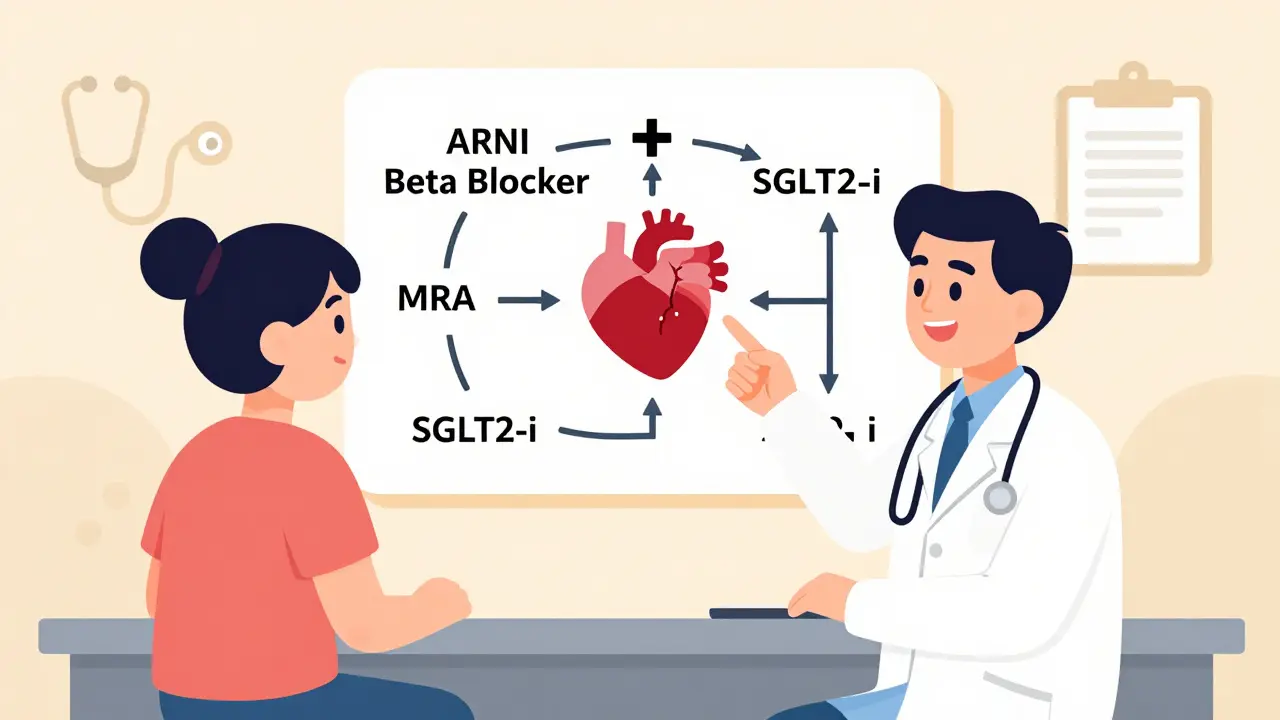
The modern approach to heart failure isn’t about one drug-it’s about four working together:- ARNI (or ACEI/ARB if ARNI isn’t possible)
- Beta blocker
- MRA (like spironolactone or eplerenone)
- SGLT2 inhibitor (like dapagliflozin or empagliflozin)
Diuretics are added on top if you’re still swollen or short of breath. This is called “quadruple therapy.”
The 2022 AHA/ACC/HFSA guidelines say this combination reduces death and hospitalizations by up to 20-21%. Yet, only 35% of eligible patients get all four drugs within a year of diagnosis. Why? Too many doctors still stick to old habits. Too many patients can’t afford ARNI. Too many don’t know they need all four.
Monitoring is key. Blood potassium and kidney function must be checked 1-2 weeks after starting or changing any of these drugs. High potassium or rising creatinine means you might need a lower dose. Your doctor will watch your blood pressure and heart rate closely, especially when titrating beta blockers or ARNI.
Real People, Real Experiences
Patients aren’t just numbers in trials. They’re real people living with these drugs every day.On Amazon, ARNI has the highest rating (4.3/5) for effectiveness, but users complain about cost. Beta blockers get 3.7/5-people appreciate the long-term benefits but hate the fatigue. Diuretics score 4.1/5 for symptom relief, but 68% of users say frequent urination ruins their sleep.
One user switched from lisinopril to Entresto and noticed less shortness of breath in two weeks-but had to pee more often. Another stopped ACEIs because of a cough that wouldn’t go away. Both found relief with ARNI.
Adherence is the biggest challenge. It’s hard to take four pills daily, especially when side effects creep in. But the payoff? People who stick with it live longer, feel better, and spend less time in the hospital.
What’s Next?
The future is bright. SGLT2 inhibitors, originally for diabetes, are now recommended for all heart failure types-even with preserved ejection fraction. Vericiguat, a newer drug, adds another layer of protection when added to existing therapy.By 2027, experts predict ARNI will be first-line for 70% of HFrEF patients. But access remains uneven. Rural areas and low-income communities still lag behind. Only 28% of eligible patients there get guideline-recommended care.
It’s not just about having the right drugs. It’s about getting them to the right people at the right time-with support, monitoring, and education.
Can I take ACE inhibitors and ARNI together?
No. You must stop ACE inhibitors for at least 36 hours before starting ARNI. Taking them together increases the risk of angioedema-a dangerous swelling of the face, tongue, or throat. This is a strict safety rule outlined in the 2022 AHA/ACC/HFSA guidelines.
Why are beta blockers used if they slow the heart?
Heart failure causes the body to overproduce stress hormones like adrenaline. This overworks the heart and damages it over time. Beta blockers block those hormones, giving the heart a chance to rest and heal. Studies show they improve heart function, reduce hospitalizations, and extend life-even if your heart rate drops.
Do I need all four heart failure medications?
If you have heart failure with reduced ejection fraction (HFrEF), yes-unless you have a medical reason not to. The four-pill approach (ARNI or ACEI, beta blocker, MRA, and SGLT2 inhibitor) is the current standard. Diuretics are added as needed for symptoms like swelling or breathlessness. Missing even one can reduce your survival benefit.
What if I can’t afford ARNI?
If ARNI is too expensive, ACE inhibitors or ARBs are still effective alternatives. Generic lisinopril costs around $4/month. Some drug manufacturers offer patient assistance programs for Entresto. Talk to your pharmacist or doctor-they can help you find financial aid or coupons. Never stop your meds just because of cost-there are options.
How often should I get blood tests on these meds?
Within 1-2 weeks after starting or increasing any of these drugs, get a blood test to check potassium, creatinine, and kidney function. After that, every 3-6 months if stable. More often if you’re on high doses or have kidney disease. Monitoring prevents dangerous side effects like hyperkalemia or kidney injury.
Can I stop taking these drugs if I feel better?
No. Feeling better is a sign the meds are working-not that you’re cured. Heart failure is a chronic condition. Stopping these drugs can cause symptoms to return quickly and increase your risk of sudden death or hospitalization. Always talk to your doctor before making any changes.

Jason Xin
January 31, 2026 AT 19:38Been on Entresto for 18 months now. Cough from lisinopril? Gone. Shortness of breath? Better. But yeah, I’m peeing like a racehorse at 3 a.m. Still worth it. My EF went from 28% to 44%.
Side effects suck, but so does dying. You take the trade.
Also, don’t skip the potassium supplements. I learned that the hard way after cramping through a movie night.
And yes, the cost is insane. My insurance covers it, but I know people who can’t. That’s not a medical issue-that’s a system failure.
Holly Robin
February 2, 2026 AT 19:11OK BUT WHAT IF THE PHARMA COMPANIES ARE LYING ABOUT PARADIGM-HF??
I mean, think about it-Entresto came out right after the 2014 FDA crackdown on ACE inhibitors. Coincidence? I think not.
And why do they say you can’t switch within 36 hours? Because they KNOW the angioedema risk is a cover-up for something else. Maybe it’s the preservatives? Or the damn sacubitril is secretly a GMO? I’ve seen Reddit threads where people got swollen tongues after switching-BUT NO ONE TALKS ABOUT THE OTHER 10,000 WHO DIDN’T.
Also, beta blockers cause depression. I’m 100% sure they’re linked to the rise in TikTok sadness.
And why are they pushing SGLT2 inhibitors? Because they’re made by the same company that sells insulin. It’s all connected. Wake up.
Shubham Dixit
February 3, 2026 AT 14:24Listen, in India we don’t even have access to half of these drugs. My uncle had heart failure and the doctor gave him furosemide and a single beta blocker because that’s all the clinic could afford. Entresto? It costs more than my entire monthly salary. We don’t have guidelines here-we have survival.
And you Americans act like this is some new miracle. We’ve been using diuretics since the 1970s. We didn’t need a 47-country trial to know that fluid buildup kills. We saw it in our villages. We saw it in our fathers.
But yes, I agree-ARNI is better. But if you can’t get it, don’t panic. Lisinopril still saves lives. And if you’re taking it with a pinch of salt (literally, not figuratively), you’re already ahead of 80% of the world.
Also, stop complaining about cost. We don’t have insurance. We pay out of pocket. And we still take our pills. Because we don’t have a choice.
Gaurav Meena
February 4, 2026 AT 14:33Hey everyone-just wanted to say this is one of the most helpful posts I’ve read in months 💪❤️
My dad started on carvedilol last year and was terrified-he thought slowing his heart would kill him. But after 6 months? He’s walking 3 miles a day, sleeping through the night, and even gardening again. No more oxygen tank.
And yeah, the fatigue is real. But it fades. Like a muscle that’s healing. You gotta be patient. Don’t quit at week 2. Wait for week 8. Your heart will thank you.
Also, if you’re struggling with cost-ask your pharmacist about patient assistance programs. I helped my neighbor get Entresto for $10/month through Novartis’ program. It’s possible. You’re not alone.
Keep taking those pills. You’re not just surviving-you’re reclaiming your life. 🙌
Eliana Botelho
February 5, 2026 AT 09:18Wait, so you’re telling me that the reason I can’t sleep is because of my diuretic? Not because my husband snores? Not because my cat sits on my chest? Not because I’m 52 and my brain won’t shut off?
And now you want me to add *another* pill? A SGLT2 inhibitor? What even is that? Is it a new kind of protein shake? Did it come from a lab in Switzerland? Why does it have to be four pills? Why not one magic pill that cures everything and also makes me lose weight?
And why do doctors always say ‘you’ll feel better’? I’ve felt worse for the last six months. And now you want me to believe that taking more pills will fix it? I don’t trust medicine anymore. I trust my gut. And my gut says: stop the pills. Let my body figure it out.
Also, I think ARNI is just a fancy name for expensive water.
Darren Gormley
February 5, 2026 AT 09:33😂😂😂 I love how everyone treats ARNI like it’s the second coming. It’s just an ARB + neprilysin inhibitor. We’ve had ARBs since the 90s. The only ‘breakthrough’ is that it’s 100x more expensive.
Also, the ‘quadruple therapy’ is a joke. Most patients can’t even tolerate two. And yet you’re telling them to take four? That’s not medicine-that’s medical bullying.
And why are we ignoring the fact that 60% of heart failure deaths happen in people who are NON-ADHERENT? Because we’re giving them too many pills. Too many side effects. Too many blood tests. Too much anxiety.
Maybe the real problem isn’t the drugs. It’s the system that makes patients feel like failures when they can’t keep up.
Also, the ‘42% of clinics use ARNI’ stat? That’s because the other 58% have patients who aren’t rich. 🤷♂️
Sheila Garfield
February 6, 2026 AT 09:54I’ve been on this journey for five years now. I started on lisinopril, then moved to Entresto after the cough got unbearable. I still take carvedilol, spironolactone, and dapagliflozin. I’ve had cramps, dizziness, weird taste in my mouth, and a lot of bathroom trips.
But here’s the thing-I’m alive. My kids still have their mom. I still cook Sunday dinners.
I don’t know if it’s the drugs or just time, but I’ve learned to accept the trade-offs. I don’t need to be ‘fixed.’ I just need to be okay.
To anyone new to this: it’s okay to feel overwhelmed. It’s okay to cry. It’s okay to ask for help. And it’s okay to take your meds at 10 p.m. if that’s when you remember. Consistency > perfection.
You’re not failing. You’re fighting.
Shawn Peck
February 6, 2026 AT 11:19Look, it’s simple. You have a weak heart. You take the pills. You don’t argue. You don’t Google conspiracy stuff. You just do it.
Entresto works. Beta blockers work. Diuretics help you breathe. That’s it.
If you can’t afford it, ask for help. If you’re tired, take a nap. If you’re scared, call your doctor.
Stop overthinking it. Just take the damn pills. Your heart doesn’t care about your Twitter thread. It just wants you to live.
Niamh Trihy
February 8, 2026 AT 00:12Just wanted to add a quick note on monitoring: if you’re on ARNI + MRA, check potassium every 1-2 weeks initially. Hyperkalemia is silent until it’s not. I’ve seen two patients in the ER with cardiac arrest from potassium levels over 6.5-both were asymptomatic until they collapsed.
Also, SGLT2 inhibitors aren’t just for diabetes. They reduce heart failure hospitalizations even in non-diabetics. That’s huge. Don’t skip them just because you don’t have type 2.
And yes, cost matters. But ask your pharmacy about coupons. Many manufacturers have $0 copay cards for Entresto and dapagliflozin. You’d be surprised how many people don’t know this.
Sarah Blevins
February 8, 2026 AT 12:35While the clinical data supporting quadruple therapy is robust, the real-world implementation remains suboptimal due to provider inertia, patient non-adherence, and systemic healthcare disparities. The gap between guideline recommendations and actual prescribing patterns is not a pharmacological issue but a structural one. Furthermore, the emphasis on pharmacologic intervention may inadvertently diminish attention to non-pharmacologic modalities such as sodium restriction, cardiac rehabilitation, and mental health support, which are equally critical to long-term outcomes. The current paradigm, while evidence-based, risks medicalizing a complex, multifactorial condition into a pill-based solution without addressing the sociocultural determinants of health.