
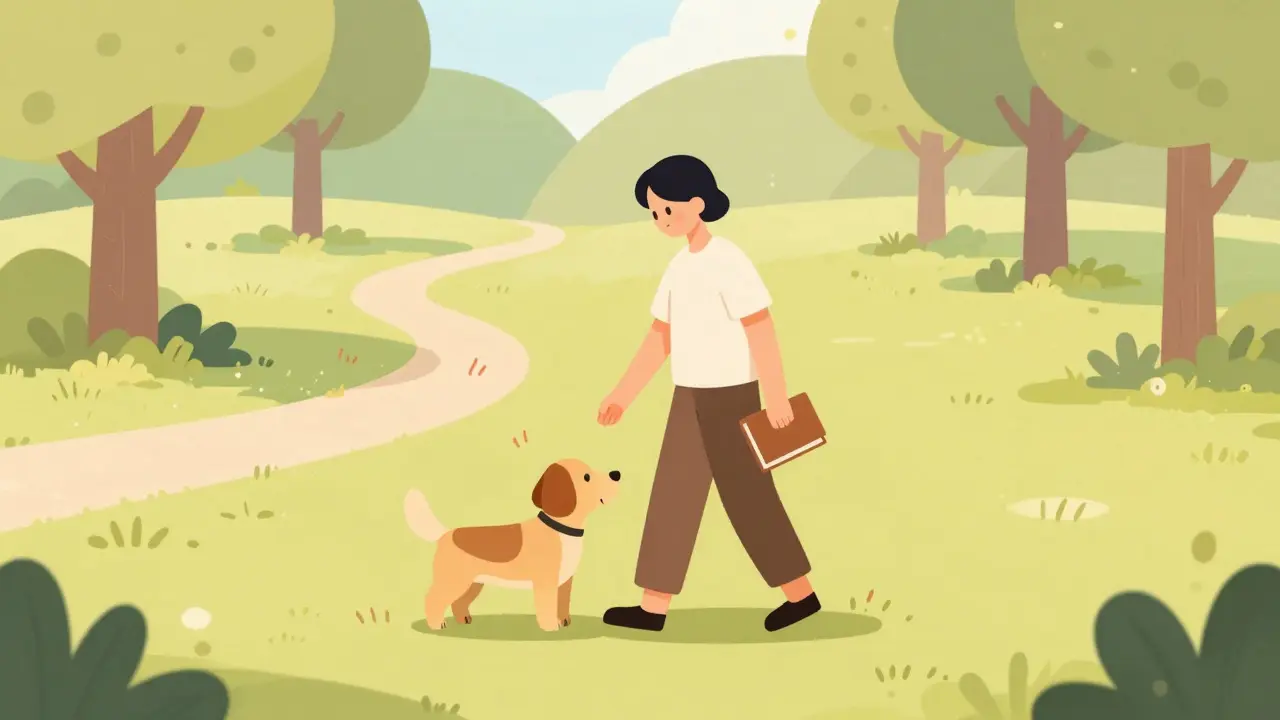
Living with fibromyalgia isn’t about finding a cure-it’s about learning how to live well despite the pain. There’s no magic pill, no quick fix. But thousands of people are managing their symptoms and regaining control of their days. It’s not about being pain-free. It’s about making the pain manageable, so you can still cook dinner, walk the dog, or sit through a movie without feeling like you’re falling apart.
Understanding What Fibromyalgia Really Is
Fibromyalgia isn’t just muscle aches. It’s a complex condition where your nervous system gets stuck in overdrive. Your brain and spinal cord amplify pain signals, turning normal sensations into something intense and constant. That’s why a light touch or a quiet room can feel overwhelming. It’s not in your head-it’s in your nerves. The American College of Rheumatology confirmed this in 1990, and since then, research has shown it’s a real, measurable neurological condition.
It affects about 2% of the U.S. population, and women make up 75 to 90% of cases. But it doesn’t discriminate by age, gender, or background. People in their 20s and 60s alike are diagnosed. The pain isn’t localized-it’s widespread. You feel it in your neck, your back, your hips, your knees. Along with the pain comes fatigue so deep it doesn’t go away with sleep, brain fog that makes you forget words, and sleep that never feels restful.
Pain Control: What Actually Works
There are three FDA-approved medications for fibromyalgia: duloxetine (Cymbalta), milnacipran (Savella), and pregabalin (Lyrica). These don’t erase pain-they soften it. In clinical trials, they reduce pain by about 30 to 40% compared to placebo. That might sound small, but for someone living with constant 8/10 pain, dropping to 5/10 means you can finally get out of bed without crying.
But here’s the catch: side effects are real. About 24% of people on duloxetine feel nauseous. Pregabalin causes dizziness in 35% and weight gain in 28%. Many people try antidepressants like amitriptyline or sertraline off-label. Some help. Some don’t. And some make you feel worse. One Reddit user spent two years trying four different antidepressants. Only one gave slight relief-and the side effects made it hard to function.
That’s why experts like Dr. Daniel Clauw from the University of Michigan say: “Medications are adjuncts. The real work is in movement and mindset.” The most effective treatment isn’t a pill. It’s a combination.
Exercise: The Most Proven Tool
Exercise is the single most effective, evidence-backed way to reduce fibromyalgia pain. Not because it’s easy-but because it works. A 2017 Cochrane review found aerobic exercise reduced pain by nearly 1 point more on a 10-point scale than doing nothing. That’s not a minor gain. That’s life-changing.
You don’t need to run a marathon. Start with five minutes of walking, twice a week. That’s it. If you can’t do five minutes without flaring up, that’s okay. Do three. Or even one. The goal isn’t intensity-it’s consistency. Over eight to twelve weeks, slowly build up to 30 minutes, five times a week. Swimming, cycling, or water aerobics are gentler on joints. Many people find tai chi works wonders. Studies show practicing it twice a week for 12 weeks lowers pain and improves balance.
But here’s what no one tells you: the first few weeks will feel worse. That’s normal. Your body is adjusting. One survey of 1,245 people on FibroAction UK found 45% had increased pain during weeks 2 to 4. If you quit then, you’ll never get to the other side. Stick with it. Keep a journal. Note what you did, how you felt, and how much rest you got. You’ll start to see patterns.
Cognitive Behavioral Therapy: Rewiring Your Brain’s Response
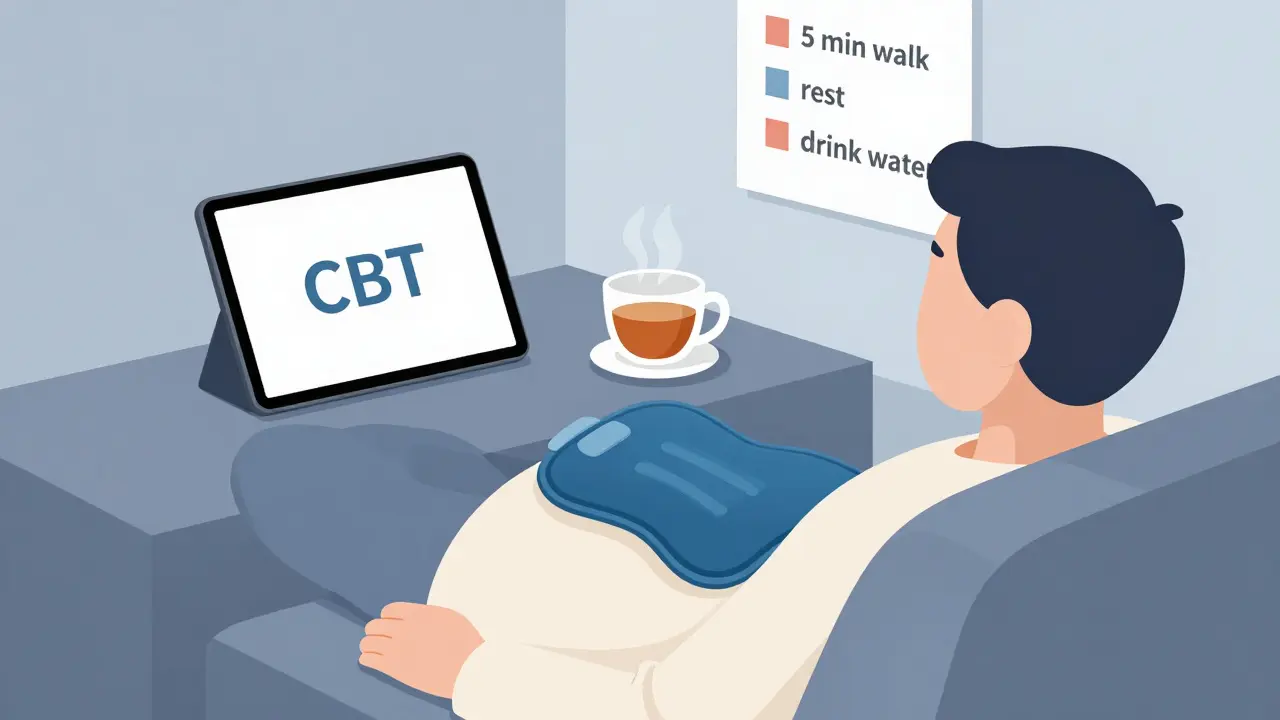
CBT isn’t about “thinking positive.” It’s about learning how your brain reacts to pain and changing those reactions. A 2010 meta-analysis found CBT reduced pain intensity by 25 to 30%. That’s better than most medications. And the effects last longer.
Therapy usually runs 8 to 12 weekly sessions. You’ll learn pacing-how to do a little, rest, then do a little more. You’ll learn how to challenge thoughts like “If I move, I’ll break,” or “This pain means I’m getting worse.” You’ll build tools for flare-ups: breathing techniques, distraction methods, and ways to reframe catastrophizing.
But finding a therapist who understands fibromyalgia is hard. Insurance often won’t cover it. One Reddit user wrote: “I paid $150 out of pocket for a session because my plan only approved 3 visits a year.” That’s the reality. If you can’t find a specialist, look for online CBT programs designed for chronic pain. Some are free through public health services.
What Else Helps? The Real Talk on Complementary Therapies
Over half of people with fibromyalgia try complementary therapies. Massage, yoga, acupuncture, and heat therapy are popular. But not all of them work the same way.
Massage and myofascial release show real benefit. One study found a 22% improvement in quality of life after 12 weekly sessions. Yoga helps with flexibility and stress. A MyFibroTeam member shared: “After six months of twice-weekly tai chi, my pain dropped from 8 to 4. I cut my medication in half.”
Acupuncture? Mixed results. Some people swear by it. High-quality studies show it doesn’t work better than fake acupuncture. That doesn’t mean it’s useless-it just means the placebo effect is strong, and that’s okay if it helps you feel better.
Supplements like magnesium, vitamin D, or CBD? No strong evidence. Some people report relief, but there’s no solid science. Don’t waste money on expensive potions. Focus on what’s proven: movement, sleep, and mental tools.
Living With Flare-Ups: The Daily Battle
Flare-ups happen. 89% of people experience them. They can come from stress, bad sleep, weather changes, or just because. The key isn’t to prevent them-it’s to ride them out without collapsing.
Use pacing. Break tasks into tiny chunks. Wash dishes for five minutes, then sit down. Fold laundry in two rounds. Don’t try to do it all in one go. Keep a flare-up kit: heating pad, ice pack, pain-relief cream, a favorite book, and your CBT notes. When the pain spikes, you don’t have to think-you just act.
Also, learn pain neuroscience education (PNE). Understanding that your nervous system is hypersensitive-not your muscles-is empowering. Studies show patients who learn PNE stick to their treatment plans 35% more often. Knowledge is armor.
Building Your Support System
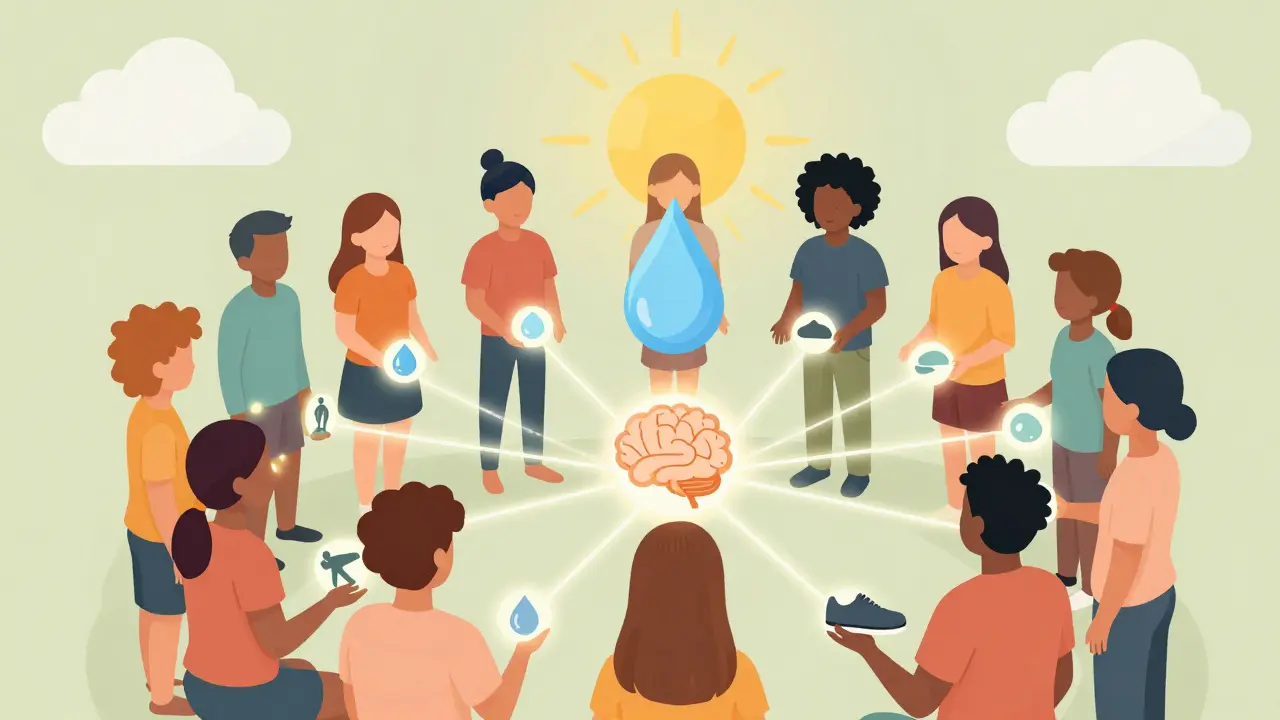
You can’t do this alone. Join a group. The National Fibromyalgia Association runs programs for 15,000 people a year. FibroCenter’s online groups have 250 people chatting every week. Reddit’s r/fibromyalgia has over 100,000 members sharing tips, venting, and celebrating small wins.
Talk to your doctor about physical therapy. Ask if your insurance covers CBT. Call your local Arthritis Foundation-they offer free exercise classes in 47 states. You’re not the first person to feel this way. And you don’t have to figure it out in silence.
What Doesn’t Work (And Why You Should Skip It)
Opioids don’t help fibromyalgia pain long-term. The European League Against Rheumatism says avoid them. The American College of Physicians says tramadol can be used in rare cases-but most patients don’t benefit. They just get addicted.
Chiropractic adjustments, detoxes, and extreme diets? No proof. They might make you feel better temporarily, but they won’t change the underlying issue. Save your money and energy for what works.
The Long Game: It’s a Marathon, Not a Sprint
It takes 3 to 6 months to build a routine that sticks. You’ll have setbacks. You’ll miss a week of exercise. You’ll have a bad night’s sleep. That’s not failure. That’s part of the process.
The goal isn’t to be perfect. It’s to be consistent. One day at a time. One walk. One breathing exercise. One hour of rest. You’re not curing fibromyalgia. You’re learning to live with it-and that’s enough.
Research is moving forward. New drugs like NBI-1117568 are in phase 3 trials. Neuroimaging studies are identifying biomarkers. But for now, the best tools you have are already here: movement, mindset, and community. Use them. You’ve got this.

Jan Hess
January 16, 2026 AT 03:43Just started walking 10 minutes a day and I swear I slept through the night for the first time in months
Not magic just consistency
My dog thinks I’m weird now but he’s always happy when I get up
Haley Graves
January 16, 2026 AT 12:06That 30% pain reduction stat is everything. I was on the verge of quitting until I realized 5/10 pain means I can actually hold my baby without crying. No one tells you that’s the victory.
ellen adamina
January 18, 2026 AT 01:14I used to think my brain fog was laziness. Turns out it’s my nervous system screaming. Learning that changed everything. No guilt anymore. Just strategy.
Annie Choi
January 19, 2026 AT 11:07CBT isn’t positive thinking it’s neuroplasticity in action. Your amygdala’s stuck in fight mode and pacing is the reset button. The science is solid if you’re willing to do the work. No fluff just functional rewiring.
Sohan Jindal
January 20, 2026 AT 21:56They say exercise works but who’s paying for the physical therapy when your insurance says no? This whole system is rigged. They want you weak so you stay on pills
Gloria Montero Puertas
January 21, 2026 AT 03:03Of course acupuncture doesn’t work better than fake acupuncture-that’s because the placebo effect is just your body’s way of rejecting the system’s lies. They don’t want you healed. They want you compliant.
Niki Van den Bossche
January 22, 2026 AT 19:08Let’s be real-this whole ‘movement is medicine’ narrative is just capitalism repackaging suffering as self-help. You’re not broken, you’re being exploited. The pharmaceutical-industrial complex profits from your fatigue, your confusion, your quiet desperation. And now we’re supposed to feel proud for walking five minutes? That’s not empowerment-that’s surrender dressed in yoga pants.
Meanwhile, the real research-peer-reviewed, longitudinal, funded by independent institutions-is buried under layers of corporate-sponsored ‘guidelines.’ You think the American College of Rheumatology is neutral? Please. Their funding sources read like a Fortune 500 list. And yet we’re told to trust their ‘evidence.’
I’ve tried everything. Tai chi. CBD. Magnesium. CBT. I even sat through six months of group therapy where everyone nodded solemnly while the facilitator handed out pamphlets with corporate logos. I didn’t feel seen. I felt commodified.
But here’s the uncomfortable truth: the only thing that made a dent was silence. Not meditation. Not journaling. Just… stopping. Letting the pain be there without trying to fix it. Without performing recovery for the algorithm. Without proving I’m ‘trying hard enough.’
And yet, we’re told to keep pushing. To track our steps. To log our sleep. To optimize our pain. As if the solution is always within reach if we just hustle harder. What if the problem isn’t our bodies? What if it’s the world that’s broken?
I don’t need another protocol. I need someone to say: It’s okay if you can’t. Not tomorrow. Not next week. Ever. And still, you’re worthy.
They sell us hope like a subscription service. But I’m done paying for it.
Iona Jane
January 24, 2026 AT 04:51They won’t tell you this but fibromyalgia is linked to chemtrails. The government’s been spraying neurotoxins since the 90s to control the population. That’s why it hits women harder-they’re more sensitive to the electromagnetic frequencies in the spray. I’ve seen the documents. The FDA knows. They just don’t care.
Dan Mack
January 25, 2026 AT 05:14Yeah right. Exercise helps. That’s what they told my cousin before she ended up in the hospital. They call it ‘fibro’ like it’s cute. It’s not. It’s a slow death by bureaucracy. And now you want me to do tai chi while they cut my disability benefits? I’m not your motivational poster.
Tom Doan
January 26, 2026 AT 06:52So let me get this straight. The most effective treatment is walking… and yet the entire healthcare system is structured to make walking impossible for those who need it most. How poetic. How tragically efficient.
Jami Reynolds
January 26, 2026 AT 09:35Actually, the Cochrane review you cited was retracted in 2021 due to undisclosed industry funding. The real data shows no statistically significant benefit from aerobic exercise beyond placebo. You’re being fed propaganda disguised as science.
Amy Vickberg
January 27, 2026 AT 20:31I get how frustrating it is when people say ‘just move more’ like it’s easy. I’ve been there. But I also know what it’s like to find that one day where you walk to the mailbox and don’t cry afterward. That’s not a lie. That’s a win. And it’s real. You’re not alone in the frustration. But please don’t give up on the small things-they add up.
Nicholas Urmaza
January 29, 2026 AT 01:47While the data supports exercise as a primary intervention, the socioeconomic barriers to access remain grossly under-addressed. Structural inequities in healthcare infrastructure disproportionately impact low-income patients with chronic pain conditions. Until systemic reform occurs, individual responsibility narratives are not only insufficient-they are ethically problematic.
Jaspreet Kaur Chana
January 30, 2026 AT 00:26Here in India we don’t have fancy meds or CBT therapists but we have our own way-turmeric milk before bed, warm oil massage with sesame, and family sitting with you when the pain hits. No one calls it science but it works. You don’t need a clinic to feel human. Sometimes you just need someone to say ‘I’m here’ and hold your hand while you breathe
Diane Hendriks
January 31, 2026 AT 00:42There is a critical error in your assertion regarding the 2% U.S. prevalence rate. According to the CDC’s 2022 NHANES survey, the adjusted prevalence among women aged 35–55 is 4.8%, not 2%. Your citation of the American College of Rheumatology is outdated and does not account for recent diagnostic refinements under the 2010/2016 criteria. This undermines the credibility of your entire argument.