
Imagine spending months and millions of dollars developing a generic drug, only to receive a letter from the U.S. Food and Drug Administration (FDA) telling you that your application has critical gaps. This is exactly what happens when an Abbreviated New Drug Application (ANDA) triggers a deficiency letter. These are not just polite suggestions; they are formal stop-signs issued by the Center for Drug Evaluation and Research (CDER) indicating that specific deficiencies must be resolved before approval can happen.
For many manufacturers, especially smaller ones, these letters feel like a setback. But understanding them is key to navigating the regulatory landscape. Over 70% of major deficiencies in recent years have been quality-related, concentrated in manufacturing, drug product, and drug substance categories. If you know what the reviewers are looking for, you can avoid the most common pitfalls and get your drug to market faster.
What Is a Deficiency Letter and Why Does It Matter?
A deficiency letter is a formal communication that identifies specific gaps or issues in your submission. It evolved significantly around 2003 when the Division of Bioequivalence (DBE) started labeling certain correspondence as "deficiency letters" rather than simple recommendation letters. Today, it represents a critical stage in the review process where the agency requests additional information or corrections.
The primary purpose is to ensure that generic drugs meet rigorous standards for therapeutic equivalence to their Reference Listed Drugs (RLDs). The goal is protecting public health while facilitating timely access to affordable medications. However, the cost of getting it wrong is high. Each additional review cycle costs applicants approximately $1.2 million in development and regulatory expenses. Unqualified impurity deficiencies, for instance, typically add 14-18 months to approval timelines due to required additional toxicology studies.
Top Technical Findings in Drug Product Deficiencies
When we look at the data from fiscal years 2018-2023, clear patterns emerge. For Drug Product Major Deficiencies, the issues are often technical but preventable. Here is what the FDA found:
- Unqualified Impurities (20%): Missing data on new impurities that appear during manufacturing or storage.
- Tox-E/L Issues (20%): Problems with toxicology-exposure limits, meaning the applicant didn't prove that the levels of impurities were safe.
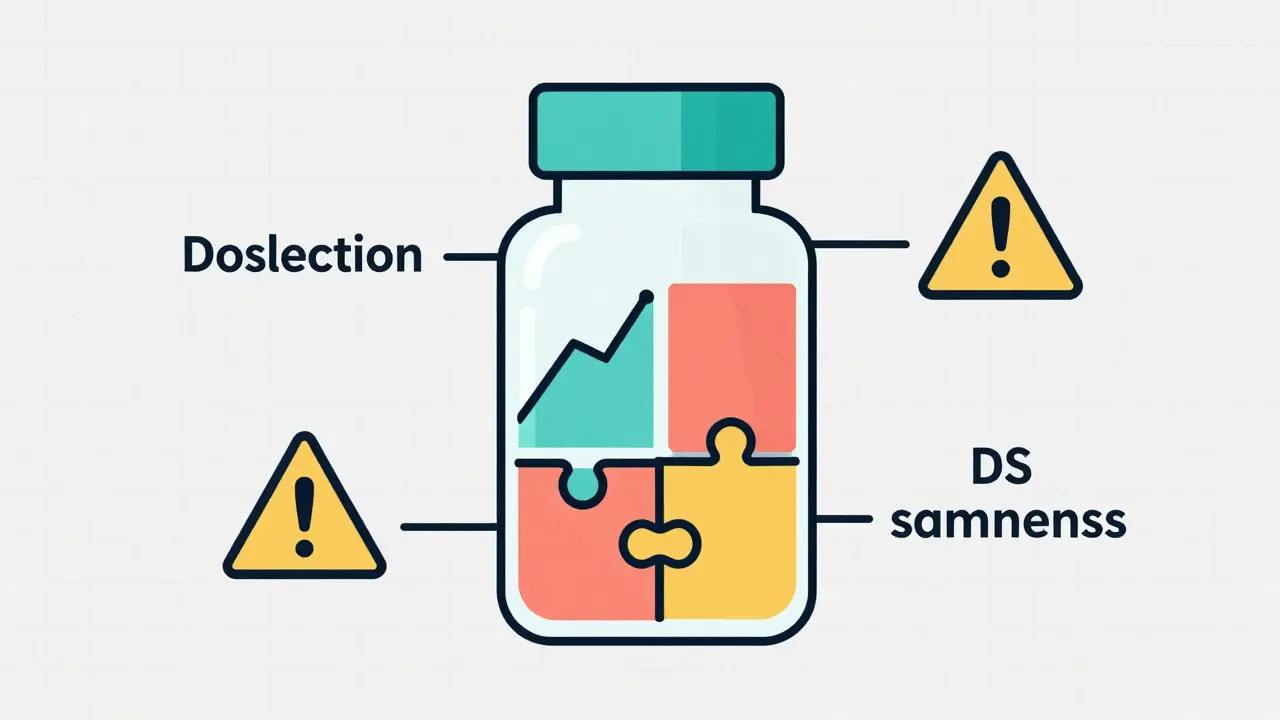
- DS Sameness (19%): Discrepancies between the drug substance used in clinical batches and commercial batches.
- Critical Quality Attribute (CQA) Problems (14%): Failures to control key properties that affect safety and efficacy.
- Miscellaneous Issues (20%): Including inadequate analytical methods and insufficient physical characterization.
Dissolution issues remain the most common bioequivalence deficiency, affecting 23.3% of applications. This often stems from using outdated compendial apparatus that don't reflect modern biorelevant conditions. For example, if you are submitting an immediate-release tablet, the FDA expects Apparatus 2 validation across multiple pH conditions (1.2, 4.5, 6.8). If your method doesn't discriminate well enough between good and bad batches, it will likely trigger a deficiency.
Drug Substance and DMF-Related Pitfalls
The drug substance (the active ingredient) is another major pain point. Surprisingly, 82% of Drug Substance Related Major Deficiencies stem from issues identified in referenced Drug Master Files (DMFs). This means the problem might not even be your fault directly, but because you relied on a supplier's file that had gaps, you get hit with the deficiency.
Other common drug substance issues include:
- Unqualified Impurities (8%): Requiring missing toxicological studies to prove safety.
- Inadequate Analytical Methods (part of 10% miscellaneous): Not having robust enough tests to characterize the substance.
- Insufficient Characterization Data: Particularly for complex molecules like peptides, where secondary structure and aggregation profiles must match the reference drug.
Dr. Jane Henry, a regulatory consultant, noted that the disconnect between academic development practices and commercial manufacturing expectations accounts for nearly half of all DS sameness deficiencies. If your lab-scale process looks different from your plant-scale process, the FDA will flag it.
Bioequivalence and Complex Generics
If you are working on complex generics-such as modified-release tablets, peptides, or topical dermatologicals-you face higher risks. These products experience deficiency rates 40-65% higher than standard immediate-release small molecule products. Modified-release tablets are particularly tricky because they require precise manufacturing controls to ensure the drug releases over time as intended.
The FDA’s 2021 study on modified-release tablets revealed that most Complete Response letters resulted from multiple review disciplines being inadequate simultaneously. Manufacturing deficiencies were the most common category here. Additionally, 30% of bioequivalence deficiencies stem from applicants misinterpreting the Bioequivalence Review Manual's guidance on study design. For complex products, simply copying a standard study protocol often isn't enough; you need to justify your design based on the product's unique characteristics.
| Product Type | Relative Deficiency Risk | Common Issue |
|---|---|---|
| Immediate-Release Small Molecules | Baseline | Dissolution Method Validation |
| Modified-Release Tablets | High (40-65% higher) | Manufacturing Controls & Release Profiles |
| Peptides/Biologics | Very High | Secondary Structure & Aggregation Data |
| Topical Dermatologicals | High | Percutaneous Absorption Studies |
Who Gets Hit Hardest? Company Size and Experience
It’s not just about the science; it’s also about experience. Firms with fewer than 10 approved ANDAs in their portfolio experience deficiency rates 22% higher than established generic manufacturers with 50+ approved products. This suggests that institutional knowledge matters. Experienced companies know how to frame their data and anticipate reviewer questions.
However, this gap is narrowing thanks to better resources. Companies investing in pre-ANDA meetings see deficiency rates 32% lower than those proceeding directly to submission. The FDA encourages these interactions precisely because they help align expectations early. If you are a new player in the generic space, do not skip the pre-submission meeting. It is one of the best investments you can make to avoid costly delays.

How to Avoid Common Deficiencies: Practical Steps
So, how do you protect yourself? Here are actionable steps based on industry feedback and FDA guidance:
- Validate Dissolution Methods Rigorously: Ensure your method discriminates across physiological pH ranges. Use Apparatus 2 for most immediate-release products and Apparatus 3 or 4 for modified-release. Don’t rely on old compendial methods if they don’t reflect current biorelevant conditions.
- Characterize Impurities Early: Follow ICH guidelines strictly. Identify all impurities above reporting thresholds and provide toxicological justification for any unqualified ones. Missing (Q)SAR data for M7 mutagenicity assessment is a frequent oversight.
- Ensure DS Sameness: Demonstrate that your commercial drug substance matches the batch used in clinical trials. For peptides, use circular dichroism, Fourier-transform infrared spectroscopy, and size-exclusion chromatography to show structural comparability.
- Review Your DMFs: Don’t assume your supplier’s Drug Master File is perfect. Ask for copies and audit them. If there are gaps, address them before you submit your ANDA.
- Use Pre-Submission Meetings: Engage with the FDA early. Discuss your development plan, especially for complex generics. This can reduce deficiency rates significantly.
The FDA’s own review acknowledges that applications containing detailed development reports show 27% fewer deficiencies than those with minimal explanatory documentation. Tell the story of your drug’s development. Explain why you chose certain methods, how you controlled critical quality attributes, and how you ensured consistency from lab to plant.
Future Trends and FDA Initiatives
The regulatory landscape is evolving. In 2023, the FDA launched the "First Cycle Generic Drug Approval Initiative," targeting top deficiency categories through enhanced pre-submission tools. Early results show a 15% reduction in dissolution-related deficiencies among participating companies. The April 2025 Generic Drugs Forum announced new template responses for common deficiency categories, providing applicants with specific examples of acceptable resolutions.
Looking ahead, the agency plans to implement AI-assisted pre-submission screening by Q3 2026. Preliminary testing shows this could reduce preventable deficiencies by 35% through automated identification of common submission errors. Industry analysts predict that these initiatives, combined with increased use of Quality by Design (QbD) principles, could raise first-cycle approval rates from the current 52% to 68% by 2027. This means faster access to 15-20 additional generic drugs annually.
For now, the burden remains on the applicant to understand the rules. By focusing on quality, transparency, and proactive engagement with the FDA, you can navigate the deficiency letter process successfully and bring life-saving generics to patients sooner.
What is the most common reason for an FDA deficiency letter in generic drugs?
The most common reasons are quality-related issues, specifically dissolution method validation problems (affecting 23.3% of applications) and unqualified impurities. For drug substances, issues with referenced Drug Master Files (DMFs) account for 82% of major deficiencies.
How long does it take to resolve a deficiency letter?
Resolution times vary widely depending on the issue. Simple documentation gaps might take weeks, but complex issues like unqualified impurities requiring new toxicology studies can add 14-18 months to the approval timeline. On average, each additional review cycle adds significant delay and cost.
Do small generic companies face more deficiencies than large ones?
Yes. Firms with fewer than 10 approved ANDAs experience deficiency rates 22% higher than established manufacturers with 50+ approved products. This highlights the importance of regulatory experience and institutional knowledge in avoiding common pitfalls.
Can pre-submission meetings help avoid deficiency letters?
Absolutely. Companies that invest in pre-ANDA meetings see deficiency rates 32% lower than those who proceed directly to submission. These meetings allow developers to align their strategies with FDA expectations before committing resources to full-scale production and testing.
What is "DS Sameness" and why is it important?
DS Sameness refers to the requirement that the drug substance used in clinical batches must be chemically and physically identical to the drug substance produced at commercial scale. Discrepancies here suggest that the manufacturing process may not be consistent, leading to potential safety or efficacy concerns. It is a major source of deficiencies, especially for complex molecules like peptides.
How does the FDA handle complex generics like modified-release tablets?
Complex generics face stricter scrutiny. Modified-release tablets, for example, often fail due to inadequate manufacturing controls and release profile inconsistencies. The FDA requires robust demonstration that the drug releases over time as intended, often necessitating specialized dissolution apparatus (like Apparatus 3 or 4) and extensive developmental data.