
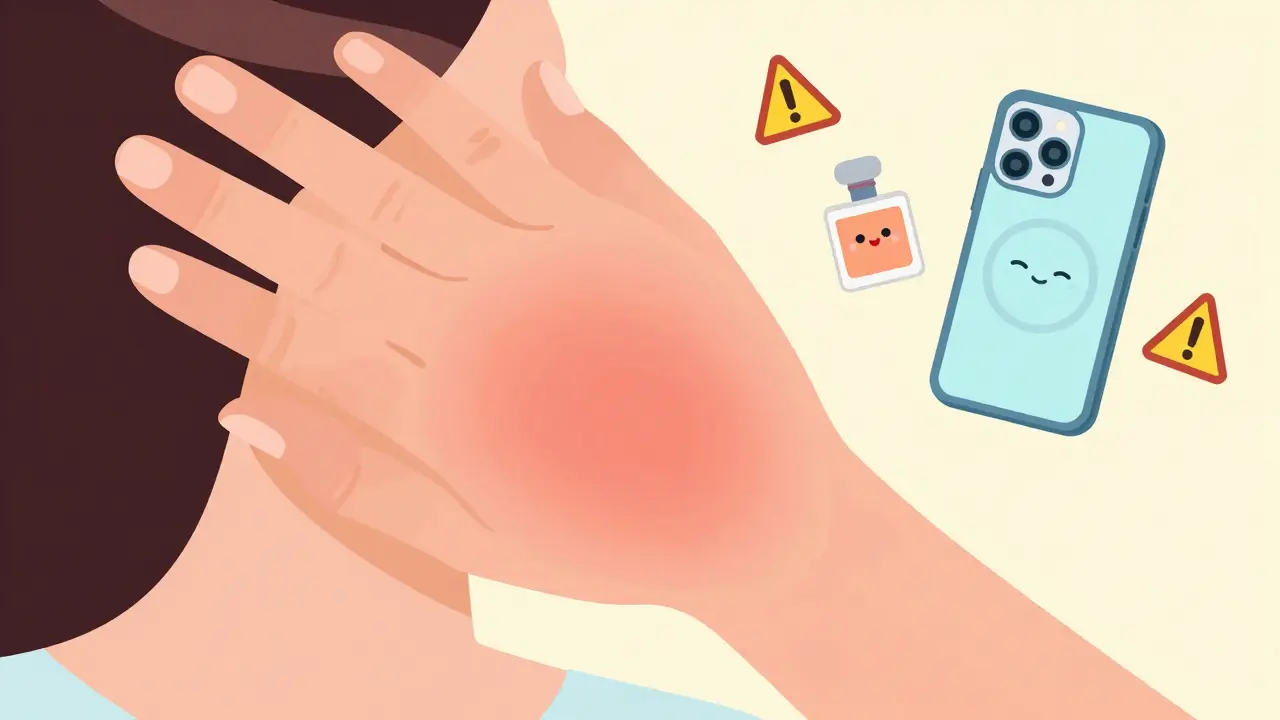
If you’ve had a stubborn, itchy rash that keeps coming back no matter what creams you use, you’re not alone. About contact dermatitis affects millions of people each year - and for many, the real problem isn’t dry skin or bad hygiene. It’s an invisible trigger hiding in your jewelry, shampoo, or even your phone case.
What Is Contact Dermatitis, Really?
Contact dermatitis isn’t one thing. It’s your skin screaming because something it touched set off an allergic reaction. This isn’t an instant burn or a quick sting - it’s a slow burn. You might touch something today, and three days later, your skin turns red, blisters, or peels. That’s allergic contact dermatitis (ACD), a delayed reaction caused by your immune system mistaking a harmless chemical for a threat.
Unlike hives or sneezing from pollen, this isn’t an immediate allergy. It’s a quiet rebellion inside your skin. The culprit? Tiny molecules called haptens. They slip through your skin’s outer layer, latch onto your body’s own proteins, and trigger a chain reaction. Langerhans cells - your skin’s immune sentinels - pick up the signal, march to your lymph nodes, and activate T-cells that attack the area. The result? A rash that looks like poison ivy but didn’t come from the outdoors.
It’s not rare. In the U.S. alone, over 13 million workers deal with this each year. Hairdressers, nurses, construction workers - anyone who handles chemicals, metals, or frequent handwashing is at higher risk. And it’s not just jobs. Your daily routine might be the problem.
The Most Common Allergens You’re Probably Exposed To
There are thousands of possible allergens, but just a few show up again and again in patch tests. The standard TRUE Test checks for 29 of the most common ones - and here’s what’s actually causing trouble for most people:
- Nickel sulfate: Found in jewelry, belt buckles, zippers, and even smartphone cases. It affects nearly 1 in 7 people tested, especially women.
- Cobalt chloride: Often paired with nickel in alloys and some cosmetics. If you’re allergic to one, you’re likely allergic to the other.
- Fragrance mix: Not just perfume. It’s in lotions, shampoos, laundry detergents, and even baby wipes. One in 25 people reacts to it.
- Balsam of Peru: A natural extract used in foods, cosmetics, and medicines. It’s in cinnamon, vanilla, citrus, and even some toothpastes.
- Thimerosal: A preservative still found in some eye drops, nasal sprays, and vaccines.
Here’s the twist: if you’re allergic to fragrance mix, you might not be allergic to “fragrance” as a whole. The mix is a blend of 8 different chemicals. One of them - say, citronellol - could be the real trigger. And that’s buried in your hand cream, your deodorant, and your favorite candle.
And nickel? It’s everywhere. A 2023 study showed 17.4% of women in North America are allergic - that’s more than 1 in 6. Since the EU banned nickel in piercing jewelry in 2004, rates dropped 25%. But in the U.S., there’s no such rule. Your cheap earrings? Your phone? Your watch? They might be leaking nickel right onto your skin.
How Patch Testing Works - And Why It’s Still the Gold Standard
There’s no blood test for contact dermatitis. No quick finger-prick. The only reliable way to find your trigger is patch testing.
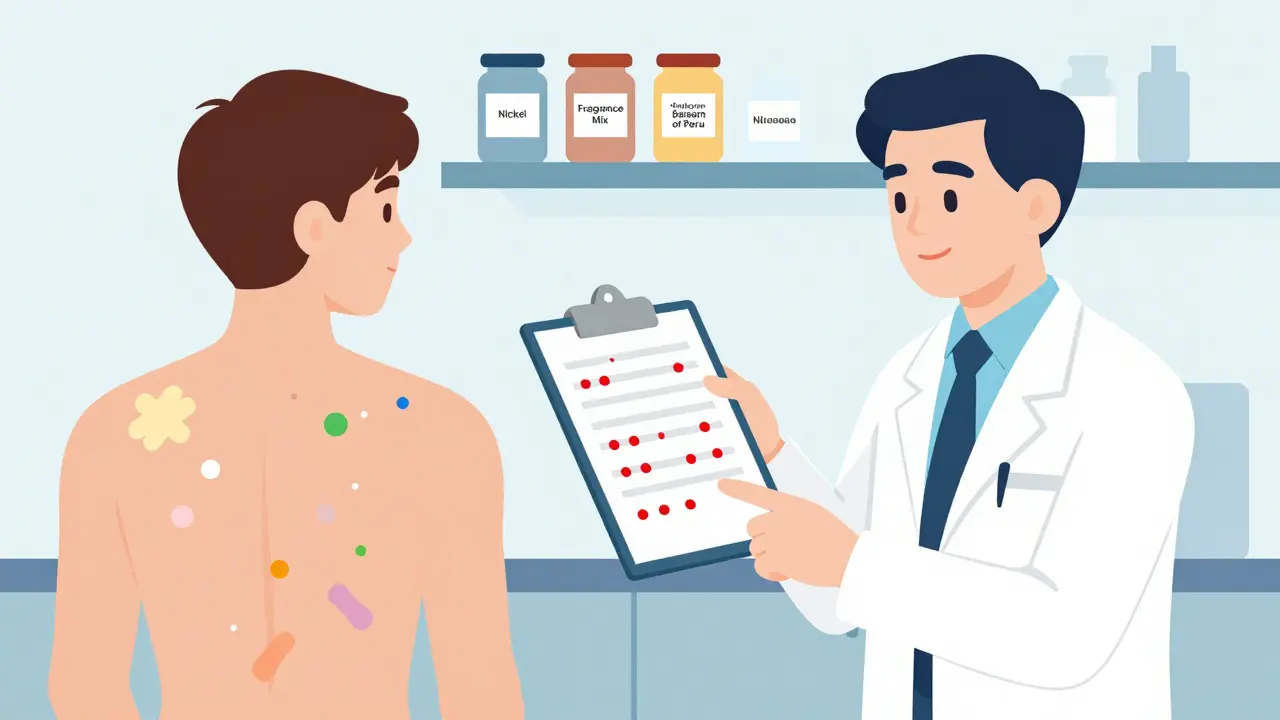
Here’s how it works: small amounts of 29 common allergens are placed on patches, taped to your back, and left for 48 hours. You come back on Day 3 and Day 4 for readings. The doctor looks for redness, swelling, or tiny blisters at each patch site.
It’s not perfect. Sensitivity and accuracy sit around 70-80%. That means about 1 in 5 people get a false negative. Some allergens - like formaldehyde or cocamidopropyl betaine - aren’t even in the standard panel. That’s why some patients need expanded testing with 70-100 allergens, especially if they work with chemicals or have chronic rashes.
Dr. Matthew Zirwas, a leading contact dermatitis specialist, says patch testing changes how people manage their condition in 60-70% of cases. For many, it’s the first time they understand why their rash won’t go away.
But here’s the catch: interpreting the results takes skill. One dermatologist might call a faint red spot a reaction. Another might ignore it. Studies show up to 30% of non-specialists misread results. That’s why seeing a board-certified dermatologist who does patch tests regularly matters.
What Happens After You Get a Positive Result?
Finding the allergen is only half the battle. Avoiding it is the real work.
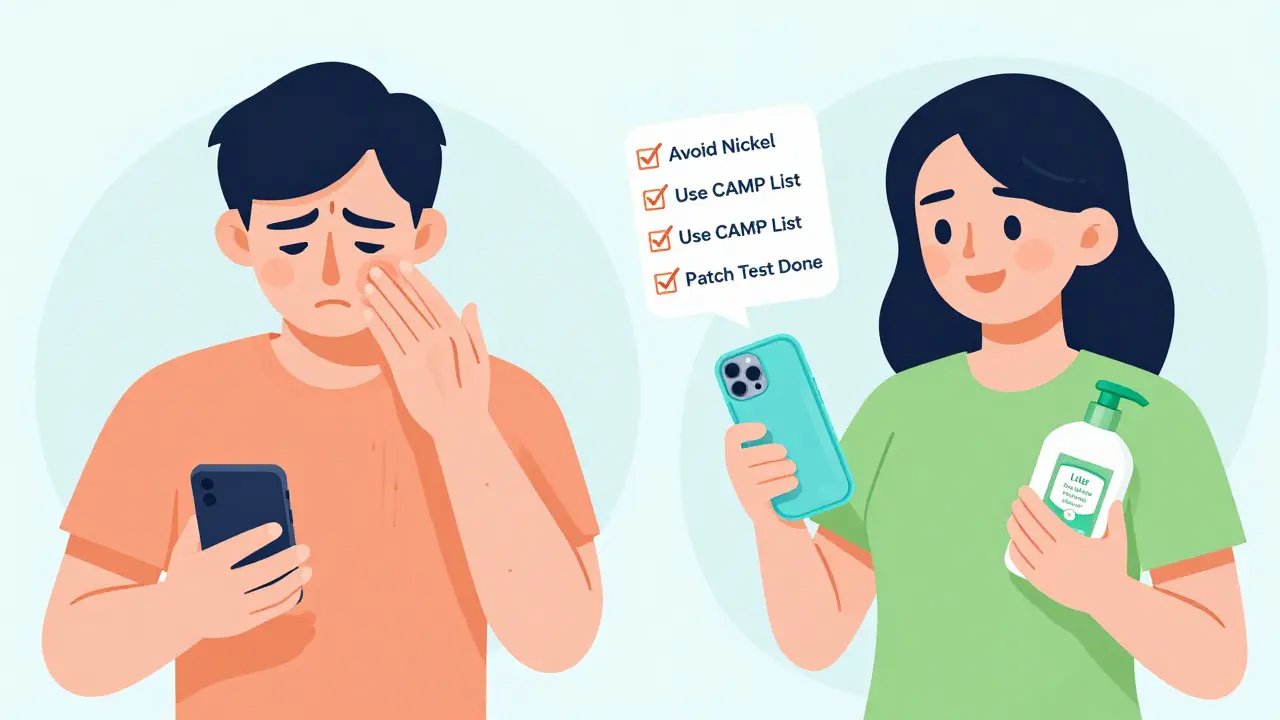
The American Contact Dermatitis Society created the Contact Allergen Management Program (CAMP) to help. After your test, they give you a personalized list of products that are safe - and ones to avoid. In their 2022 report, 78% of patients saw major improvement in their skin after following CAMP’s advice.
But avoiding allergens isn’t easy. Take nickel. You can’t just stop wearing jewelry. You might need to:
- Use clear nail polish on the back of your watch or phone case to create a barrier.
- Buy stainless steel or titanium jewelry labeled “nickel-free” (not just “hypoallergenic” - that term isn’t regulated).
- Check product labels for “nickel” or “Co” (cobalt) in the ingredients.
For fragrance? Look for products labeled “fragrance-free,” not “unscented.” Unscented often still has masking fragrances. The Contact Allergen Replacement Database (CARD) now lists over 18,000 safe products - from shampoos to cleaning sprays - matched to your specific allergens.
One patient on Reddit said: “After 5 years of hand rashes, patch testing found I was allergic to cocamidopropyl betaine - it’s in 90% of body washes. Switching brands cleared my skin in 3 weeks.”
Why Some Allergies Are Hard to Catch - And What’s New
Not all allergens are on the standard panel. Formaldehyde, for example, is a common preservative in lotions and makeup. It’s not in the TRUE Test. Some people need extra patches just for that. Others react to chemicals in their work - like epoxy resin in construction or hair dye in salons.
And then there’s the “hidden allergen” problem. You might think your lotion is the issue. But what if the real culprit is the soap you use to wash your hands before applying it? Or the laundry detergent that washed your towels? One study found 47% of patients struggled to trace their allergens to the right product.
Science is catching up. Researchers are exploring blood markers like IL-18, which rises with ACD severity. In 2024, a study showed a strong link between IL-18 levels and rash intensity. That could lead to future blood tests - but not yet.
Meanwhile, the EU is phasing out animal testing for allergens by 2027. New methods use lab-grown skin models. The American Contact Dermatitis Society is also expanding its patch test panel to 80 allergens by late 2025 - adding emerging triggers like chemicals in smartwatches and “green” cosmetics that claim to be natural but still contain allergens like limonene or linalool.
But here’s the truth: nothing replaces patch testing yet. Dr. Howard Maibach put it simply: “Molecular tools might help us understand why, but patch testing tells us what.”
How to Start Your Own Allergen Avoidance Plan
If you suspect contact dermatitis, here’s how to begin:
- Track your flare-ups. When did the rash start? What were you doing? What new product did you use? Keep a daily log.
- See a dermatologist. Ask specifically for patch testing. Not all skin doctors do it - make sure they do.
- Get the full panel. If your rash is chronic or occupational, ask about expanded testing.
- Use CAMP or CARD. After testing, get your personalized avoidance list. Don’t guess.
- Give it time. Avoid the allergen for at least 2-4 weeks. Improvement often takes weeks, not days.
And remember: “Hypoallergenic” means nothing legally. “Fragrance-free” is better than “unscented.” “Natural” doesn’t mean safe - balsam of Peru is natural and one of the top allergens.
What You Can Do Right Now
You don’t need to wait for a doctor’s appointment to start protecting your skin:
- Wear cotton gloves under rubber gloves if you clean or wash dishes.
- Switch to a fragrance-free, soap-free cleanser like Cetaphil or Vanicream.
- Check your phone case. If it’s metallic, cover it with a silicone sleeve.
- Wash new clothes before wearing them - dyes and finishes can trigger reactions.
- Read labels. Look for “paraben-free,” “fragrance-free,” “nickel-tested.”
It’s not about perfection. It’s about progress. One less trigger can mean fewer flare-ups, less itching, and more confidence.
Final Thought: You’re Not Just Managing a Rash - You’re Taking Back Control
Contact dermatitis feels like a mystery. But it’s not. There’s a reason your skin reacts. And once you know what it is, you can stop guessing. You can stop buying products that make things worse. You can stop blaming yourself for something that’s not your fault.
It’s not a cure. But it’s a path - and it starts with one simple question: What did my skin touch?
Can contact dermatitis go away on its own?
Yes, if you stop touching the allergen. The rash usually clears in 2-4 weeks once exposure ends. But if you keep using the product - even once a week - the rash will keep coming back. It doesn’t go away because you’re “immune.” It goes away because you removed the trigger.
Is patch testing painful?
No. The patches are taped to your back and don’t break the skin. You might feel mild itching or tightness, but no needles or pricks. The reaction appears days later as redness or bumps - that’s the result, not the test itself.
Can I do patch testing at home?
No. Patch testing requires medical supervision. The allergens are potent and can cause severe reactions if misapplied. Over-the-counter “allergy tests” for skin are not reliable and can give false results. Only a dermatologist should perform and interpret patch tests.
Why does my rash only happen on my hands?
Hands are exposed to the most allergens - soap, cleaning products, tools, gloves, and even your own sweat. Nickel from jewelry or tools, fragrances from hand creams, and preservatives in lotions are common culprits. If your hands are the only area affected, your allergen is likely something you touch daily.
Are natural or organic products safer?
Not necessarily. Many natural ingredients - like tea tree oil, lanolin, balsam of Peru, and essential oils - are common allergens. “Organic” doesn’t mean non-allergenic. In fact, plant extracts are among the top triggers in expanded patch testing panels.
Can I be allergic to my own sweat?
No. Sweat itself isn’t an allergen. But it can carry metals (like nickel from jewelry) or push chemicals deeper into the skin. If you get a rash where your watch sits or under your bra strap, it’s likely the metal reacting with sweat - not the sweat itself.


Ryan Pagan
January 28, 2026 AT 14:35Nickel’s everywhere and nobody talks about it. I had a rash on my neck for two years-thought it was stress or bad laundry detergent. Turned out my damn watch strap was leaching nickel like a rusty pipe. Put on a silicone band, switched to titanium jewelry, and boom-skin cleared in 10 days. No more steroid creams, no more scratching while watching Netflix. If you’ve got a stubborn rash, check your accessories first. Seriously. Your phone case, your belt buckle, even your damn bra clasp. It’s not magic, it’s metallurgy.
Paul Adler
January 29, 2026 AT 07:34This is an exceptionally well-researched and clearly articulated overview of contact dermatitis. The distinction between allergic and irritant types is often blurred in public discourse, and the emphasis on patch testing as the diagnostic gold standard is both accurate and necessary. I appreciate the inclusion of specific allergens and the context around regulatory disparities between the EU and the U.S. The mention of CAMP and CARD provides actionable next steps for patients, which is rare in medical content of this nature. Well done.
ryan Sifontes
January 31, 2026 AT 03:48Megan Brooks
February 1, 2026 AT 08:29It’s fascinating how our skin becomes a battleground for invisible chemical warfare. The idea that a molecule so small it can slip past our defenses, bind to our proteins, and trigger a full immune response-it’s almost poetic in its betrayal. And yet, we’re expected to guess what’s causing it. The emotional toll of chronic rashes is rarely discussed: the shame of visible skin, the frustration of failed products, the isolation of avoiding social touch because you’re afraid of reactions. Patch testing isn’t just medical-it’s a form of liberation. Knowing the ‘why’ transforms you from a victim of your own body to an informed navigator of your environment.
Frank Declemij
February 2, 2026 AT 02:45Kacey Yates
February 2, 2026 AT 16:43Stop buying ‘natural’ crap. Tea tree oil? Balsam of Peru? Lavender? All top allergens. I used ‘organic’ shampoo for a year thinking I was being healthy. Turns out I was slowly poisoning my scalp. Patch test found I was allergic to three plant extracts. Now I use plain water and a bar of unscented glycerin soap. My skin hasn’t been this calm since college. Stop romanticizing ‘clean’ products-they’re not clean, they’re just more expensive allergens with a hippie label.
Laura Arnal
February 4, 2026 AT 13:18Jasneet Minhas
February 5, 2026 AT 07:38Interesting how the EU banned nickel in piercings and suddenly rates dropped. Meanwhile in the U.S., we’re still letting corporations profit off our itchy skin. Maybe the real allergen isn’t nickel-it’s capitalism. 🤷♂️ But seriously, this post is gold. I’m printing it out and handing it to my dermatologist tomorrow. And yes, I just covered my iPhone case in duct tape. It’s ugly, but my wrist isn’t burning anymore. 😎