
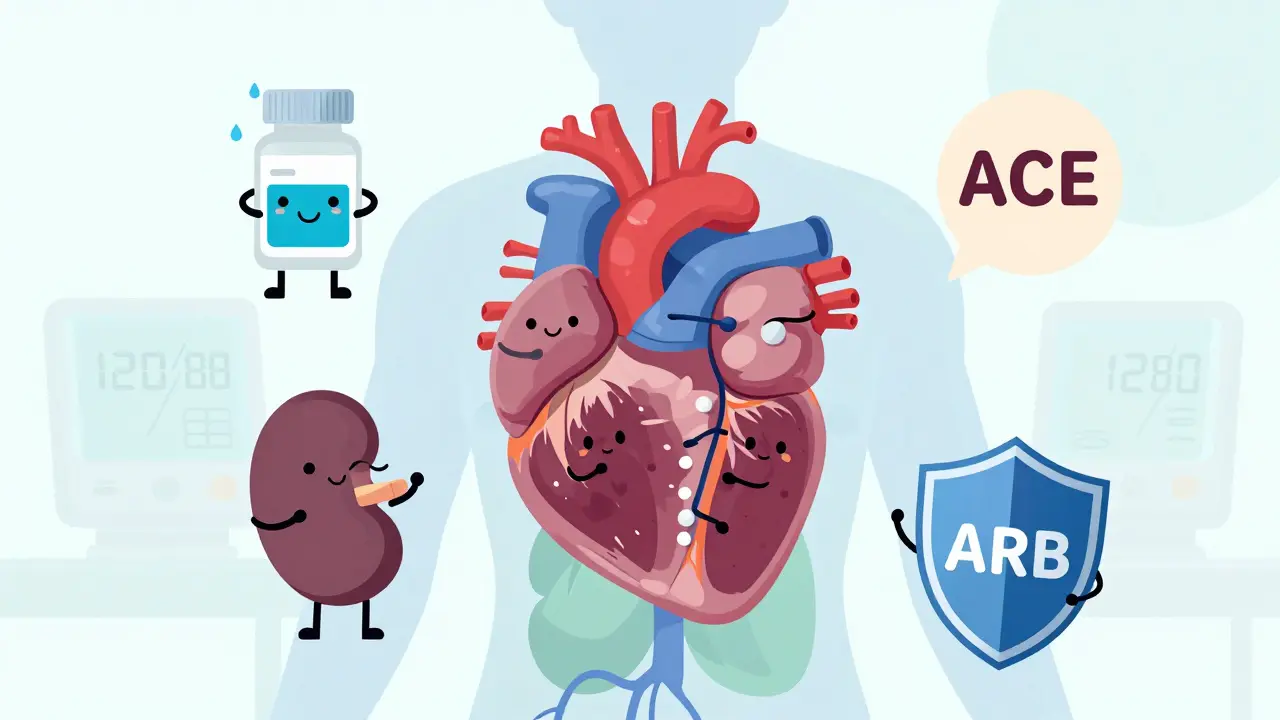
High blood pressure doesn’t shout. It doesn’t make you dizzy or give you a headache. It just creeps up, quietly increasing your risk of heart attack, stroke, or kidney failure. That’s why blood pressure medication is one of the most commonly prescribed treatments in the UK and worldwide. But knowing which one you’re on - and why - matters just as much as taking it. Not all pills work the same. Not all side effects are equal. And skipping a dose because you feel fine? That’s how things go wrong.
How Blood Pressure Medications Work
Your body doesn’t need to be told to lower blood pressure. It does it naturally - through blood vessels, kidneys, nerves, and hormones. But when those systems get out of balance, medication steps in to help. Each class of drug targets a different part of the system. Think of it like fixing a leaky pipe: sometimes you tighten a valve, sometimes you drain water, sometimes you widen the pipe. The goal isn’t just to lower the number on the monitor. It’s to protect your heart, brain, and kidneys over time.
Most people start with one of four main types: diuretics, calcium channel blockers, ACE inhibitors, or ARBs. These are backed by decades of research showing they cut stroke and heart attack risk. Beta-blockers? They’re still used, but mostly if you’ve had a heart attack or have another heart condition. They’re not the first choice for most people anymore.
The Main Types of Blood Pressure Medications
There are more than ten classes, but only a handful are used regularly. Here’s what you’re likely to be prescribed - and why.
- Thiazide diuretics (like hydrochlorothiazide): These are often the first step. They help your kidneys flush out extra salt and water. Less fluid in your blood = less pressure on your arteries. They’re cheap, effective, and work well for older adults and Black patients. But they can lower potassium and trigger gout in some people.
- Calcium channel blockers (like amlodipine): These relax your blood vessels by stopping calcium from entering muscle cells. Amlodipine is one of the most prescribed drugs in the US and UK. It’s great for older adults and those with angina. Side effects? Swollen ankles, flushing, dizziness. Not everyone gets them, but if you do, they usually fade after a few weeks.
- ACE inhibitors (like lisinopril): These block a hormone that tightens blood vessels. They’re especially good if you have diabetes or kidney disease because they protect your kidneys. But about 1 in 5 people get a dry, hacking cough - and it won’t go away until you switch meds. Rarely, they can cause swelling in the face or throat (angioedema). If that happens, stop taking it and get help immediately.
- ARBs (like losartan): These work like ACE inhibitors but block the hormone at a different point. They don’t cause the cough. If you can’t tolerate lisinopril, your doctor will likely switch you to losartan. Same kidney protection. Same risks of high potassium.
- Beta-blockers (like metoprolol): These slow your heart rate and reduce how hard your heart pumps. They’re not first-line anymore unless you’ve had a heart attack, have heart failure, or have an irregular heartbeat. They can make you tired, cold, or cause sleep problems. Diabetics need to be careful - they can hide low blood sugar symptoms.
Other types - like alpha-blockers, vasodilators, or aldosterone blockers - are usually added later if the first few don’t work. They’re not for everyone.
Common Side Effects - And What to Do
Side effects aren’t rare. They’re normal. But they’re not all the same. And they’re not always permanent.
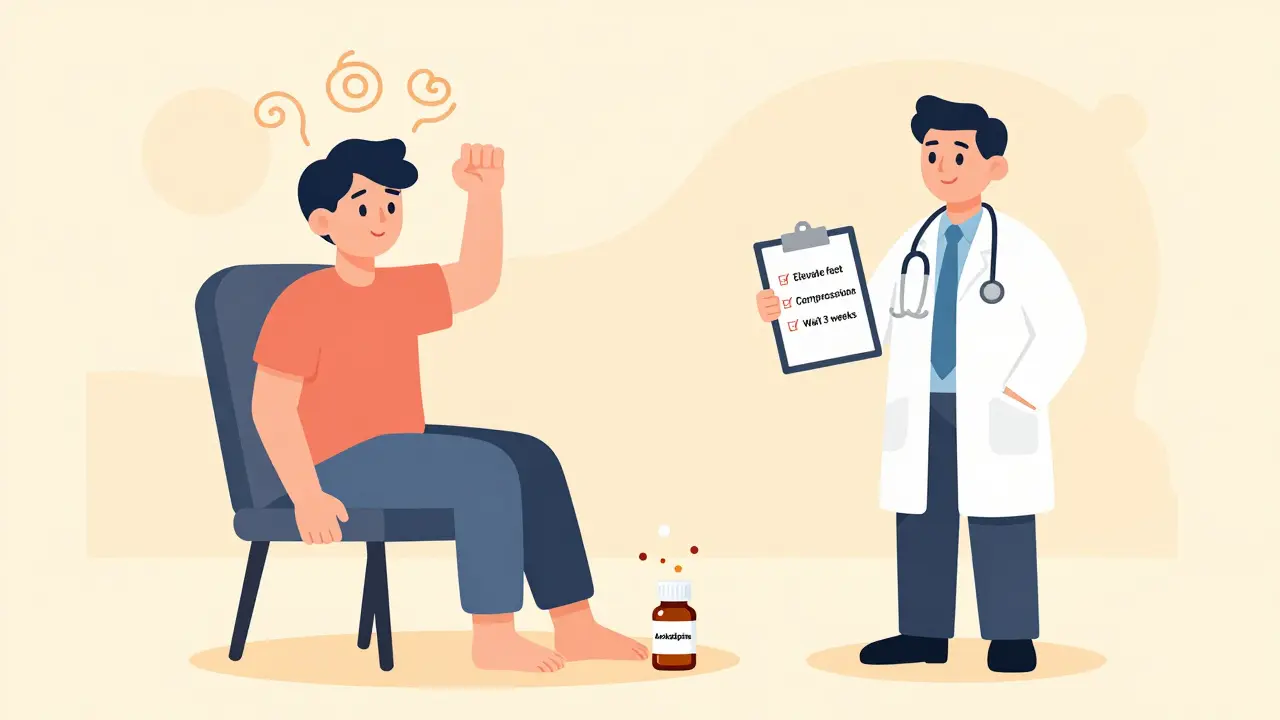
- Swollen ankles (from amlodipine): Elevate your feet. Wear compression socks. If it’s painful or doesn’t improve in 2-3 weeks, talk to your doctor. Sometimes switching to a different calcium blocker helps.
- Dry cough (from ACE inhibitors): It’s annoying, but harmless. Still, if it keeps you up at night, ask for an ARB instead. No cough. Same protection.
- Feeling tired or dizzy: Especially when standing up. This is common at first. Get up slowly. Drink water. If it lasts more than 10 days or makes you fall, your dose may be too high.
- High potassium (from ACE inhibitors, ARBs, or diuretics like spironolactone): You won’t feel it. But too much can stop your heart. Your doctor will check your blood every few months. Avoid salt substitutes and too many bananas or oranges if you’re on these.
- Low potassium (from thiazides): Can cause muscle cramps or irregular heartbeat. Your doctor might add a potassium supplement or switch to a different diuretic.
- Sexual side effects: Some beta-blockers and diuretics can reduce libido or cause erectile dysfunction. If this matters to you, say so. There are alternatives.
Most side effects are mild and fade. But if you get swelling in your lips, tongue, or throat - or trouble breathing - call 999. That’s angioedema. It’s rare but deadly if ignored.
Safety First: Who Should Avoid What?
Not all drugs are safe for everyone. Your age, other health problems, and even your ethnicity matter.
- Pregnancy: ACE inhibitors, ARBs, and direct renin inhibitors are strictly off-limits. They can cause serious birth defects. If you’re planning pregnancy or think you might be, tell your doctor immediately. Methyldopa and labetalol are safer options.
- Black patients: Studies show thiazide diuretics and calcium channel blockers work better than ACE inhibitors or ARBs as first-line treatment. This isn’t about race - it’s about how the body responds to certain drugs. Your doctor should know this.
- Elderly patients: Older adults are more sensitive. Starting with a low dose is key. Orthostatic hypotension (dizziness on standing) is common and can lead to falls. Blood pressure targets are often less strict for people over 80.
- People with asthma or COPD: Beta-blockers can tighten airways. If you have breathing issues, avoid non-selective ones like propranolol. Carvedilol or bisoprolol may be safer choices.
- People with kidney disease: ACE inhibitors and ARBs are actually helpful here - they protect kidney function. But they need close monitoring. Too much can cause potassium to spike or kidney function to dip.
Drug Interactions You Can’t Ignore
These meds don’t live in a vacuum. What else you take changes how they work.
- NSAIDs (like ibuprofen or naproxen): These common painkillers can make blood pressure meds less effective - and damage your kidneys. If you need pain relief, try paracetamol instead.
- ACE inhibitor + ARB: Never take both together. It doesn’t work better. It just increases your risk of kidney failure and high potassium.
- Potassium supplements: Don’t take them unless your doctor says so. Especially if you’re on an ACE inhibitor or ARB.
- St. John’s Wort: This herbal supplement can lower the effect of some blood pressure drugs. If you use it, tell your doctor.
- Alcohol: Can drop your blood pressure too much, especially when you first start a new drug. Limit it.
What Happens If You Don’t Take Your Medication?
High blood pressure doesn’t hurt - so it’s easy to skip pills. But here’s what happens when you do:
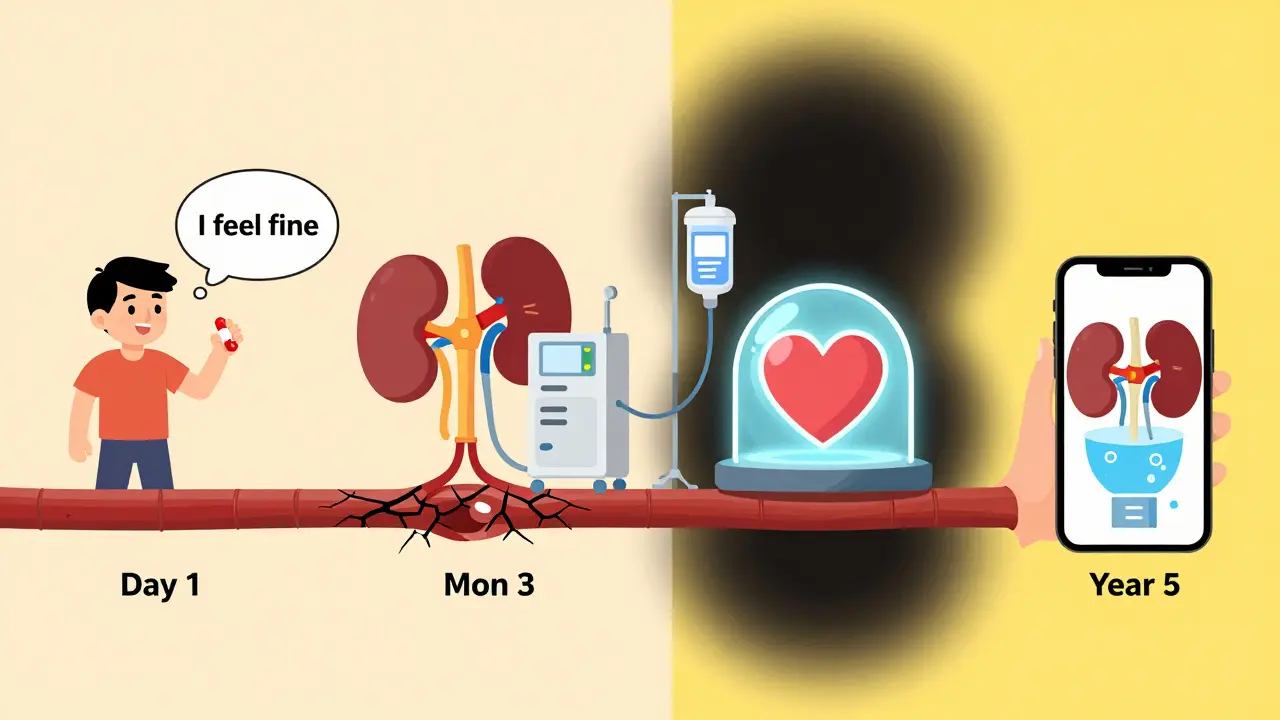
- Within days: Your pressure rises again. No symptoms? Doesn’t matter.
- Within months: Your arteries stiffen. Your heart thickens. Your kidneys start to struggle.
- Within years: You’re at higher risk of stroke, heart attack, or needing dialysis.
Studies show half of people stop taking their blood pressure meds within a year. The reasons? Side effects, cost, forgetting, or thinking “I feel fine.” But high blood pressure isn’t about how you feel. It’s about what’s happening inside. The damage is silent until it’s too late.
How Treatment Is Chosen - And Adjusted
Your doctor doesn’t pick a drug randomly. They look at your age, your ethnicity, your other conditions, and even your lifestyle. The UK’s NICE guidelines recommend starting with a thiazide diuretic or calcium channel blocker for most people. If you’re under 55, ACE inhibitors or ARBs are often first. If you’re over 55, or Black, they go with the diuretic or calcium blocker.
And if one pill doesn’t do it? You don’t just get more of it. You get a second drug - from a different class. Most people need two or three to reach their goal. Some need four. That’s normal. It’s not failure. It’s science.
Follow-up is key. Your blood pressure should be checked 2-4 weeks after starting or changing a drug. Blood tests for potassium and kidney function happen every few months. Your doctor will adjust based on results - not just how you feel.
What’s Next? Personalised Treatment
The future of blood pressure treatment isn’t just about more pills. It’s about better choices. Research is looking at how your genes affect how you respond to beta-blockers or ACE inhibitors. Some people naturally process these drugs faster. Others are more sensitive. In the next 5-10 years, we may see genetic tests used to pick your first drug - not guess.
Meanwhile, apps that remind you to take your pills and sync with your home blood pressure monitor are helping. Studies show they improve adherence by 15-20%. That’s huge. If you forget often, ask your pharmacist about one.
Final Thoughts: It’s Not About the Number
That number on the screen - 130/80? It’s just a target. What matters more is keeping it steady. And staying on your meds. Even if you feel fine. Even if you think it’s not working. Even if your ankle swells or you get a cough. Most side effects are fixable. The damage from uncontrolled blood pressure isn’t.
Work with your doctor. Ask questions. Tell them what’s bothering you. There’s almost always another option. And yes - you can live a full, healthy life with high blood pressure. But only if you treat it. Not ignore it.
Can I stop my blood pressure medication if I feel fine?
No. High blood pressure rarely causes symptoms, even when it’s dangerously high. Stopping medication allows your pressure to rise again, increasing your risk of stroke, heart attack, or kidney damage. Always talk to your doctor before making any changes - even if you feel perfectly well.
Which blood pressure medication has the least side effects?
There’s no single answer. Thiazide diuretics and calcium channel blockers like amlodipine are generally well-tolerated by most people. ACE inhibitors cause a dry cough in 10-20% of users, so ARBs like losartan are often chosen as an alternative. Side effects vary by person. What’s mild for one person may be unbearable for another. The best approach is to start low, monitor closely, and switch if needed.
Why do I need two or more blood pressure pills?
Most people need more than one because high blood pressure has multiple causes. One drug might relax blood vessels, another might reduce fluid volume, and a third might slow heart rate. Combining them targets different pathways, making treatment more effective than doubling one drug. About 70% of people require two or more medications to reach their target blood pressure.
Are natural remedies like garlic or fish oil enough to replace medication?
No. While lifestyle changes - reducing salt, losing weight, exercising - can lower blood pressure by 5-10 mmHg, they’re not enough for most people with diagnosed hypertension. Natural remedies like garlic or fish oil have very modest effects and aren’t proven to prevent heart attacks or strokes. They can help as a supplement to medication, but never as a replacement.
Can blood pressure medication damage my kidneys?
Actually, the opposite is usually true. ACE inhibitors and ARBs protect kidney function, especially in people with diabetes or protein in the urine. However, if you’re taking multiple RAAS-blocking drugs (like ACE + ARB) or combining them with NSAIDs, kidney function can decline. That’s why regular blood tests are essential. Your doctor monitors this closely.
What should I do if I miss a dose?
If you miss a dose, take it as soon as you remember - unless it’s close to your next scheduled dose. Never double up. If you’re unsure, check the leaflet or call your pharmacist. Missing one dose won’t cause immediate harm, but regularly skipping doses raises your long-term risk. Setting phone reminders or using a pill box can help.
Is it safe to take blood pressure medication during pregnancy?
Some are, some aren’t. ACE inhibitors, ARBs, and direct renin inhibitors are dangerous during pregnancy and can cause serious birth defects. Safe alternatives include methyldopa and labetalol. If you’re planning pregnancy or discover you’re pregnant while on blood pressure medication, contact your doctor immediately to switch to a safer option.
Why do some people get swelling in their ankles on blood pressure meds?
This is most common with calcium channel blockers like amlodipine. These drugs relax blood vessels, which can cause fluid to leak into the tissues of the lower legs and ankles. It’s not dangerous, but it can be uncomfortable. Elevating your legs, wearing compression socks, or switching to a different class of medication can help. Your doctor can adjust your treatment if it’s bothersome.
How long does it take for blood pressure medication to work?
Some effects show within days, but full control usually takes 2-6 weeks. Diuretics and calcium channel blockers often work faster. ACE inhibitors and ARBs may take longer to show full benefit, especially for kidney protection. Don’t stop or change your dose if you don’t feel better right away. Give it time - and keep your follow-up appointments.
Can I drink alcohol while on blood pressure medication?
Moderate alcohol is usually okay - but it can lower your blood pressure too much, especially when you first start treatment. It can also make dizziness worse. Limit to 1 drink per day for women and 2 for men. Avoid binge drinking. If you’re on multiple medications or are older, even small amounts can be risky. Always check with your doctor if you’re unsure.
Next steps: If you’re on blood pressure medication, schedule your next check-up. Ask your pharmacist for a pill box. Set a daily alarm. And remember - your health isn’t measured by how you feel today. It’s measured by what you prevent tomorrow.
Dean Jones
February 28, 2026 AT 18:44It's wild how we treat blood pressure like it's some kind of moral failing-like if you just tried harder, your arteries would magically loosen up. The truth is, your body isn't broken because you have hypertension. It's just doing what it's been taught to do by decades of processed food, stress, and sleep deprivation. Medication isn't a crutch; it's a bridge. And bridges aren't shameful-they're necessary. I've seen people quit their meds because they 'felt fine,' only to end up in the ER six months later with a stroke they didn't see coming. You don't feel damage until it's too late. That’s not fear-mongering. That’s biology.
And let’s not pretend lifestyle changes are some magic bullet. Sure, losing weight and cutting salt helps-but for most people with stage 1 or 2 hypertension, it’s not enough. Not even close. If you need two or three drugs to get your numbers down, that’s not failure. That’s precision medicine. We don’t shame diabetics for needing insulin. Why do we shame people for needing a calcium channel blocker?
Also, the idea that ‘natural remedies’ can replace meds is dangerous nonsense. Garlic? Fish oil? They’re like putting a Band-Aid on a ruptured aneurysm. They might make you feel better emotionally, but they won’t stop your heart from failing. The science is clear: drugs save lives. Not supplements. Not yoga. Not cold showers. Drugs.
And yes, side effects suck. Swollen ankles? Cough? Dizziness? I get it. But most of those are manageable. Switch the drug. Adjust the dose. Talk to your doctor. Don’t just ghost your treatment plan. Because the silent killer doesn’t care if you’re ‘feeling good.’ It’s still building up pressure behind the walls of your arteries, one silent beat at a time.
Gretchen Rivas
March 2, 2026 AT 15:09Just wanted to say: if you're on an ACE inhibitor and got that cough, don't suffer. Ask for losartan. It's the same protection, zero cough. Done.
Betsy Silverman
March 4, 2026 AT 12:28I love how this post breaks down the why behind each med. So many people think it's just random pills, but it's actually tailored. I'm on a diuretic and a calcium blocker, and honestly? It's been life-changing. Used to get dizzy just walking to the fridge. Now I hike on weekends. Also, the point about potassium is HUGE. I didn't know bananas could be risky until my blood test came back high. Now I eat apples instead. Small shifts, big impact.
And to anyone thinking about skipping doses because you 'feel fine'-I was you. I stopped for three days last winter. Felt fine. Then I got hit with a wave of dizziness that knocked me into the coffee table. That's when I realized: my body was lying to me. Blood pressure doesn't ask for permission. It just breaks things. Don't wait for symptoms. Protect what you can't feel.
Ivan Viktor
March 5, 2026 AT 23:37So let me get this straight-we're told to take pills for a condition we can't feel, that might kill us in 10 years, while the same doctors tell us to avoid ibuprofen because it might kill us in 5? And we're supposed to trust this system? Also, why does every single med come with a list of side effects that sound like a horror movie trailer? Swelling? Cough? Kidney failure? I feel like I'm signing up for a dystopian experiment.
Also, who decided that 'over 55' means you get a different drug? Is that based on science or ageism? Just saying. I'm 54. I feel 30. My arteries feel like they're in their 20s. Maybe I should just keep drinking coffee and ignoring it.
Zacharia Reda
March 7, 2026 AT 18:07Okay but why is everyone acting like the only way to fix high BP is pills? What about the fact that 80% of people with hypertension are sedentary? Or that 60% of Americans eat more sodium than the entire planet combined? You can’t medicate your way out of a culture that turns fries into a food group. I get that meds are necessary, but we’re treating symptoms like they’re the disease. The real fix is food. Movement. Sleep. Not another pill.
And don’t get me started on the ‘natural remedies’ crowd. People think drinking apple cider vinegar is going to replace a diuretic? That’s not holistic. That’s delusional.
But yeah, I take my amlodipine. I also walk 8K steps a day. I sleep 7 hours. I don’t eat processed crap. I’m not choosing between meds and lifestyle. I’m doing both. Because one doesn’t cancel the other. It complements it.
Jeff Card
March 9, 2026 AT 10:40My dad was on lisinopril for 12 years. Got the cough. Switched to losartan. No cough. Still alive at 78. He didn’t know any of this. Just trusted his doctor. And that’s the thing-trust matters. But so does asking questions. If something feels off, say something. Your doctor isn’t judging you. They’re trying to help you stay alive.
Also, the part about potassium? Mind blown. I had no idea salt substitutes were dangerous. Now I read labels. It’s scary how little we’re taught about this stuff.
Matt Alexander
March 11, 2026 AT 10:38Simple version: If you got BP meds, take them. Don't skip. Side effects? Talk to doc. They can change it. Feeling fine? Doesn't matter. BP is quiet. It kills slow. You don't wanna be the guy who didn't take his pill and ended up in stroke rehab. Just take it. Easy.
Stephen Vassilev
March 12, 2026 AT 20:25Let’s be honest: the pharmaceutical industry has turned hypertension into a multi-billion-dollar industry by convincing people that a chronic condition requiring lifelong medication is normal. But what if we’re wrong? What if hypertension isn’t a disease-it’s a symptom of systemic toxicity? What if the real solution is detoxification, mineral balancing, and circadian rhythm correction? We’re told to take pills because it’s profitable. We’re not told about the role of magnesium deficiency, chronic inflammation, or endothelial dysfunction. The system doesn’t want you to heal. It wants you to consume. And now we’re being told to avoid NSAIDs, potassium supplements, and even alcohol? This isn’t healthcare. This is a controlled experiment in compliance.
And why are we told not to combine ACE and ARB? Because it’s dangerous? Or because the drug companies don’t want you to know that combining them actually works better? The data is suppressed. The truth is buried. The numbers don’t lie-but the system does.
Don’t just take your pills. Question everything.
Richard Elric5111
March 12, 2026 AT 22:03One must confront the ontological paradox of pharmaceutical intervention: if the body possesses an intrinsic homeostatic mechanism for regulating blood pressure, then why must we intervene pharmacologically? Is it not an act of epistemological arrogance to assume that our synthetic molecules can outperform the evolutionary architecture of the human vascular system? The very notion that a diuretic can 'restore balance' implies a mechanistic reductionism that ignores the holistic interplay of neuroendocrine, renal, and vascular feedback loops. Furthermore, the normalization of polypharmacy-especially in the elderly-raises profound ethical concerns regarding autonomy, iatrogenesis, and the commodification of physiological variance. Are we treating disease, or are we pathologizing aging itself? The answer, I fear, lies not in the pharmacopeia, but in the philosophy of medicine.
Mike Dubes
March 13, 2026 AT 07:24just wanna say-i’ve been on 3 different bp meds in 5 years. each one had side effects. i thought i was broken. turns out, i just needed to find the right combo. my doc didn’t push me. we tried stuff. talked. adjusted. now i’m on a low dose of amlodipine + a tiny bit of hydrochlorothiazide. no cough, no dizziness, no swollen ankles. i feel great. the key? don’t give up. and don’t be shy to say ‘this isn’t working.’ your doc’s job is to help you find the fit-not to make you suffer through trial and error alone. also, pill box + phone alarm = game changer. i used to forget all the time. now? i take it like brushing my teeth. easy.