
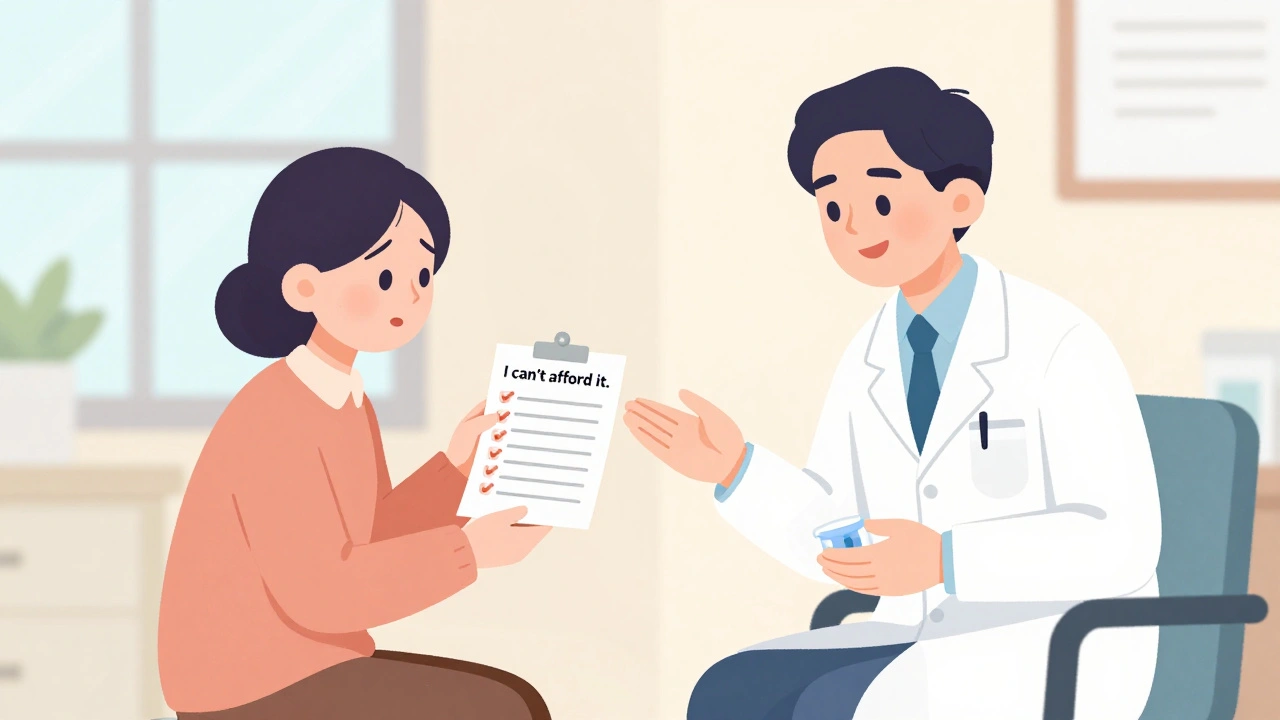
More than half of people with chronic conditions don’t take their medications as prescribed. Not because they’re careless, but because they’re confused, overwhelmed, scared, or ashamed. And too often, they never tell their doctor. If you’ve ever skipped a pill because you didn’t understand why you were taking it, or felt too embarrassed to admit you ran out of money for your prescription, you’re not alone. But here’s the truth: medication compliance isn’t just about remembering to take your pills. It’s about having a real conversation with your doctor-one that doesn’t start with blame and ends with guilt.
Why Talking About Medications Matters More Than You Think
Skipping doses doesn’t just make your condition worse. It costs lives. In the U.S., poor medication adherence leads to 125,000 deaths every year and pushes hospital readmissions up by nearly 8 percentage points. For people with high blood pressure, diabetes, or heart failure, missing even a few doses can trigger a crisis. And the financial toll? Over $300 billion a year in avoidable healthcare costs.
But here’s the surprising part: the problem isn’t usually about forgetfulness. It’s about communication. Studies show that when doctors use open, non-judgmental language, patients are 37% more likely to admit they’re struggling. That’s not magic. It’s basic human psychology. If you feel judged, you shut down. If you feel heard, you open up.
What Doctors Are Taught to Say (And What They Should Say)
Many doctors still start with: “Why aren’t you taking your meds?” That question puts patients on the defensive. It assumes failure before the conversation even begins. Research shows that approach leads to 55% of nonadherence going unreported.
Instead, trained professionals use phrases like: “Lots of people have trouble keeping up with their meds. Do you ever feel that way?” This simple shift works. It normalizes the struggle. It removes shame. And it opens the door to real solutions.
Doctors who use this method also ask follow-ups: “What’s getting in the way?” Not “Why didn’t you take it?” The difference matters. One invites explanation. The other invites guilt.
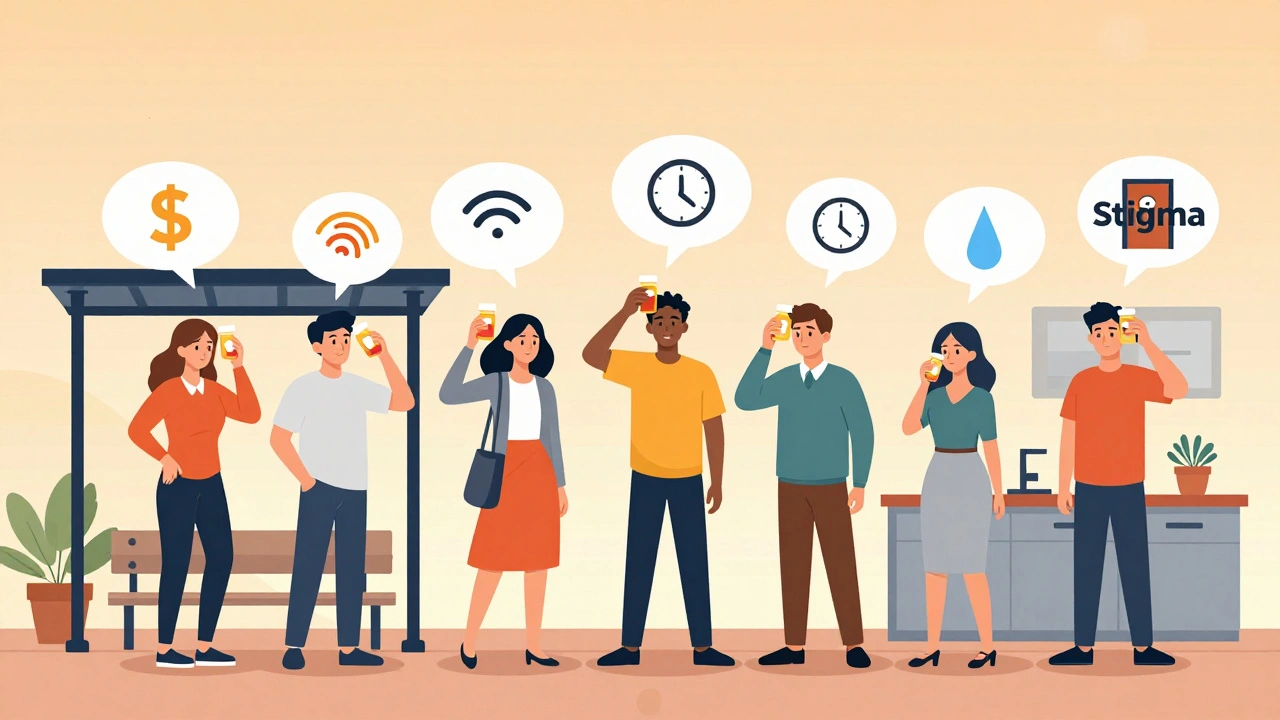
Common Reasons People Skip Medications (And How to Bring Them Up)
You might think your reasons are too small to mention. They’re not.
- Cost: “The pill costs $150 a month. I can’t afford it.” This is the #1 reason people skip meds. But if you don’t say it, your doctor won’t know to help. They can often switch you to a generic, connect you with patient assistance programs, or even write a letter to your insurer.
- Side effects: “I feel dizzy every time I take it.” Don’t tough it out. There are usually alternatives. Maybe a lower dose. Maybe a different time of day. But only if you tell them.
- Too many pills: “I have seven different meds. I get confused.” That’s not your fault. Doctors can simplify regimens. Pill organizers, once-daily combinations, or even apps can help.
- Feeling fine: “I don’t feel sick, so why take it?” This is common with blood pressure or cholesterol meds. But those drugs work quietly. Stopping them doesn’t make you feel worse right away-it just lets damage build up.
- Stigma: “I’m on antidepressants. I don’t want anyone to know.” Your doctor is not here to judge. They’ve seen it all. Talking about it is the first step to managing it well.
Bring up any of these without fear. Your doctor’s job isn’t to scold you. It’s to help you live better.
The Teach-Back Method: A Simple Trick That Works
One of the most powerful tools in medicine isn’t a new drug. It’s a five-second habit called the “teach-back” method.
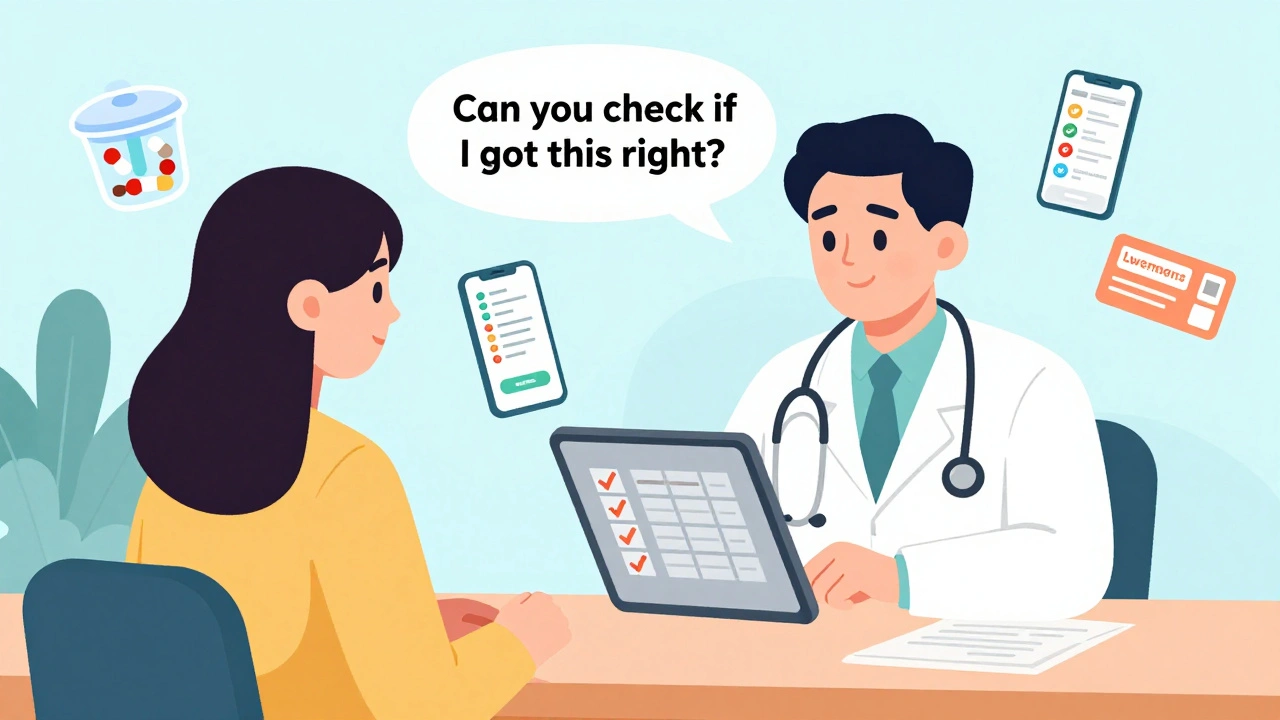
After your doctor explains your meds, they ask: “Can you tell me in your own words how and when you’ll take this?”
It sounds simple. But here’s why it works: 50% of patients leave the office not understanding what they were told. They nod along, afraid to admit they didn’t get it. Teach-back catches that gap. It turns confusion into clarity.
And it’s proven. Patients who use teach-back are 17% more likely to stick to their regimen. You can even ask for it yourself: “Can you just check I got this right?”
What to Do When Your Doctor Doesn’t Ask
Not all doctors are trained in this. If your doctor never brings up adherence, take the lead.
Try this script: “I want to make sure I’m taking my meds right. I’ve been having a hard time keeping up. Can we talk about what’s working and what’s not?”
Or: “I’m worried I’m forgetting doses. Do you have any tools or tips that help people like me?”
These aren’t signs of weakness. They’re signs of strength. You’re taking control of your health.
What to Bring to Your Appointment
Preparation makes the conversation easier.
- Bring all your pills in a bag-even the ones you stopped taking.
- Write down: When you skip, why you skip, and how you feel when you do.
- Know your costs: How much do you pay per month? Can you afford it?
- Write down questions: “Is there a cheaper version?” “What happens if I miss a dose?” “Can I take this with my other meds?”
Don’t rely on memory. Write it down. Your doctor will appreciate it. And you’ll walk out with a plan, not just a prescription.
What Happens When You Do Talk
Real stories show the difference.
One woman in Melbourne stopped her heart medication because she couldn’t afford it. She didn’t say anything until her doctor asked, “Have you been able to fill your prescriptions?” She broke down. The doctor connected her with a local pharmacy program that cut her cost by 80%. She’s been stable for two years now.
A man with diabetes skipped his insulin because he was afraid of needles. He thought he was the only one. His doctor showed him a pen injector, offered a nurse to demonstrate, and gave him a free trial. He now takes it every day.
These aren’t miracles. They’re results of honest talk.
What to Avoid
Don’t lie. Don’t pretend. Don’t nod and smile when you’re confused.
Don’t wait until you’re in the ER to say, “I didn’t take my meds.” That’s too late.
Don’t assume your doctor knows what you’re going through. They don’t. You have to tell them.
And don’t believe the myth that “good patients” never miss doses. There’s no such thing. Good patients are the ones who speak up.
It’s Not Just About Pills. It’s About Partnership.
Medication compliance isn’t a test you pass or fail. It’s a partnership. Your doctor isn’t your boss. They’re your teammate. And like any good team, you need to communicate.
When you talk openly about your meds, you get better outcomes. Fewer hospital visits. Lower costs. More energy. More life.
And the best part? You don’t need to be perfect. You just need to be honest.
What if I feel embarrassed to tell my doctor I’m not taking my meds?
Feeling embarrassed is normal-but it’s also the biggest barrier to getting help. Doctors hear this every day. They’ve seen patients skip meds for cost, side effects, forgetfulness, or fear. They’re not there to judge. They’re there to fix the problem. Start by saying, “I’m worried I’m not taking my meds the way I should.” That’s enough. Most doctors will respond with relief, not blame.
Can my doctor help me if I can’t afford my medication?
Yes. Many medications have generic versions, patient assistance programs, or coupons that cut costs by 50% or more. Some pharmacies offer $4 generic lists. Your doctor can write a letter to your insurer, switch you to a cheaper drug, or connect you with nonprofit programs. But they can’t help if you don’t tell them you’re struggling. Be honest-your health is worth more than your pride.
What if my doctor gets upset when I admit I missed doses?
If your doctor reacts with anger, criticism, or dismissal, that’s not your fault. That’s a sign they need better training. You have the right to respectful care. You can say, “I’m trying to be honest so we can fix this. If you’re not the right person to talk to, can you refer me to someone who is?” Most clinics now have care coordinators or pharmacists trained specifically to help with adherence. Ask for them.
Is it okay to use a pill organizer or phone reminders?
Absolutely. In fact, doctors recommend them. Pill organizers, alarms, and apps like Medisafe or MyTherapy are proven to improve adherence by up to 20%. There’s no shame in using tools. If anything, using them shows you’re serious about your health. Bring your organizer to your next appointment-your doctor might even give you one for free.
How do I know if I’m really taking my meds correctly?
Ask your doctor to walk you through your full list. Many people take meds at the wrong time, mix them with foods they shouldn’t, or double up after missing a dose. Use the teach-back method: “Can you explain how I should take this?” Then repeat it back in your own words. If you’re unsure, call your pharmacist. They’re trained to explain meds in plain language-and they’re usually happy to help.
Next Steps: What to Do Today
- Look at your pill bottle. Do you know why you’re taking it? If not, write down the name and call your pharmacy.
- Write down one reason you’ve struggled with your meds-cost, side effects, confusion, or something else.
- Next time you see your doctor, say: “I want to make sure I’m taking my meds right. Can we talk about what’s working and what’s not?”
- Ask if they use the teach-back method. If not, suggest it.
- Download a free medication tracker app or pick up a pill organizer from your local pharmacy.
Medication compliance isn’t about being perfect. It’s about being real. Your doctor can’t help you if they don’t know what’s going on. So speak up. You’ve already taken the hardest step-you’re reading this. Now take the next one. Talk to them. Your health depends on it.


Grant Hurley
December 3, 2025 AT 06:09Man, I skipped my blood pressure meds for like 3 weeks last year because I thought I was fine. Turned out I wasn’t. My doc didn’t ask, so I didn’t say. Big mistake. This post? 100% needed. Just started using Medisafe and it’s a game changer. No more guessing.
Shannon Gabrielle
December 5, 2025 AT 01:59Wow. Another guilt-trip disguised as public service. Next they’ll tell us to smile more while our insulin costs $400. Real helpful, buddy. Meanwhile, my copay’s higher than my rent. Thanks for the pep talk, Oprah.
ANN JACOBS
December 5, 2025 AT 06:50It is truly remarkable how the intersection of patient autonomy and clinical responsibility can be so profoundly misunderstood in contemporary healthcare discourse. The psychological burden of non-adherence is not merely a function of individual choice, but a systemic failure of accessibility, education, and compassionate communication. I have witnessed firsthand, in my professional capacity as a nurse practitioner, how the simple act of asking, ‘What’s getting in the way?’-rather than ‘Why didn’t you take it?’-can transform a patient’s entire trajectory. The teach-back method, though seemingly elementary, is one of the most empirically validated tools in preventive medicine, yet it remains underutilized due to time constraints and institutional inertia. We must advocate not only for better patient education but for structural reforms that prioritize human connection over bureaucratic efficiency.
Nnaemeka Kingsley
December 5, 2025 AT 14:18Bro, i been there. Took my diabetes pills only when i felt like it. Then my leg went numb. Doc didn’t judge. Just asked ‘what’s stoppin’ you?’ I told him money. He gave me a free sample and a number for help. Now i use a pill box and phone alarm. Simple. But it works. You ain’t weak for strugglin’. You weak for stayin’ silent.
Bee Floyd
December 6, 2025 AT 02:51I used to hide my antidepressants in a spice jar. Thought if I didn’t see them, I didn’t have to deal with them. My doctor asked me one day, ‘Do you ever feel like your meds are working against you?’ That question cracked me open. I didn’t cry. I didn’t panic. I just said, ‘Yeah.’ And we fixed it. No shame. Just science and kindness.
Jeremy Butler
December 6, 2025 AT 03:19The epistemological framework underlying pharmaceutical adherence is predicated upon an implicit assumption of rational agency-a premise that fails to account for socioeconomic precarity, cognitive load, and the phenomenological alienation experienced by individuals navigating complex medical systems. The notion that ‘honesty’ alone resolves structural inequities is a form of neoliberal mystification. While the teach-back method may yield marginal statistical improvements, it does not address the root causes: the commodification of healthcare, the absence of universal pharmacare, and the institutionalized devaluation of patient testimony. To reduce adherence to a behavioral checklist is to obscure the moral economy of suffering.
Patrick Smyth
December 7, 2025 AT 12:08My sister died because she couldn’t afford her heart meds. She didn’t tell anyone. She was too proud. Now I scream at every doctor I meet. ‘ASK THEM!’ Don’t wait for them to break down. Don’t wait for them to ‘speak up.’ You have to force the conversation. They’re scared. You have to be brave for them. I’m not crying. I’m just… tired.
patrick sui
December 7, 2025 AT 21:08Just wanna say-this is the kind of content that makes me believe in humanity again 🙏. The teach-back method? Genius. I use it with my elderly mom. She forgets everything, but if I say ‘Can you tell me how you take this?’ she nails it every time. Also, pill organizers are underrated. Got one from CVS for $3. Game changer. Keep sharing stuff like this.
Declan O Reilly
December 9, 2025 AT 20:27Look i know this sounds corny but i read this whole thing and i cried a little. Not because i’m weak but because i finally felt seen. I’ve been taking my cholesterol pills wrong for 2 years cause i thought ‘if i take it after food it wont hurt so bad’. Turns out it’s supposed to be on empty stomach. My doc never asked. I never told. Now i got a sticky note on my mirror. ‘Take it before coffee.’ Small thing. Big difference. Thanks for not judging.
Conor Forde
December 11, 2025 AT 07:55Wow. So now we’re all supposed to be emotionally intelligent, financially stable, and medically literate while being poor, tired, and medicated? The real problem? Doctors don’t get paid to care. They get paid to prescribe. If you want adherence, pay people to listen. Not just ‘ask’-pay them. Fix the system. Stop putting the burden on the sick.