
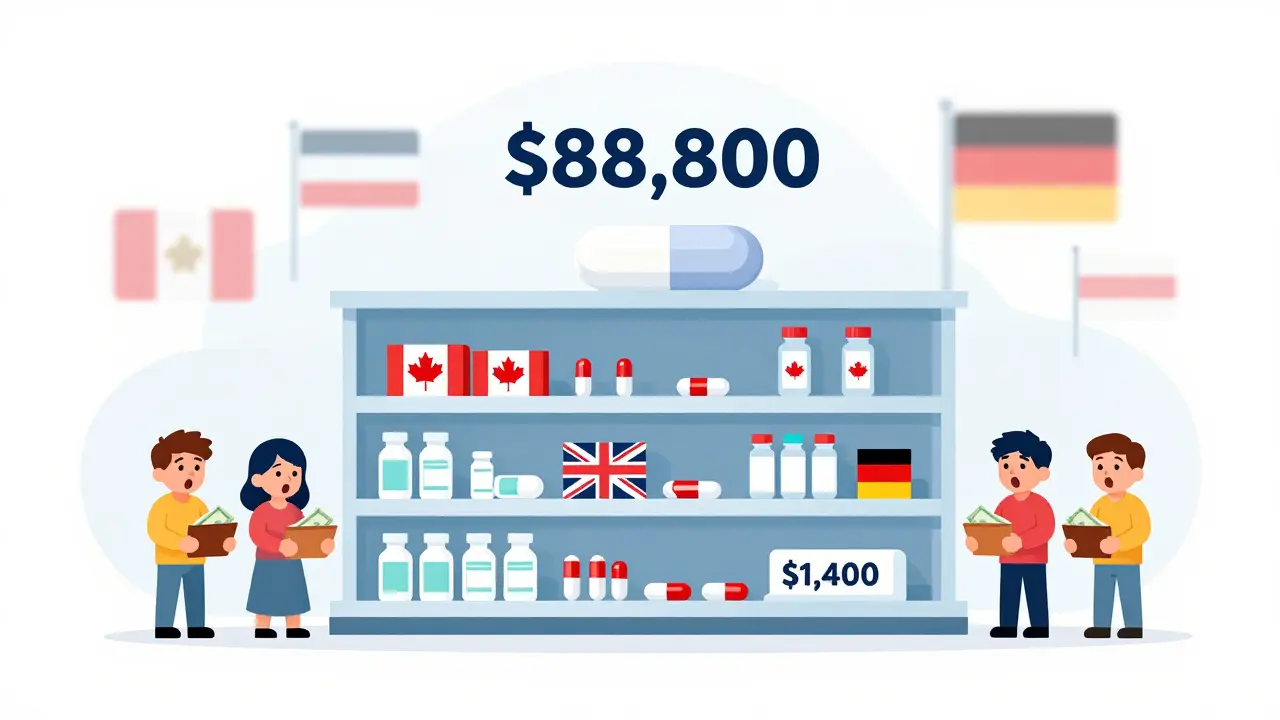
Americans pay three times more for the same prescription drugs than people in Canada, Germany, or the UK. It’s not because the pills are better. It’s not because they’re made with higher-quality ingredients. It’s the same factory, the same chemical formula, the same pill - but in the U.S., it costs $88,800 a year. In the UK, it’s $1,400. That’s not a mistake. That’s the system.
The System Was Built This Way
The U.S. doesn’t have a national drug pricing system. That’s not an accident. It was designed this way. In 2003, Congress passed the Medicare Modernization Act, which banned Medicare from negotiating drug prices directly with manufacturers. That’s the single biggest reason prices stay high. Every other wealthy country negotiates. Canada, France, Australia - they all sit down with drug companies and say, "This is what we’re willing to pay." The U.S. doesn’t. Medicare, which covers over 65 million people, has to take whatever price the company sets. Pharmaceutical companies argue they need high prices to pay for research. But the data doesn’t back that up. The White House found that the U.S. generates 75% of global pharmaceutical profits, even though we’re less than 5% of the world’s population. That means other countries are paying less - and effectively subsidizing drug development in the U.S.Who’s Really in Charge? The Middlemen
You think the price you see at the pharmacy is what the drug company charges? It’s not. There’s a whole chain of middlemen. First, the manufacturer sets a list price - often wildly inflated. Then come the Pharmacy Benefit Managers, or PBMs. These companies were supposed to be negotiators, working to get discounts for insurers. Now, they’re owned by big insurers themselves. Their business model? They get paid based on the size of the rebate they negotiate. So the higher the list price, the bigger the rebate - and the more money they make. That’s why a drug might be listed at $1,000 a pill, but the actual cost to the patient is $350. The PBM takes a cut. The insurer takes a cut. The pharmacy takes a cut. And the patient? They’re left paying the difference - often hundreds, sometimes thousands, of dollars a month.Specialty Drugs Are Breaking the Bank
The biggest price hikes aren’t for antibiotics or blood pressure pills. They’re for specialty drugs: treatments for cancer, diabetes, obesity, and rare diseases. These drugs cost $10,000 to $20,000 a month. And they’re growing fast. IQVIA reported that in 2024, U.S. drug prices rose 11.4% - up from 4.9% the year before. The main drivers? New obesity drugs like Ozempic and Wegovy. These drugs are life-changing for patients. But they’re also profit machines. In 2025, the White House announced deals to lower prices on some of these drugs. Ozempic dropped from $1,000 to $350 a month. Wegovy went from $1,350 to $350. That’s a win. But here’s the catch: those deals only apply to Medicare. Millions of Americans on private insurance still pay the full price. And even those $350 prices are unaffordable for many without insurance.
The Inflation Reduction Act - A Start, But Not Enough
In 2022, Congress passed the Inflation Reduction Act. For the first time, Medicare could negotiate prices on a small number of drugs. In 2026, that list includes ten drugs. Those negotiations are expected to save $1.5 billion in out-of-pocket costs for seniors. That’s real. But it’s a drop in the ocean. The law also introduced a $2,000 annual cap on out-of-pocket drug costs for Medicare Part D beneficiaries. That’s huge. For someone paying $10,000 a year for insulin or cancer drugs, that’s life-changing. But the 2025 budget bill weakened the negotiation program, reducing its potential savings by billions. And it doesn’t help people on private insurance at all.Other Countries Do It Differently - And It Works
In Germany, drug prices are set by a government panel that compares the drug’s effectiveness to existing treatments. If it’s not better, it doesn’t get a high price. In the UK, the National Health Service negotiates bulk prices. In Canada, the Patented Medicine Prices Review Board sets price caps based on what other countries pay. The U.S. is the only developed country that lets drug companies set prices with no limits. And it shows. The same drug - Galzin, used to treat Wilson’s disease - costs $88,800 in the U.S. and $1,400 in the UK. That’s not a pricing error. That’s policy.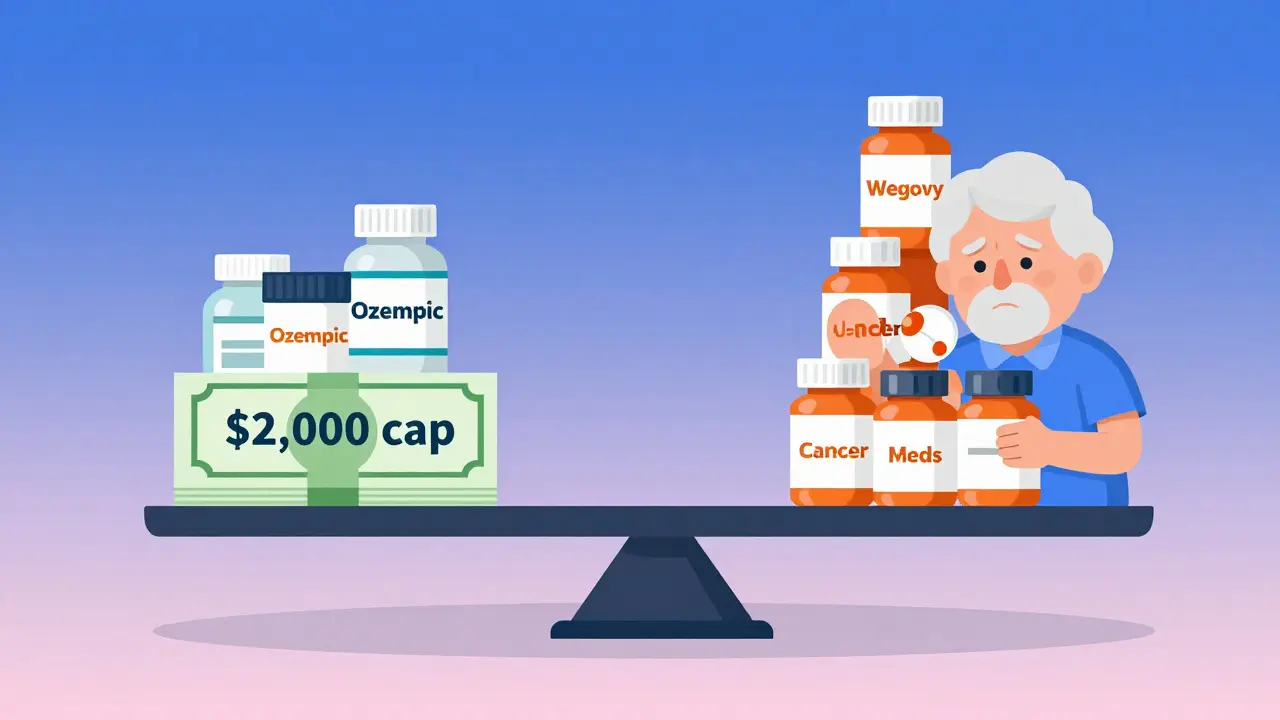
What’s Really Stopping Change?
The pharmaceutical industry spends over $300 million a year lobbying Congress. They fund political campaigns. They hire former lawmakers. They threaten lawsuits. They argue that price controls will kill innovation. But the data says otherwise. The U.S. leads the world in drug innovation - not because prices are high, but because of decades of public funding through NIH research. The government paid for the science. Private companies then took it to market and charged whatever they wanted. Even when presidents promise to lower prices, the system pushes back. Senator Bernie Sanders’ 2025 report found that 688 drugs increased in price since 2017, despite Trump’s public promises to fix it. After Trump sent letters to drug companies asking them to lower prices, 87 drugs went up - by an average of 8%.Who Pays the Real Price?
It’s not just the money. It’s the choices people make. A 2025 report from the Medicare Rights Center found that 1 in 4 seniors skip doses or cut pills in half to make their meds last. Some don’t fill prescriptions at all. One woman in Ohio told her doctor she was rationing her diabetes meds because she couldn’t afford both her insulin and her heating bill. The American Progress report warns that Project 2025’s proposed drug plan could raise costs for 18.5 million seniors. That’s not speculation. It’s based on policy details already published. If those changes happen, more people will choose between food and medicine.What’s Next?
There’s no single fix. But there are real steps that would help:- Let Medicare negotiate prices on all drugs, not just ten.
- Require drug companies to justify price hikes above inflation.
- End the PBM rebate system that rewards higher list prices.
- Adopt international reference pricing - pay what other countries pay.
- Cap out-of-pocket costs for everyone, not just Medicare beneficiaries.
Why do U.S. drug prices cost so much more than in other countries?
The U.S. is the only developed country that doesn’t allow the government to negotiate drug prices. Other nations set price limits based on value, cost, or international benchmarks. In the U.S., drug companies set prices freely, and Medicare is legally barred from negotiating - even though it covers millions of patients. This gives manufacturers near-total pricing power.
What role do Pharmacy Benefit Managers (PBMs) play in high drug prices?
PBMs were created to negotiate discounts for insurers. Today, many are owned by big insurers and make money by maximizing rebates - not lowering costs. The higher the list price, the bigger the rebate they earn. That creates a perverse incentive: they push for higher list prices, even if it means patients pay more out of pocket. Their lack of transparency makes it nearly impossible to track how much of the price actually reaches the patient.
Does the Inflation Reduction Act really lower drug prices?
Yes - but only for a small number of drugs and only for Medicare beneficiaries. Starting in 2026, Medicare can negotiate prices on 10 drugs, with savings projected at $1.5 billion annually. It also caps out-of-pocket costs at $2,000 per year for Medicare Part D users. But it doesn’t apply to private insurance, and the 2025 budget bill weakened its scope. It’s a step forward, but far from a full solution.
Why do drug prices keep rising even when politicians promise to lower them?
Because the system is designed to protect profits. Drug companies spend hundreds of millions lobbying Congress. They own patents that block generic competition for years. Even when presidents publicly pressure companies to lower prices, those same companies often raise them anyway. In 2025, Senator Sanders found 87 drugs increased in price after Trump asked manufacturers to cut costs. The incentives to raise prices are stronger than political pressure.
Are specialty drugs the main reason drug spending is rising?
Yes. Drugs for cancer, diabetes, obesity, and rare diseases are driving the biggest increases. IQVIA reports these specialty drugs caused 9-11% growth in U.S. drug spending in 2024 and 2025. While they’re often life-saving, they’re also extremely expensive - sometimes over $1,000 per dose. Their high cost comes from complex manufacturing, small patient populations, and limited competition, which lets manufacturers charge whatever the market will bear.
Can the U.S. adopt the same pricing system as Canada or the UK?
Legally, yes. The Prescription Drug Price Relief Act, introduced in 2025, would require U.S. drug prices to match those in five major countries - Canada, the UK, Germany, France, and Japan. This is called international reference pricing. It’s already used successfully in most developed nations. The main barrier isn’t technical - it’s political. The pharmaceutical industry has spent decades fighting these kinds of reforms.
What happens if nothing changes?
Drug spending will keep rising. IQVIA predicts a 9-11% increase in 2025, with specialty drugs leading the way. More patients will skip doses, ration pills, or go without medication. Medicare costs will keep climbing, putting pressure on federal budgets. And Americans will continue to pay more for the same drugs than anyone else on Earth - with no end in sight.

Anna Weitz
December 27, 2025 AT 17:38The system is rigged and everyone knows it
Drug companies don't invent cures they invent profit engines
We pay for their stock options not our health
And the politicians? They're on the payroll
It's not capitalism it's corporate feudalism
And we're the serfs with insulin pens
Someone once said freedom isn't free
Turns out medicine isn't either
Jane Lucas
December 28, 2025 AT 05:41i just cut my metformin in half to make it last
my cat eats better than me and she dont need prescriptions
Elizabeth Alvarez
December 28, 2025 AT 13:29Did you know the FDA is secretly owned by Big Pharma? They've been suppressing generic versions since the 90s
And the WHO? Same deal. They take bribes to keep prices high
There's a hidden network of shadow boards that decide who lives and who dies based on stock portfolios
That's why Ozempic is $350 now - it's a controlled release scam
The real cure is already out there but they bury it in patent cliffs and offshore shell companies
They even tamper with clinical trials to make cheaper alternatives look unsafe
It's not just greed it's a full-scale medical dictatorship
And they're using your Medicare card as a weapon
Miriam Piro
December 30, 2025 AT 01:27They call it capitalism but it's just legalized robbery with a white coat
They patent genes for chrissake 😤
And now they're charging us for the science WE paid for with our taxes 🤡
NIH did the work, then Pfizer swooped in like a vulture and slapped a $100k price tag on it
Meanwhile my neighbor's kid has to choose between insulin and rent
And the CEOs? They're on a yacht in Monaco sipping champagne with their 12th private jet
It's not a market failure - it's a moral collapse
And we're all just collateral damage in their profit game 🫠
Will Neitzer
December 30, 2025 AT 17:50While the systemic issues raised in this post are undeniably profound, it is imperative to acknowledge that the pharmaceutical industry also bears the burden of extraordinarily high R&D costs, regulatory compliance, and clinical trial logistics.
That said, the current PBM rebate structure is indeed perverse and requires immediate reform.
Moreover, the limited scope of Medicare negotiation under the Inflation Reduction Act, while commendable, is insufficient to address the broader crisis.
Legislative action to mandate international reference pricing and eliminate rebate-based incentives would represent a statistically significant step toward equitable access.
Collaborative policy design - involving stakeholders from patient advocacy groups, insurers, and manufacturers - remains the most viable path forward.
It is not a question of whether reform is possible, but whether we possess the collective will to implement it.
Janice Holmes
December 31, 2025 AT 07:49OMG I CAN'T EVEN
YOU KNOW WHAT HAPPENED TO MY FRIEND? SHE TOOK HER DIABETES MEDS FOR TWO WEEKS THEN JUST STOPPED
SHE SAID SHE COULDN'T CHOOSE BETWEEN HER KID'S SCHOOL SUPPLIES AND HER INSULIN
AND NOW SHE'S IN THE HOSPITAL AGAIN
THIS ISN'T HEALTHCARE THIS IS A HORROR MOVIE AND WE'RE ALL STUCK IN IT
THEY'RE MAKING BILLIONS OFF OUR PAIN AND WE'RE STILL SITTING HERE LIKE GOOD LITTLE CITIZENS
WHEN ARE WE GOING TO RIOT??
THEY'RE NOT GOING TO FIX THIS THEMSELVES
WE HAVE TO BREAK THE SYSTEM
OR WE'RE ALL DEAD IN FIVE YEARS
Olivia Goolsby
December 31, 2025 AT 16:28Let me tell you something - this isn't about drugs, it's about control!
They're using pharmaceuticals to depopulate the lower classes, and you're too blind to see it!
They want you dependent, they want you broke, they want you too tired to protest!
And don't even get me started on the WHO and the CDC - they're all in on it!
They release a drug, then they raise the price, then they tell you it's 'essential' - so you pay!
Meanwhile, they're secretly testing mind-control chemicals in the water supply - that's why the prices are so high, they're covering up the real experiments!
And the PBMs? They're not middlemen - they're AI-driven surveillance bots tracking your prescriptions!
They're building a database of who's sick so they can target you next with higher premiums!
And the Inflation Reduction Act? A distraction! A shiny object while they pass the Real Bill - the one that lets them patent your DNA!
You think you're getting medicine? No - you're paying for your own surveillance and social engineering!
Wake up before they take your last pill - and your last right!
Alex Lopez
January 2, 2026 AT 08:48Interesting how everyone blames Big Pharma while ignoring that the U.S. is the only country where drug pricing is completely deregulated - and yet somehow still leads in innovation.
Perhaps the issue isn't greed, but the lack of a coherent pricing framework.
Also - PBMs are a disaster, yes - but let’s not pretend that government price controls won’t create their own set of unintended consequences.
For example: reduced R&D investment, fewer new drugs, longer wait times.
Maybe instead of vilifying every actor, we should focus on transparency - force PBMs to disclose their rebates, cap out-of-pocket costs universally, and allow Medicare to negotiate across the board.
It’s not about being anti-corporate - it’s about being pro-patient.
And yes - $88k for a pill is absurd.
But let’s fix the system, not just scream at the shadows.
😉
Gerald Tardif
January 2, 2026 AT 11:21Look - I’ve been in this game for 20 years.
Drug companies aren’t evil - they’re just following the rules we gave them.
But the rules are broken.
The rebate system? Toxic.
Medicare’s hands tied? Criminal.
Patients choosing between food and insulin? Unforgivable.
Here’s the thing - change doesn’t come from rage.
It comes from smart, quiet, relentless pressure.
Vote for the people who’ll fight for negotiation.
Call your reps - not once, but every week.
Join a patient advocacy group.
Help someone fill a prescription.
It’s not glamorous.
But it’s how real change happens.
One pill. One person. One vote at a time.
Don’t burn it down.
Build something better.
Monika Naumann
January 2, 2026 AT 23:42In India, we have universal access to life-saving medications at less than 5% of U.S. prices - because our government prioritizes human life over corporate profits.
It is shameful that the United States, a nation with the greatest technological and scientific capacity on Earth, allows its citizens to suffer under a predatory, profit-driven healthcare model.
While we in India face challenges of infrastructure and distribution, we do not allow pharmaceutical monopolies to dictate who lives and who dies.
It is not a question of economics - it is a question of moral character.
The American system is not broken - it is intentionally cruel.
And until the U.S. embraces the principle that health is a human right - not a commodity - it will remain a global disgrace.