
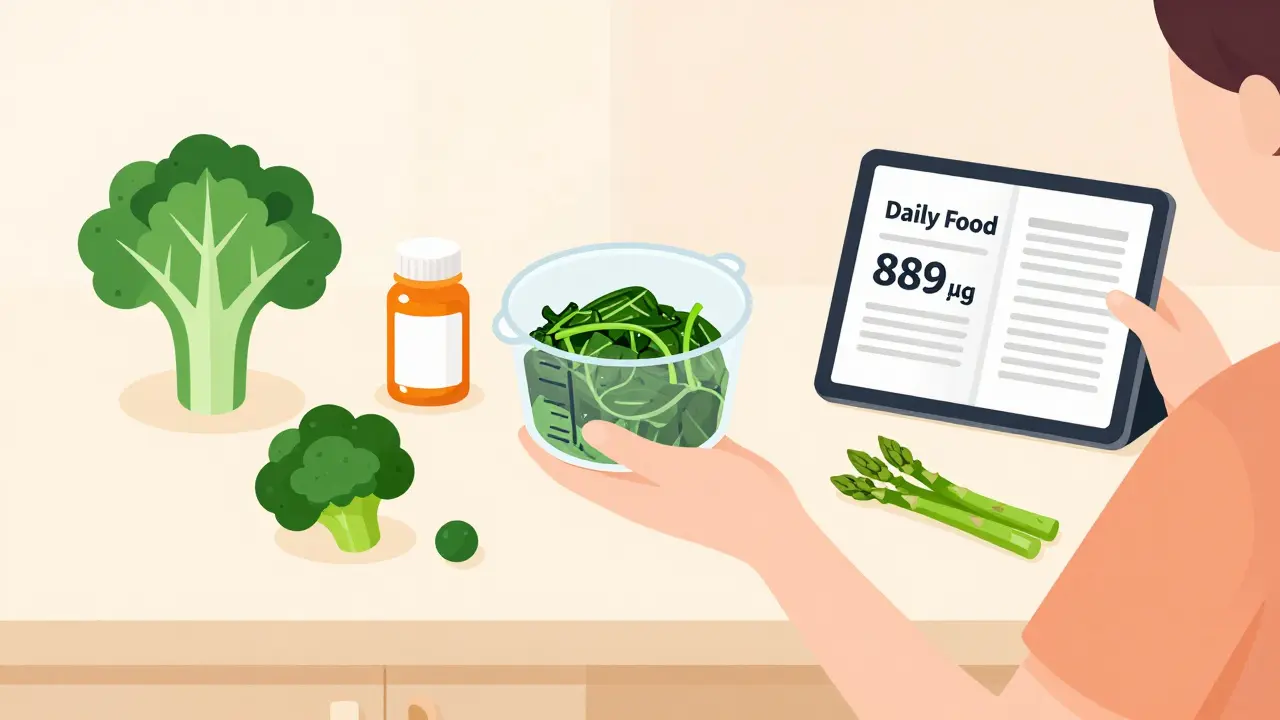
Vitamin K Intake Calculator for Warfarin Patients
Calculate your daily vitamin K intake from foods and supplements to stay within the target range of 90-120 µg. Consistency is key for stable INR levels while on warfarin.
Add Your Daily Vitamin K Sources
Your Daily Vitamin K Intake
Your target is 90-120 µg per day
When you're on warfarin, your diet isn't just about eating healthy-it's about eating consistent. One day you eat a big salad with spinach and kale, the next you skip greens entirely, and suddenly your INR drops. That’s not luck. That’s risk. Warfarin works by blocking vitamin K, the nutrient your body needs to make blood clot. Too much vitamin K, and the drug doesn’t work well. Too little, and you could bleed too easily. The goal isn’t to avoid vitamin K. It’s to keep it steady.
Why Vitamin K Matters So Much on Warfarin
Warfarin doesn’t thin your blood directly. It stops your liver from using vitamin K to activate clotting factors. Think of vitamin K as the key that turns on your body’s clotting system. Warfarin jams that key. If you suddenly eat a lot of vitamin K-say, a huge bowl of cooked spinach-you’re flooding the system with keys. Your body starts making clotting factors again. Your INR plummets. That’s when clots can form. On the flip side, if you go days without vitamin K, your body runs out of keys. Warfarin works too well. Your INR spikes. You’re at risk for bleeding.Studies show that people who eat 90 to 120 micrograms (µg) of vitamin K every day, give or take a little, stay in their target INR range 75-80% of the time. Those who swing wildly-eating greens one day and none the next-only hit the target 55-65% of the time. That’s not just inconvenient. It’s dangerous.
Which Foods Are High in Vitamin K?
Not all greens are created equal. Some pack a punch. Others barely register. Here’s what you need to know:- 1 cup cooked spinach: 889 µg
- 1 cup cooked kale: 547 µg
- 1 cup cooked collard greens: 772 µg
- 1 cup cooked broccoli: 220 µg
- 1 cup raw spinach: 145 µg
- ½ cup cooked asparagus: 70 µg
- ½ cup green beans: 14 µg
Notice the difference between raw and cooked spinach? Cooking concentrates vitamin K. That’s why a salad one day and a sautéed spinach side dish the next can throw your INR off. It’s not the spinach-it’s the change.
Other sources include Brussels sprouts, cabbage, and soybean oil. Even some fermented foods like natto (a Japanese soybean dish) are extremely high in vitamin K2, which also affects warfarin. Don’t assume “healthy” means safe. A green smoothie with kale, spinach, and parsley could easily hit 1,000 µg of vitamin K in one go.
Consistency Over Restriction: The Real Rule
For years, doctors told people on warfarin to avoid green vegetables. That advice is outdated-and harmful. Cutting out vitamin K doesn’t make warfarin safer. It makes your INR more unpredictable.Here’s what actually works: pick one or two high-vitamin-K foods you like, and eat the same amount every day. If you love spinach, have one cup cooked, every morning. If you prefer broccoli, have half a cup every night. Don’t switch. Don’t skip. Don’t binge.
Research from Brigham and Women’s Hospital shows patients who tried to eliminate vitamin K ended up with worse INR control. Why? Because when they slipped-maybe ate a bit of salad at a restaurant-their bodies reacted hard. Their INR crashed. Emergency doses were needed.
On the flip side, patients who ate 90-120 µg daily, no matter the source, had INR stability that matched or beat those on newer, pricier blood thinners. The American Heart Association, the American College of Cardiology, and the American Society of Hematology all agree: consistency, not restriction, is the gold standard.
What About Supplements and Meal Replacements?
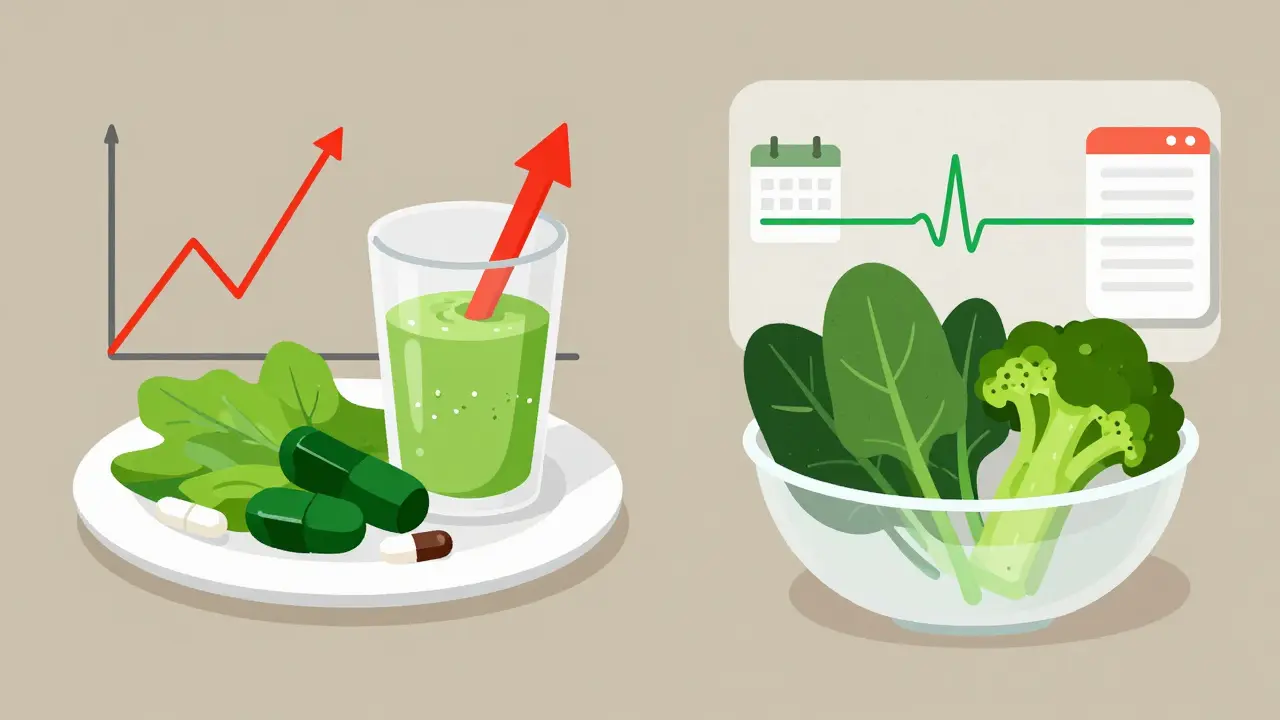
It’s not just vegetables. Many supplements and drinks sneak in vitamin K.- Ensure®: 50 µg per serving
- Boost®: 55 µg per serving
- Many multivitamins: 50-100 µg (check the label)
- Vitamin K2 supplements: often 100-200 µg
If you’re taking any of these, tell your anticoagulation clinic. Even small, daily doses can interfere with your warfarin dose. If you’ve been taking a multivitamin for years, don’t quit cold turkey. Just keep it the same. Consistency still applies.
Antibiotics can also mess with your vitamin K. Your gut bacteria make a small amount of vitamin K2. When antibiotics wipe them out, your vitamin K drops-sometimes by 70%. That can cause your INR to rise unexpectedly. If you’re on antibiotics, monitor your INR more closely. Don’t assume it’s just the infection.
How to Build a Stable Routine
You don’t need to become a nutritionist. You just need to be predictable.- Choose your daily vitamin K food: pick one high-K food (spinach, kale, broccoli) and stick to one portion size. Example: 1 cup cooked spinach every morning.
- Track it: Use a food diary or an app like MyFitnessPal or CoumaDiet. Log your portion size, not just “greens.”
- Plan ahead: If you’re going out to dinner, check the menu. If you know you’ll eat a big salad, skip your morning spinach. Don’t double up.
- Keep portions simple: Don’t mix five different greens. Pick one. Cook it the same way. Same amount. Every day.
- Don’t change your routine during illness: If you’re sick and eating less, your INR might rise. Call your clinic. Don’t adjust your warfarin dose yourself.
Most people need 8 to 12 weeks to get into a rhythm. INR stability improves about 5% per month. That’s slow-but it’s steady. And that’s what matters.
What to Do When Things Go Off Track
Even with the best routine, things happen. You eat a kale salad at a friend’s house. You forget your spinach. You’re traveling.If you eat a high-vitamin-K meal:
- Don’t panic.
- Don’t skip your next dose.
- Do call your anticoagulation clinic. They may want to check your INR sooner.
If you eat almost no vitamin K for a few days:
- Same thing. Don’t adjust your dose.
- Get back to your normal intake as soon as possible.
- Let your clinic know. Your INR might be higher than usual.
The biggest mistake? Trying to fix it yourself. Warfarin doses are fine-tuned based on your INR, your weight, your age, your other meds. A single meal won’t ruin your therapy-but a rushed dose change might.
Why This Still Matters in 2026
Newer blood thinners like apixaban and rivaroxaban don’t care about vitamin K. So why does warfarin still exist? Because it’s cheap. Generic warfarin costs $4 to $10 a month. The alternatives cost over $3,000. For many people-especially older adults on fixed incomes-warfarin is the only option.And here’s the truth: if you manage your vitamin K intake well, warfarin works just as well as the expensive drugs. In fact, a 2023 study showed patients with consistent vitamin K intake had fewer clots and bleeds than those on DOACs who skipped doses.
But only if they’re consistent.
That’s why education still matters. Many doctors still tell patients to avoid greens. A 2023 survey found 41% of primary care providers give outdated advice. Don’t let that be you. Ask your pharmacist or anticoagulation nurse for the updated guidelines. Bring this article. Ask: “Should I avoid vitamin K, or just keep it steady?”
Real Stories, Real Results
One woman in Ohio ate kale salads three times a week. Her INR bounced between 1.5 and 3.8. She felt anxious. She stopped eating greens entirely. Her INR jumped to 5.2. She ended up in the ER with bleeding gums.After switching to one cup of cooked spinach every day, her INR stabilized at 2.4. Her TTR (time in therapeutic range) went from 52% to 81% in six months.
A man in Texas used to eat spinach once a week. He thought he was being careful. His INR was always off. His clinic taught him to eat half a cup every day. He started using the CoumaDiet app to log it. His INR hasn’t been out of range since.
It’s not about perfection. It’s about pattern.
Can I eat spinach if I’m on warfarin?
Yes, but only if you eat the same amount every day. One cup of cooked spinach has nearly 900 µg of vitamin K. That’s fine-if you have it daily. If you eat it one day and skip it the next, your INR will swing dangerously. Consistency is the key, not avoidance.
Is it better to avoid vitamin K completely?
No. Avoiding vitamin K makes your INR more unstable. Your body needs vitamin K to function. When you cut it out, even small amounts (like a handful of broccoli) cause big INR drops. Experts agree: eating a steady 90-120 µg per day is safer than restriction.
Do I need to stop eating green vegetables?
No. You don’t need to stop. You need to be consistent. Pick one or two greens you like, eat the same portion every day, and track it. That’s all. You can still have a healthy, vegetable-rich diet-it just needs to be predictable.
What if I forget my vitamin K food one day?
Don’t double up the next day. Just get back to your normal routine. If you miss a day, your INR might rise slightly, but it’s not an emergency. Call your clinic if you miss more than two days in a row or if you feel unwell.
Can I use a vitamin K supplement to stabilize my INR?
Some patients with unstable INRs benefit from a daily 100-150 µg vitamin K supplement, but only under medical supervision. Don’t start one on your own. It can interfere with your warfarin dose and make things worse if not monitored.
How long does it take to see improvement in INR stability?
Most people see improvement within 8 to 12 weeks of consistent intake. INR stability typically improves by about 5% per month. It’s not fast, but it’s lasting. The goal is to reduce the number of INR checks and emergency visits over time.
Are there apps to help track vitamin K intake?
Yes. Apps like CoumaDiet and INR Tracker Pro are designed for people on warfarin. They use USDA data to track vitamin K in foods and can help you log your daily intake. Many anticoagulation clinics recommend them. MyFitnessPal also works if you log portions carefully.
Next Steps: What to Do Today
1. Check your last INR report. Look at your time in therapeutic range (TTR). If it’s below 70%, your diet might be the issue. 2. Write down what you ate yesterday. Did you have spinach? Kale? Broccoli? How much? Be specific. 3. Choose one food. Pick one high-vitamin-K food you’re willing to eat daily. Start with a small, known portion. 4. Call your anticoagulation clinic. Ask: “What’s my target vitamin K intake?” and “Do you have a food list with exact µg values?” 5. Download an app or start a food diary. Log your vitamin K intake every day for two weeks. You’ll see patterns you never noticed before.You don’t need to be perfect. You just need to be predictable. That’s how you stay safe on warfarin.

Amber Daugs
January 27, 2026 AT 17:58You people still don't get it, do you? Eating spinach every day like it's cereal? That's not consistency-that's obsession. Warfarin isn't a diet plan, it's a medical treatment. If you're that obsessed with your greens, maybe you should've picked a DOAC. Stop pretending this is some zen ritual. It's pharmacology, not yoga.
And don't even get me started on those apps. CoumaDiet? Really? Next you'll be tracking your vitamin K with a crystal and a tarot deck.
I've seen 70-year-olds on warfarin for 15 years who never tracked a damn thing and never had a clot. Your INR isn't broken because you missed a kale smoothie. It's broken because you're scared of your own shadow.
Stop blaming your diet. Start blaming your doctor for not adjusting your dose properly.
And if you're still on warfarin in 2026? You're either broke or stubborn. Pick one.
Ambrose Curtis
January 27, 2026 AT 22:08lol i used to be the guy who’d eat a whole bag of spinach salad on monday and then go cold turkey til friday. my inr would swing like a pendulum. doc said ‘just pick one thing and eat it every day’ so i picked broccoli. half a cup, steamed, every night. no more stress. no more panic before blood tests. my inr’s been stable for 11 months now.
and yeah, i still eat other greens sometimes-but not the same amount. consistency isn’t about being perfect. it’s about being predictable. my body knows what to expect now. that’s the magic.
also-yes, i use coumadiet. it’s dumb but it works. and i don’t care if it’s ‘too techy.’ i’d rather have a stable INR than look cool.
Robert Cardoso
January 28, 2026 AT 13:29Let’s be brutally honest: the entire premise of this article is built on a flawed assumption-that vitamin K intake is the primary variable influencing INR stability. It’s not. Weight fluctuations, hydration status, liver function, concurrent medications (especially antibiotics), and even circadian rhythm have a far greater impact than dietary K.
The 90–120 µg range? That’s a population average. Individual metabolic clearance rates vary by up to 400%. One person’s ‘consistent’ is another’s overdose.
And let’s not ignore the confounding variable: gut microbiome. The paper from Brigham and Women’s? It didn’t control for antibiotic use in the prior 30 days. That’s a massive oversight.
Furthermore, vitamin K2 from fermented foods like natto has a different half-life than K1. Mixing them without accounting for isoform kinetics is biochemical negligence.
App tracking? Cute. But if your INR is unstable, the problem isn’t your spinach. It’s your dosing algorithm. Fix the pharmacokinetics, not the salad.
jonathan soba
January 30, 2026 AT 07:28Interesting how everyone here treats vitamin K like it’s some sacred ritual. Meanwhile, in the real world, people on warfarin are dying because they got a new prescription for amoxicillin and didn’t tell anyone. Or they started taking OTC painkillers. Or they drank grapefruit juice. But no-let’s focus on whether you had spinach or kale.
It’s not that the advice is wrong. It’s just that it’s the *easiest* thing to blame. Easier than admitting your clinic doesn’t have the resources to monitor you properly.
Consistency helps. But it’s not a cure-all. And pretending it is? That’s dangerous. You’re letting patients think they’re in control when they’re not. The drug does the work. You’re just along for the ride.
matthew martin
February 1, 2026 AT 01:19Man, I used to be terrified of greens. Thought I had to give them up entirely. Then my anticoagulation nurse sat me down and said, ‘Pick one thing you actually like and eat it like clockwork.’ I picked boiled broccoli. Half a cup, every night, same time, same pot.
It’s not sexy. It’s not trendy. But it’s mine. I don’t stress. I don’t check my INR like a gambling addict. I just show up. Same broccoli. Same time. Same life.
And yeah-I still eat other veggies. But I don’t count them. I don’t log them. I just don’t turn them into a daily ritual. That’s the secret. You don’t need to control everything. Just control one thing. That’s enough.
Also-my dog knows when it’s broccoli night. He sits by the pot. He’s more consistent than I was.
Jeffrey Carroll
February 1, 2026 AT 02:36While the emphasis on dietary consistency is scientifically sound and clinically validated, it is equally important to recognize the psychological burden this places on patients. The pressure to maintain rigid daily intake patterns may inadvertently contribute to anxiety, disordered eating behaviors, or non-adherence due to perceived inflexibility.
It is imperative that clinicians frame this guidance not as a rulebook, but as a personalized tool-offering structure without rigidity. The goal is not perfection, but sustainable, manageable routine.
Patients should be empowered to adapt within a framework, not imprisoned by it. A single deviation should not trigger guilt or panic, but rather serve as a data point for clinical review.
Consistency, yes-but compassion must accompany it.
doug b
February 2, 2026 AT 22:50Here’s the truth: you don’t need an app. You don’t need to memorize micrograms. Just pick one green. One portion. Every day. Same time. That’s it.
I used to be the guy who’d eat a whole pot of kale on Sunday and then forget about it for a week. My INR was a rollercoaster. Then I started eating one cup of cooked spinach every morning with my coffee. No more guessing. No more stress.
My doctor was shocked. Said my TTR jumped from 58% to 84% in three months.
It’s not magic. It’s just… showing up. Same as brushing your teeth. You don’t need a PhD to do it right.
Katie Mccreary
February 4, 2026 AT 07:23So you’re telling me I have to eat the same damn spinach every day? What if I hate it? What if I’m sick? What if I’m on vacation? You’re asking me to turn my life into a spreadsheet.
And don’t even get me started on those apps. I’m not downloading another thing to track. I have enough apps telling me how to live.
Maybe the real problem is that warfarin is outdated. Not my diet.
SRI GUNTORO
February 5, 2026 AT 17:59In my country, we don’t need apps or charts. We just eat what our grandmother cooked. Spinach, mustard greens, bitter melon-all part of daily meals. No one ever died from warfarin in my village. Because we never changed what we ate.
Modern medicine thinks it’s smarter than tradition. It’s not.
Consistency isn’t a strategy. It’s culture.
Kevin Kennett
February 5, 2026 AT 23:12I used to think this was all nonsense. Then my mom had a stroke because her INR dropped after a big salad. She didn’t know the difference between raw and cooked spinach. She thought ‘healthy’ meant ‘safe.’
After she got back home, we sat down. We picked broccoli. Half a cup. Every night. No more guessing. No more panic. She’s been stable for two years now.
It’s not about being perfect. It’s about being present. You don’t have to love the food. You just have to show up for it.
And if you’re too busy to cook? Steam a bag of frozen broccoli. It’s the same damn thing. Same vitamin K. Same peace of mind.
Jess Bevis
February 7, 2026 AT 21:53Natto is wild. I tried it once. Tasted like fermented socks. But it’s got 1,000 µg per serving. One bite and your INR goes nuclear.
My Japanese neighbor eats it daily. Said his doctor told him to keep it steady. He doesn’t even look at the label. Just eats it. Like rice.
Point is: culture doesn’t care about apps. It just eats. And stays alive.
Rose Palmer
February 8, 2026 AT 10:15While the clinical guidance presented herein is empirically supported and endorsed by major professional societies, it is imperative to underscore the necessity of individualized care. Dietary adherence must be contextualized within socioeconomic, cognitive, and psychosocial determinants of health. A one-size-fits-all approach to vitamin K intake may inadvertently exacerbate health disparities among populations with limited access to fresh produce, nutrition education, or anticoagulation monitoring services.
It is not sufficient to instruct patients to ‘choose one food’ without addressing barriers to consistent access, preparation, or cultural acceptability. Structural interventions-such as subsidized produce programs, culturally tailored dietary counseling, and telehealth monitoring-are equally critical to achieving therapeutic stability.
Consistency is a goal. Equity is the foundation.
Lance Long
February 8, 2026 AT 19:47I used to think I was being healthy by eating giant green smoothies every morning. Kale. Spinach. Parsley. Chia. Flax. All the superfoods.
Then my INR spiked to 6.8. I was bleeding from my gums. My wife cried. I almost died.
Turns out, one of those smoothies had 1,200 µg of vitamin K. I didn’t know. I thought ‘more greens = better.’
Now? I eat one cup of cooked spinach every morning. Same time. Same spoon. Same pot. No more smoothies. No more guessing.
My INR is 2.3. I sleep at night. I hug my wife. I live.
It’s not glamorous. But it’s mine.
And if you’re still trying to ‘optimize’ your greens? You’re not being healthy. You’re being reckless.