
When you buy a hearing aid, you’re not just buying a device-you’re buying a solution to hear clearly in noisy rooms, understand your grandkids, and reconnect with conversations you’ve been missing. But here’s the thing most people don’t know: hearing aid fitting without real-ear measurement (REM) is like prescribing glasses without checking the prescription. You might get something that looks right, but it won’t actually work for your ears.
What Real-Ear Measurement Actually Does
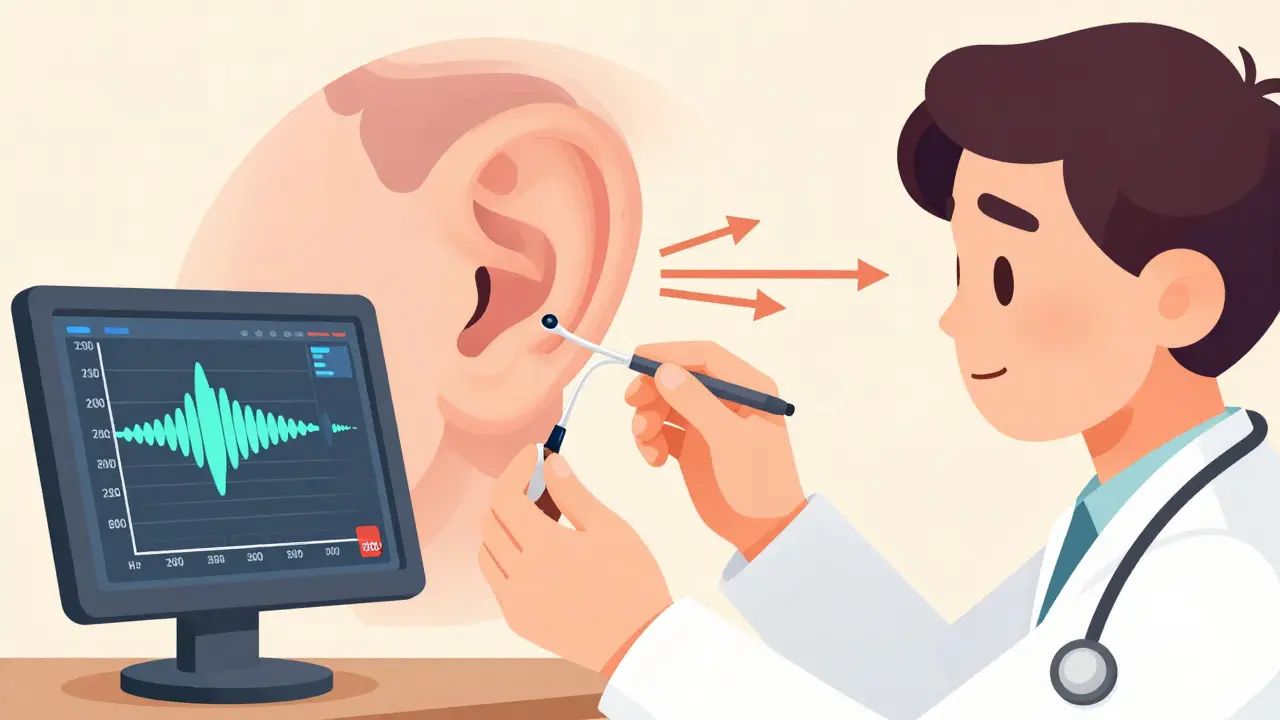
Real-ear measurement (REM) is the only way to see exactly how much sound your hearing aid is delivering inside your own ear canal. It’s not a guess. It’s not a simulation. It’s a direct, real-time measurement using a tiny microphone placed near your eardrum. This probe mic picks up the actual sound pressure levels-measured in decibels (dB)-across the full range of speech frequencies, from 250 Hz to 8000 Hz.
Why does this matter? Because every ear is different. The shape of your ear canal, the size of your eardrum, even the thickness of your earwax changes how sound travels. Research from the International Journal of Audiology shows these differences can cause up to 20 dB of variation in sound delivery between people. That’s like turning the volume up or down by half on your TV. If your hearing aid isn’t calibrated to your unique anatomy, you’re not getting the right amplification.
REM compares what your hearing aid is actually producing to a scientifically proven target-like NAL-NL2 or DSL v5.0-that’s based on your hearing test results. The goal? To make sure soft speech is audible, normal speech is clear, and loud sounds aren’t too harsh. This isn’t optional. It’s the standard endorsed by the American Speech-Language-Hearing Association (ASHA), the American Academy of Audiology (AAA), and the American Medical Association (AMA).
How REM Works Step by Step
The process takes about 15 to 25 minutes, but it’s one of the most important parts of your fitting. Here’s what happens:
- An audiologist checks your ear canal with an otoscope to make sure there are no blockages, infections, or perforations.
- A thin, flexible probe tube-just 0.5 to 1.0 mm wide-is gently inserted into your ear canal, placed within 5 mm of your eardrum. This is measured from the intertragal notch, not just eyeballed.
- Your hearing aid is inserted, and the probe stays in place. You’ll hear a series of speech sounds played through a calibrated speaker positioned at a 45-degree angle.
- The system measures how much sound reaches your eardrum with the hearing aid in, then compares it to your target curve.
- The audiologist adjusts the hearing aid settings in real time until the output matches the prescription.
It’s not just about one setting. They test at multiple input levels-50 dB (whisper), 65 dB (normal conversation), and 80 dB (shouting)-to make sure the device works across all situations. And yes, it’s normal to feel a slight tickle. About 22% of first-time users report mild discomfort, but 98% say it’s brief and worth it.
Why Other Methods Fall Short
Most hearing aids come with a default “first fit” setting based on manufacturer algorithms. These are built using averages from standardized test boxes (2cc couplers), which simulate an “average” ear. But here’s the problem: less than 1 in 5 people actually have an average ear.
Studies show these first-fit settings only hit the target gain about 52% of the time. That means nearly half the time, your hearing aid is either too quiet or too loud. Compare that to REM, which gets you within target 92% of the time.
Even advanced software from brands like Phonak or Oticon-tools that claim to predict real-ear performance-only correlate at 65% accuracy with actual measurements. And over-the-counter (OTC) hearing aids? The FDA explicitly says they can’t replace professional fitting because they lack any verification process.
Without REM, you’re relying on guesswork. With it, you’re getting science-backed precision.
The Real Impact on Your Daily Life
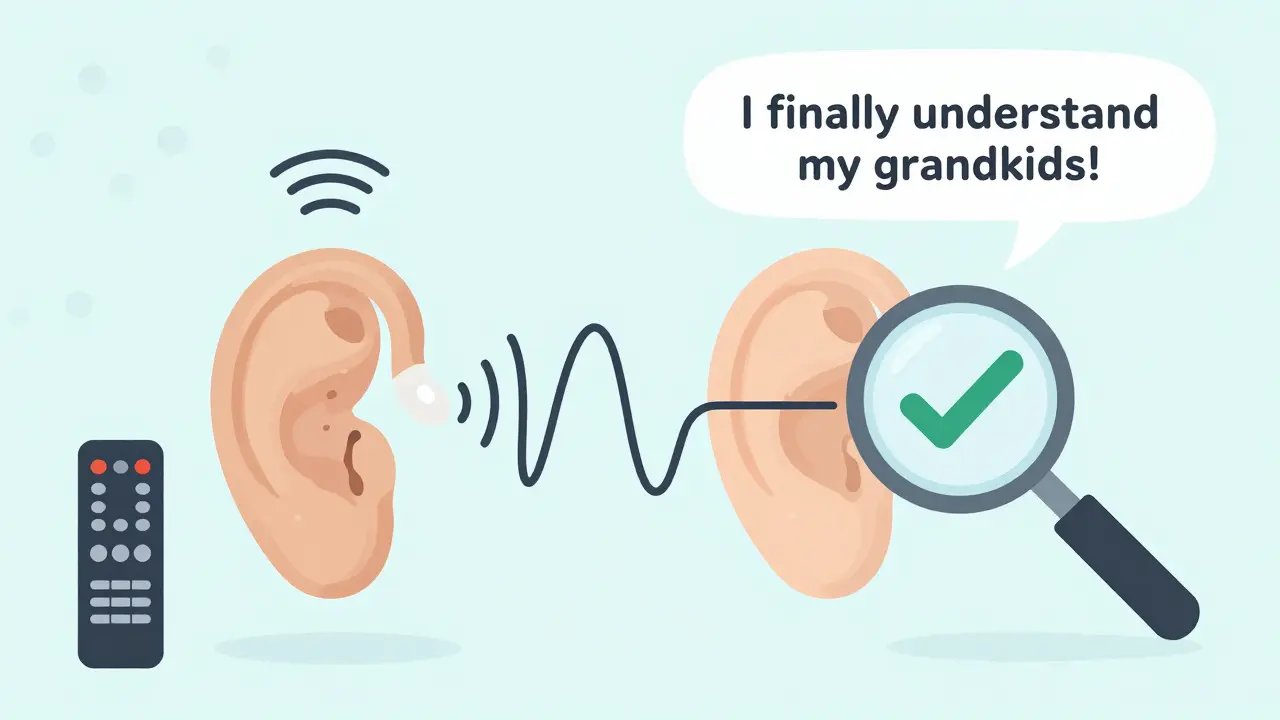
People who get REM during their fitting don’t just get better numbers-they get better lives.
A 2022 survey of 1,247 hearing aid users on HealthyHearing.com found that 87% of those who had REM rated their hearing aids as “very effective.” Only 52% of those without REM said the same. In the MarkeTrak XVII study, 76% of REM-fitted users reported immediate improvements in speech clarity. Nearly 7 out of 10 noticed less listening effort-meaning you don’t have to concentrate as hard just to follow a conversation.
One Reddit user, HearingHelp42, wrote: “I went from struggling in restaurants to understanding 90% of conversations.” That’s not luck. That’s verification.
And the long-term benefit? Fewer returns. A 2021 study found that patients who had REM needed 43% fewer follow-up visits for adjustments. That saves time, money, and frustration.
What Professionals Say
Dr. H. Gustav Mueller, a leading researcher and co-author of The Hearing Aid Handbook, puts it bluntly: “Without real-ear verification, you’re fitting hearing aids by guesswork-there’s no other way to say it.”
The American Speech-Language-Hearing Association’s 2020 Practice Portal states: “Probe microphone measures are the only way to verify that the hearing aid is providing the appropriate gain and output for a client’s hearing loss and ear acoustics.”
Even critics, like Dr. David Fabry, acknowledge the value: “Practical barriers exist, but REM is still the standard to strive for.”
And it’s not just opinion. The American Medical Association created a specific CPT code-92597-in 2017 to reimburse for REM. That means they officially recognize it as a necessary medical service, not a luxury.

The Future of Hearing Aid Verification
Technology is evolving. Widex’s 2023 MOMENT 2 platform now uses AI to analyze REM data and cut fitting time by 30%. The International Organization for Standardization updated ISO 12121:2023 to require REM for all hearing aids sold in Europe. And the NIH has invested $2.4 million into improving verification tools through 2026.
But here’s the key takeaway: no matter how advanced 3D ear scanning or AI modeling gets, we still need to measure what’s happening in the real ear. As Dr. Pamela Souza said in her 2022 AAA keynote: “No matter how advanced our modeling becomes, we’ll always need to verify what’s actually happening in the real ear.”
What to Ask Your Audiologist
If you’re getting fitted for a hearing aid, don’t assume REM is included. Ask these questions:
- “Will you perform real-ear measurement during my fitting?”
- “What prescriptive targets will you use-NAL-NL2 or DSL v5.0?”
- “Will you show me the before-and-after curves so I can see the difference?”
- “Is this covered by my insurance? I know CPT code 92597 is billable.”
If they hesitate, ask why. If they say, “We just use the manufacturer’s settings,” walk out. You deserve better.
Final Thought
Hearing aids aren’t like buying a new pair of headphones. You can’t just plug them in and hope they work. Your ears are unique. Your hearing loss is unique. Your needs are unique. Real-ear measurement is the only way to make sure your hearing aid is truly yours.
Don’t settle for “close enough.” Demand the gold standard.
Is real-ear measurement painful?
No, it’s not painful. A thin probe tube is gently inserted into the ear canal, about 5 mm from the eardrum. Most people feel a slight tickling sensation, especially during the first few seconds. About 22% of first-time users report mild discomfort, but 98% say it lasts less than a minute and is completely tolerable. It’s far less uncomfortable than a dental cleaning.
Do all audiologists use real-ear measurement?
Most do-89% of audiologists use REM routinely, according to the 2022 American Academy of Audiology survey. But not all hearing aid providers do. Retail chains and non-audiologist specialists often skip it to save time. If you’re being fitted by someone who isn’t a licensed audiologist, always ask if REM is included. If they say no, consider going elsewhere.
Can I skip REM if I’m using over-the-counter (OTC) hearing aids?
The FDA explicitly warns that OTC hearing aids are not a substitute for professional evaluation. Without REM, you’re relying on generic settings that don’t account for your unique ear anatomy or hearing loss pattern. Many users report whistling, poor speech clarity, or discomfort with OTC devices precisely because they lack verification. Professional fitting with REM is still the best path to reliable results.
How much does real-ear measurement cost?
Most insurance plans-including Medicare-cover REM under CPT code 92597. In many cases, there’s no out-of-pocket cost. Even if you’re paying out-of-pocket, the fee is typically between $50 and $150, and it’s often bundled into the overall fitting cost. The real savings come from avoiding multiple adjustment visits later. Studies show REM reduces follow-up visits by 43%, which saves time and money in the long run.
Is REM necessary for children and seniors?
Absolutely. Children’s ear canals are smaller and more sensitive, and their hearing loss can be subtle. The 2023 Joint Committee on Infant Hearing states REM is essential for all pediatric fittings. Seniors often have complex hearing loss patterns and may have wax buildup or narrow canals. REM ensures the hearing aid is delivering the right amount of amplification without causing discomfort or feedback. Age doesn’t matter-verification does.


Benjamin Fox
February 22, 2026 AT 05:20Jonathan Rutter
February 24, 2026 AT 01:12Jana Eiffel
February 25, 2026 AT 23:15aine power
February 26, 2026 AT 10:36Irish Council
February 27, 2026 AT 07:13Freddy King
March 1, 2026 AT 00:33Laura B
March 1, 2026 AT 08:19Robin bremer
March 2, 2026 AT 17:39Jayanta Boruah
March 4, 2026 AT 09:14Robert Shiu
March 4, 2026 AT 12:54Scott Dunne
March 4, 2026 AT 21:03