

What Is Swimmer’s Ear, Really?
Swimmer’s ear is an infection of the outer ear canal, medically called otitis externa. It’s not just a minor annoyance-it’s a painful, common condition that hits hardest in summer months when people are swimming more often. Unlike middle ear infections, which happen behind the eardrum, swimmer’s ear affects the skin lining the canal from the eardrum to the outer ear. Water trapped in that warm, dark space creates the perfect breeding ground for bacteria, especially Pseudomonas aeruginosa and Staphylococcus aureus. About 98% of cases are bacterial. Fungal cases are rare, making up just 2%.
It’s called swimmer’s ear because it’s most common in people who spend a lot of time in water-swimmers, divers, even people who splash around in pools or lakes. But you don’t have to be an athlete to get it. Kids aged 7 to 12 and young adults 15 to 25 are most at risk. Men are diagnosed more often than women, and people with eczema or other skin conditions in the ear canal are more likely to develop chronic cases.
How Do You Know You Have It?
The symptoms are hard to miss. The biggest sign is severe ear pain-so bad that even the slightest touch makes it worse. If you tug on your earlobe or press on the bump in front of your ear (the tragus), and it feels like someone’s stabbing your ear, that’s a classic sign. Studies show this pain increases by 300-400% with movement, and 97% of people with swimmer’s ear experience it.
You might also notice:
- Discharge from the ear-starting clear, then turning yellow or green
- Feeling like your ear is full or blocked
- Hearing that sounds muffled, like you’re underwater
- Redness and swelling inside the ear canal
When the canal swells, it can narrow by half or more. That’s why hearing drops off-usually by 20 to 30 decibels. It’s not permanent, but it’s enough to make conversations fuzzy. If you’re unsure whether it’s swimmer’s ear or a middle ear infection, the tragus test is the key. Press gently on the tragus. If it hurts badly, it’s likely otitis externa. Middle ear infections don’t cause that kind of tenderness.
Why Do People Keep Getting It?
Most cases aren’t random. They’re tied to habits. The biggest trigger? Water stuck in the ear. Swimming more than four days a week raises your risk by more than seven times. But it’s not just swimming. Showering, bathing, or even sweating heavily can do it if water doesn’t drain out.
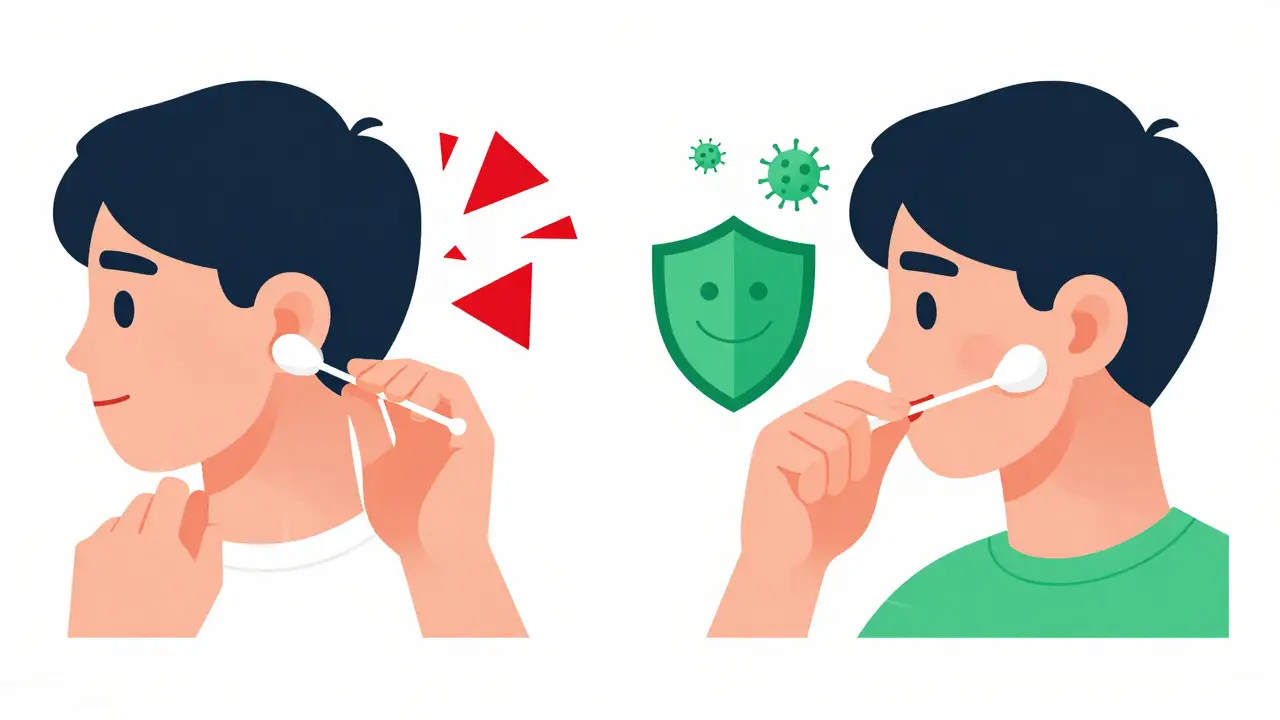
The second biggest cause? Cotton swabs. People think they’re cleaning their ears, but they’re actually pushing wax deeper and scratching the skin. That tiny cut is all bacteria need to get in. Studies show cotton swabs are behind 65% of cases caused by injury. Even fingernails or hairpins can do damage.
People with eczema or psoriasis in the ear canal are more vulnerable because their skin is already dry, cracked, or inflamed. And if you’ve had swimmer’s ear before, you’re more likely to get it again-especially if you keep poking your ear after being told not to. Eighty-seven percent of people with three or more episodes in a year still insert objects into their ears.

How Is It Treated?
The good news? Swimmer’s ear responds well to treatment-when it’s done right. The first-line treatment is topical antibiotic ear drops. The most common and effective are drops containing ciprofloxacin and hydrocortisone (like Cipro HC). These fight the infection and reduce swelling at the same time.
Here’s how to use them correctly:
- Wash your hands.
- Warm the bottle in your hand for a minute-cold drops can make you dizzy.
- For adults: pull the earlobe up and back. For kids under 3: pull down and back.
- Put in 10 drops, twice a day for seven days.
- Stay on your side for five minutes after putting in the drops. This lets the medicine soak in.
- Use a calibrated dropper. Most people guess the dose, and that leads to mistakes.
Studies show that doing this right boosts the chance of full recovery from 60% to over 90%. If you don’t, the treatment fails 40% more often. That’s why so many people feel like the drops “didn’t work”-they just didn’t use them properly.
For fungal infections (the rare 2%), clotrimazole drops are used instead. They take longer-14 days-but work just as well.
Pain control is part of treatment too. Mild pain can be managed with acetaminophen. But if it’s severe, doctors may prescribe oxycodone for a few days. Don’t ignore the pain. It’s your body’s signal that something’s wrong.
What NOT to Do
There are three big mistakes people make:
- Don’t stick anything in your ear. Not cotton swabs, not bobby pins, not fingers. Ever.
- Don’t try to dry your ear with a hairdryer on high heat. You can burn the skin. Use cool air, held 12 inches away, for 30 seconds.
- Don’t assume it’s a middle ear infection. Treating it like one delays recovery by an average of 3.2 days. That’s three extra days of pain.
And here’s something most people don’t realize: you still need to keep your ear dry during treatment. That means no swimming, no showers without protection, and no letting water sit in your ear after washing your hair. One study found that patients who didn’t keep their ears dry had a 63% chance of treatment failure. Those who did? Only 28% failed.
How to Prevent It Before It Starts
Prevention is easier than treatment. And it’s cheap.
The most effective method? A homemade solution of 70% isopropyl alcohol and 30% white vinegar. Use a few drops in each ear right after swimming or bathing. The alcohol dries out the water, and the vinegar creates an acidic environment that kills bacteria. A 2022 study with 1,200 swimmers showed this cut infection rates by 72%.
Another option: custom silicone earplugs. They cost $45 to $120, but they block 68% of water from entering the ear canal. Over-the-counter foam plugs? Only 42% effective. If you swim regularly, the custom ones pay for themselves in avoided doctor visits.
Even small habits help:
- After swimming, tilt your head to each side and gently pull the earlobe to help water drain.
- Limit post-swim water exposure to under two minutes-like quick rinses under the shower.
- Use a soft towel to gently wipe the outer ear-never push inside.
One Reddit user with four years of recurrent infections stopped it cold by using a hairdryer on cool, low setting for 30 seconds after every swim. That’s not magic-it’s physics. Drying the canal stops bacteria before they start.
When to See a Doctor
You don’t need to rush to the ER for every earache. But you should see a doctor if:
- The pain doesn’t improve after 48 hours of home care
- You have a fever, swelling around the ear, or trouble moving your jaw
- You’re diabetic or have a weakened immune system
- You’ve had three or more episodes in a year
Doctors can also check for underlying issues-like a narrow ear canal or chronic skin conditions-that make you more prone to infection. In severe cases, they might insert a wick-a tiny sponge that holds medicine inside the swollen canal. The FDA approved a new hydrogel wick in early 2023 that holds medication longer and works better than older versions.
What’s New in Treatment?
Antibiotic resistance is rising. About 8.7% of Pseudomonas bacteria are now resistant to ciprofloxacin. That’s why researchers are testing new treatments. One promising option is cadazolid-otic drops, currently in Phase II trials, showing 96.3% effectiveness in early tests.
Another exciting development is microbiome-sparing therapy. Instead of wiping out all bacteria, scientists are testing treatments that target only the bad ones. A lysate made from Staphylococcus hominis, a harmless skin bacteria, is being tested to crowd out the bad bugs. Early results suggest it could cut recurrence rates from 14% to under 7%.
Telehealth is also changing things. With smartphone otoscopes like TytoCare, you can send clear images of your ear to a doctor from home. Studies show they’re 89% accurate-almost as good as an in-person exam. That means faster diagnosis and treatment, often in under 24 hours.
Why This Matters Beyond the Pain
Swimmer’s ear isn’t just a summer nuisance. It costs the U.S. healthcare system over $547 million a year. Emergency visits run $312 per case. Primary care visits? Just $117. Preventing it saves money, time, and stress.
And it’s not just about swimming. With climate change extending swimming seasons, experts predict cases will rise 12.3% by 2030. But better education could offset nearly 9% of that increase. That’s not just a medical win-it’s a public health win.
If you or your kids swim often, this isn’t something to ignore. It’s preventable. It’s treatable. And with the right steps, you can enjoy the water without the pain.

Shelby Price
February 3, 2026 AT 17:00Geri Rogers
February 4, 2026 AT 20:05Nathan King
February 6, 2026 AT 14:26Alex LaVey
February 7, 2026 AT 11:59Jesse Naidoo
February 9, 2026 AT 00:19Alec Stewart Stewart
February 10, 2026 AT 21:26Demetria Morris
February 11, 2026 AT 11:08Justin Fauth
February 12, 2026 AT 09:17Caleb Sutton
February 14, 2026 AT 02:30Roshan Gudhe
February 15, 2026 AT 12:15Jhoantan Moreira
February 17, 2026 AT 11:54Lorena Druetta
February 19, 2026 AT 07:30rahulkumar maurya
February 20, 2026 AT 21:36Joy Johnston
February 22, 2026 AT 03:07Samuel Bradway
February 22, 2026 AT 03:34