
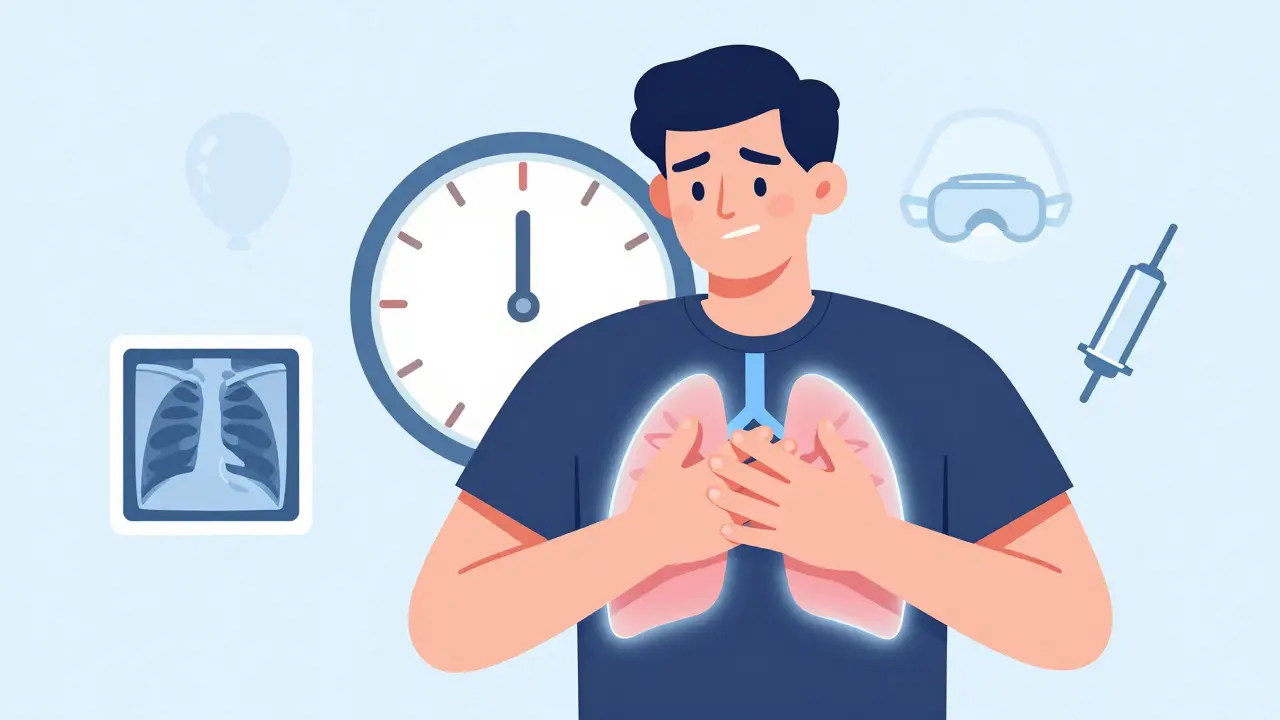
When your lung suddenly collapses, it doesn’t happen slowly. There’s no warning beep or gradual ache. One moment you’re breathing normally, the next, a sharp pain lances through your chest - like a knife twisting with every breath. Your air feels thin. Your ribs feel tight. You can’t take a full breath, no matter how hard you try. This isn’t just a pulled muscle or indigestion. This is pneumothorax - a collapsed lung - and it demands immediate action.
What Exactly Is a Collapsed Lung?
A pneumothorax happens when air leaks out of your lung and gets trapped between the lung and the chest wall. That space, called the pleural space, is normally empty. When air fills it, the pressure pushes against the lung and stops it from expanding properly. Think of it like a balloon inside a sealed jar. If air gets into the jar, the balloon can’t inflate anymore. That’s your lung - unable to fill with air, struggling to keep you alive. There are four main types:- Primary spontaneous pneumothorax: Happens in people with no known lung disease. Often affects tall, thin young men, especially smokers.
- Secondary spontaneous pneumothorax: Occurs because of an existing lung condition like COPD, emphysema, cystic fibrosis, or pneumonia. This type is far more dangerous.
- Traumatic pneumothorax: Caused by injury - a car crash, stab wound, broken rib, or even a forceful CPR compression.
- Iatrogenic pneumothorax: Triggered by a medical procedure - like inserting a central line, lung biopsy, or even mechanical ventilation.
Signs You’re Having a Collapsed Lung
The symptoms are hard to ignore - and they don’t lie. If you’re experiencing any of these, treat it like an emergency:- Sharp, stabbing chest pain on one side, usually worse when you breathe in or cough. It often radiates to the shoulder on the same side.
- Sudden shortness of breath, even at rest. If you can’t speak in full sentences, you’re in serious trouble.
- Fast heart rate - over 134 beats per minute.
- Low oxygen levels - your skin may look bluish, and your pulse oximeter reads below 90%.
- Decreased breath sounds - a doctor will hear little or no air moving on the affected side.
- Hyperresonance - tapping on your chest sounds unusually hollow on the collapsed side.
- Severe drop in blood pressure (below 90 mmHg)
- Trachea shifting away from the affected side (a late sign)
- Cyanosis - lips or fingers turning blue
- Extreme anxiety or confusion
Emergency Care: What Happens in the ER
Time is everything. Every 30-minute delay increases complication risk by over 7%. If you’re unstable - low blood pressure, low oxygen, struggling to breathe - doctors don’t wait for an X-ray. They act. For tension pneumothorax, the first step is needle decompression. A long needle is inserted between the ribs to let the trapped air escape. This isn’t optional. It’s life-saving. Done right, it can stabilize you in under a minute. For less severe cases, diagnosis starts with a chest X-ray. It catches 85-94% of pneumothoraces. But if you’re lying down after trauma, the X-ray might miss it. That’s why many emergency departments now use ultrasound - specifically the lung point sign. Experienced providers can detect even small air leaks with over 94% accuracy using this technique.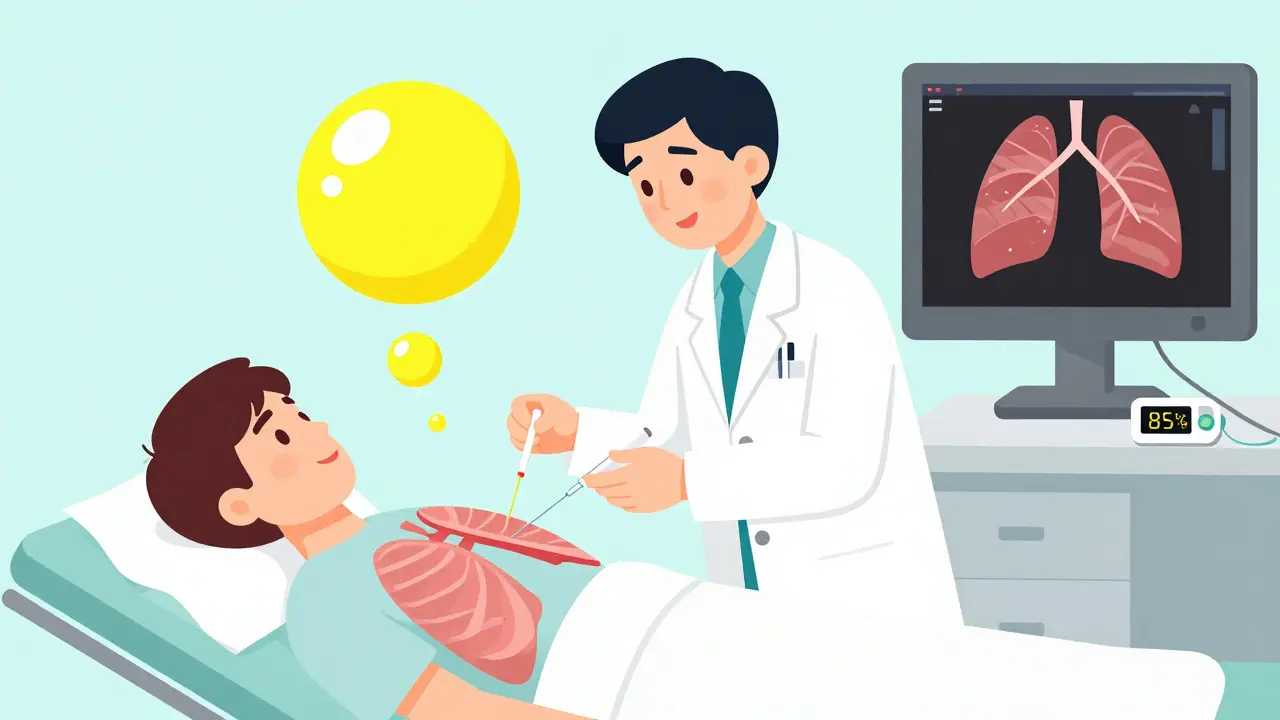
Treatment: From Observation to Surgery
Not every collapsed lung needs a tube shoved into your chest. Treatment depends on size, cause, and your health.- Small, primary pneumothorax (less than 30% collapse): Often treated with oxygen and observation. Breathing pure oxygen speeds up air absorption - up to 4.2% of the air is gone every hour. In 82% of cases, it reabsorbs on its own within two weeks.
- Larger primary pneumothorax: Needle aspiration is tried first. A thin tube is inserted to suck the air out. It works about 65% of the time.
- Failed aspiration or secondary pneumothorax: A chest tube (usually 28F size) is inserted. It drains air continuously until the lung re-expands. Success rate is 92%, but complications like infection or fluid buildup happen in 15-30% of cases.
- Recurrent cases: If you’ve had two or more episodes on the same side, surgery is recommended. Video-assisted thoracoscopic surgery (VATS) removes the damaged lung tissue and seals the area. It cuts your recurrence risk from 40% down to 3-5%.
Why Secondary Pneumothorax Is a Different Beast
If you have COPD, emphysema, or another chronic lung disease, a collapsed lung isn’t just inconvenient - it’s deadly. Your lung is already damaged. It can’t handle the extra pressure. Mortality for secondary pneumothorax is 16.2% within a year - nearly 100 times higher than in healthy people. Even a small leak can turn fatal. That’s why doctors treat these cases more aggressively - often jumping straight to chest tubes or surgery.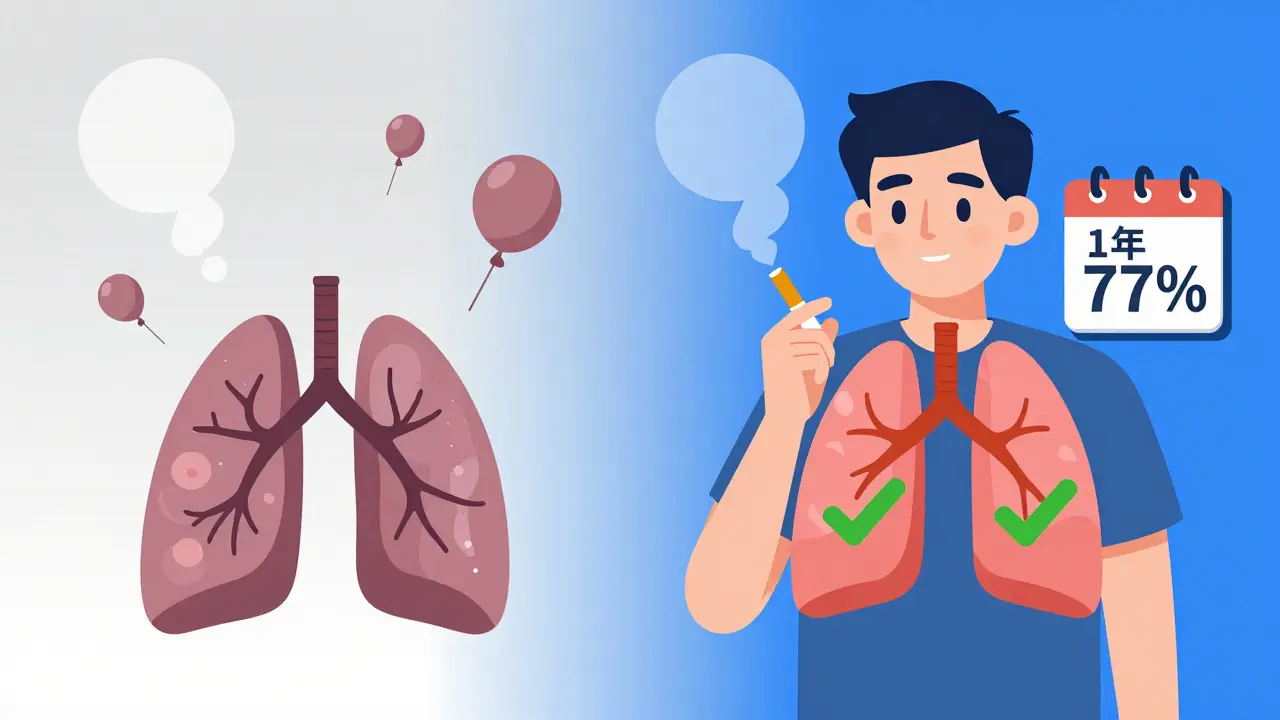
What Happens After You Leave the Hospital
Recovery isn’t over when you walk out the door. Follow-up care saves lives.- Get a follow-up X-ray at 4-6 weeks. About 8% of people develop delayed complications if they skip this.
- Quit smoking. It’s the single most effective way to prevent recurrence. Quitting cuts your risk by 77% in the first year.
- Avoid flying for at least 2-3 weeks after recovery. Pressure changes in the cabin can cause the lung to collapse again.
- Never scuba dive unless you’ve had surgery. The risk of recurrence underwater is 12.3% - and in a dive, you can’t just call 000.
- Know the warning signs of recurrence: sudden sharp pain, inability to catch your breath, bluish skin. If you feel these, call emergency services immediately.
Who’s at Highest Risk?
Some people are far more likely to get a collapsed lung:- Men - 6.5 times more likely than women
- Tall, thin individuals - especially those over 70 inches (178 cm)
- Smokers - risk jumps 22 times if you’ve smoked more than 10 pack-years
- People with COPD, asthma, or connective tissue disorders
- Those who’ve had a previous pneumothorax - 15-40% will have another within two years
Final Warning: Don’t Wait for a Diagnosis
Pneumothorax doesn’t care if you’re busy, tired, or think it’s “just a cramp.” If you have sudden chest pain and trouble breathing, especially if you’re young and tall or have lung disease, don’t Google it. Don’t wait to see your GP. Go to the emergency room. Or call an ambulance. The difference between waiting an hour and acting fast isn’t just comfort - it’s survival. In tension pneumothorax, death can come in minutes. Even in simple cases, delays lead to bigger interventions, longer hospital stays, and higher chances of recurrence. Your lungs work every second of every day. Don’t wait until they stop.Can a collapsed lung heal on its own?
Yes, but only in small, primary cases. If the collapse is less than 30% and you’re otherwise healthy, doctors often recommend oxygen therapy and rest. The body naturally reabsorbs the trapped air - about 1.25% per hour normally, up to 4.2% with high-flow oxygen. In 82% of these cases, the lung fully reinflates within two weeks. But if you’re short of breath, have underlying lung disease, or the collapse is larger, you need medical intervention.
Is a collapsed lung the same as a pulmonary embolism?
No. A collapsed lung (pneumothorax) means air is leaking out of the lung into the chest cavity. A pulmonary embolism is a blood clot blocking an artery in the lung. Both cause sudden chest pain and shortness of breath, but they’re completely different conditions. A pulmonary embolism often comes with leg swelling, coughing up blood, or a racing heart without chest pain. Diagnosis requires different tests - a CT scan with contrast for embolism, a chest X-ray or ultrasound for pneumothorax.
Can stress or anxiety cause a collapsed lung?
No. Stress and anxiety can make you feel like you can’t breathe - hyperventilation, tight chest, dizziness - but they don’t cause air to leak from your lung. However, people with anxiety may mistake pneumothorax symptoms for panic attacks and delay seeking help. If you have sudden, sharp, one-sided chest pain that worsens with breathing, it’s not anxiety. Get checked.
How long does it take to recover from a pneumothorax?
Recovery depends on treatment. If it’s small and treated with oxygen and rest, you might feel better in a few days, but full healing takes 2-4 weeks. If you had a chest tube, expect 3-7 days in hospital, then 2-4 weeks of light activity. After surgery, most people return to normal activities in 4-6 weeks. But you should avoid heavy lifting, contact sports, and flying for at least 3 weeks - and scuba diving forever unless you’ve had preventive surgery.
Can I fly after a collapsed lung?
No - not for at least 2-3 weeks after the lung has fully reinflated and your doctor confirms it with a follow-up X-ray. The lower air pressure in airplane cabins can cause any remaining air to expand, triggering another collapse. The FAA and aviation medical guidelines strictly prohibit flying until clearance is given. Even then, if you’ve had multiple episodes or have underlying lung disease, flying may be permanently unsafe without surgical prevention.
Does smoking really increase my risk so much?
Yes - dramatically. Smokers are 22 times more likely to have a spontaneous pneumothorax than non-smokers. Smoking damages the tiny air sacs in your lungs (alveoli), making them weak and prone to rupture. The risk rises with how much and how long you smoke. Quitting cuts your recurrence risk by 77% in the first year. It’s not just about preventing another collapse - it’s about saving your lungs from permanent damage.

Alex Ronald
December 28, 2025 AT 15:28Just had a small spontaneous pneumothorax last year - didn’t even know what it was until the ER doc said, ‘You’re lucky you came in when you did.’ Oxygen and rest did the trick. Took me about three weeks to feel normal again, but I quit smoking cold turkey after that. Best decision I ever made. If you’re reading this and still smoking - please, just stop. Your lungs don’t owe you another chance.
Also, never fly without a follow-up X-ray. I ignored that advice once. Big mistake.
Teresa Rodriguez leon
December 28, 2025 AT 21:07My brother died from a tension pneumothorax after a car crash. They didn’t recognize it fast enough. Don’t wait. Don’t hope it’s nothing. Call 911. Now.
Manan Pandya
December 29, 2025 AT 09:37Excellent breakdown of pneumothorax types and management. I’d only add that in resource-limited settings, ultrasound for the lung point sign is often the only accessible diagnostic tool - and it’s remarkably reliable when performed by trained personnel. Also, for those with COPD, even a 10% collapse can be catastrophic. Early intervention isn’t optional; it’s the only path to survival. The 16.2% one-year mortality statistic is chilling but accurate. This post should be mandatory reading for all ER staff and primary care providers.
Aliza Efraimov
December 31, 2025 AT 05:23I’m crying just reading this. My best friend had a spontaneous pneumothorax at 21 - tall, thin, smoker. She thought it was a panic attack. Took her 3 hours to get to the hospital. By then, it had turned into tension pneumothorax. They had to stick a chest tube in her while she was screaming. She’s fine now - but she’ll never forget it. And neither will I. If you’re reading this and you’re young and thin and smoke - please. Please. Just stop. Your lungs are not a gamble.
Duncan Careless
December 31, 2025 AT 14:48good post. i had one of these last year after a bad coughing fit. i thought it was just a pulled muscle. turned out it was like 30% collapse. doc said i was lucky it wasnt worse. oxygen helped, no tube needed. but i quit smoking after that. 10 pack years. no regrets. also, dont fly for 3 weeks. i did, and my ear popped like a balloon. not fun.
Samar Khan
January 2, 2026 AT 00:14OMG I KNEW IT 😭 I told my cousin he was being dramatic when he said his chest hurt after vaping - now he’s in the ICU with a bilateral pneumothorax. He’s 19. He thought it was ‘just anxiety.’ Now he’s got two chest tubes. I’m so mad. Vaping is a death sentence waiting to happen. 🤦♀️💔
Nicole K.
January 3, 2026 AT 03:53Why do people keep smoking if they know this? It’s not rocket science. If you’re tall and thin and smoke, you’re basically playing Russian roulette with your lungs. You think you’re invincible? You’re not. This isn’t a ‘maybe’ - it’s a ‘when.’ Stop being selfish. Quit now.
Amy Cannon
January 4, 2026 AT 15:54It is of paramount importance to underscore the fact that the pathophysiological underpinnings of pneumothorax, particularly in the context of secondary etiologies, are not merely clinical curiosities but rather life-altering events that necessitate a comprehensive, multidisciplinary approach to care. The notion that one might ‘wait and see’ in the presence of even minor respiratory distress - particularly in individuals with preexisting pulmonary pathology - is not only medically unsound, but ethically indefensible. I have personally witnessed the tragic consequences of delayed intervention, and I implore all readers to treat this condition with the gravity it deserves. Do not rely on Google. Do not wait for a second opinion. Go to the ER. Immediately.
Himanshu Singh
January 5, 2026 AT 12:35man i had this happen to me in college. i was 20, 6’4”, smoked like a chimney. one day i just couldn’t breathe. thought i was having a heart attack. went to the clinic and they sent me to the ER. turned out it was 35% collapse. they stuck a tube in me. i was so scared. but i quit smoking after that. still have the scar. but i’m alive. and i don’t smoke anymore. if you’re reading this and you smoke - just stop. your lungs will thank you.
Jasmine Yule
January 5, 2026 AT 21:13Thank you for writing this. I’ve had two spontaneous pneumothoraxes - both in my early 20s. I thought I was fine after the first one. I wasn’t. The second one almost killed me. I had surgery. I’m 30 now. I’ve never smoked. I don’t fly. I don’t dive. And I’m still alive. If you’re reading this and you’re young, tall, thin, and you smoke - please, please, please listen. This isn’t fear-mongering. This is survival. I’m so glad I got help. Don’t wait like I did.
Lisa Dore
January 6, 2026 AT 14:18I’m a respiratory therapist and I’ve seen this too many times. People think ‘it’ll never happen to me.’ Then it does - and they’re on the floor, gasping, wondering why no one warned them. This post? This is the kind of thing that saves lives. Please share it. With your friends. Your family. Your coworkers. Especially if they smoke. Especially if they’re tall. Especially if they’re young. This isn’t just medical info - it’s a lifeline.
Sharleen Luciano
January 8, 2026 AT 01:45It’s amusing how casually people treat this. I’ve reviewed over 200 cases in my tenure as a pulmonologist. The majority of patients who presented with ‘mild’ symptoms were the ones who ended up in ICU. The ones who ‘waited it out’? They needed VATS, prolonged hospitalization, and sometimes, mechanical ventilation. The notion that a ‘small’ pneumothorax is benign is dangerously outdated. If you’re over 178 cm and smoke? You’re not ‘at risk.’ You’re already on the list. Wake up.
Jim Rice
January 8, 2026 AT 01:53Actually, I think this post is overblown. I’ve had chest pain before - didn’t collapse. My friend had a ‘collapsed lung’ and it turned out to be a pinched nerve. You’re scaring people unnecessarily. Not every sharp pain is a pneumothorax. Maybe we should stop turning every minor symptom into a medical emergency.
Henriette Barrows
January 9, 2026 AT 08:12Thank you for this. My mom had a secondary pneumothorax from COPD. She was 72. They didn’t catch it right away because she was ‘just tired.’ By the time they did, her oxygen was at 82%. She spent a week in the hospital. She’s okay now, but I’ll never forget how close we came to losing her. Please - if you have lung disease and feel like you can’t breathe, don’t wait. Don’t be polite. Don’t wait for your appointment. Go now. Your life isn’t a scheduling conflict.