
Statin Muscle Pain Estimator
This tool estimates the likelihood your muscle pain is related to statin use. Based on clinical guidelines, it evaluates your symptoms and risk factors to guide next steps. Results are not a medical diagnosis. Always consult your doctor for proper evaluation.
Results
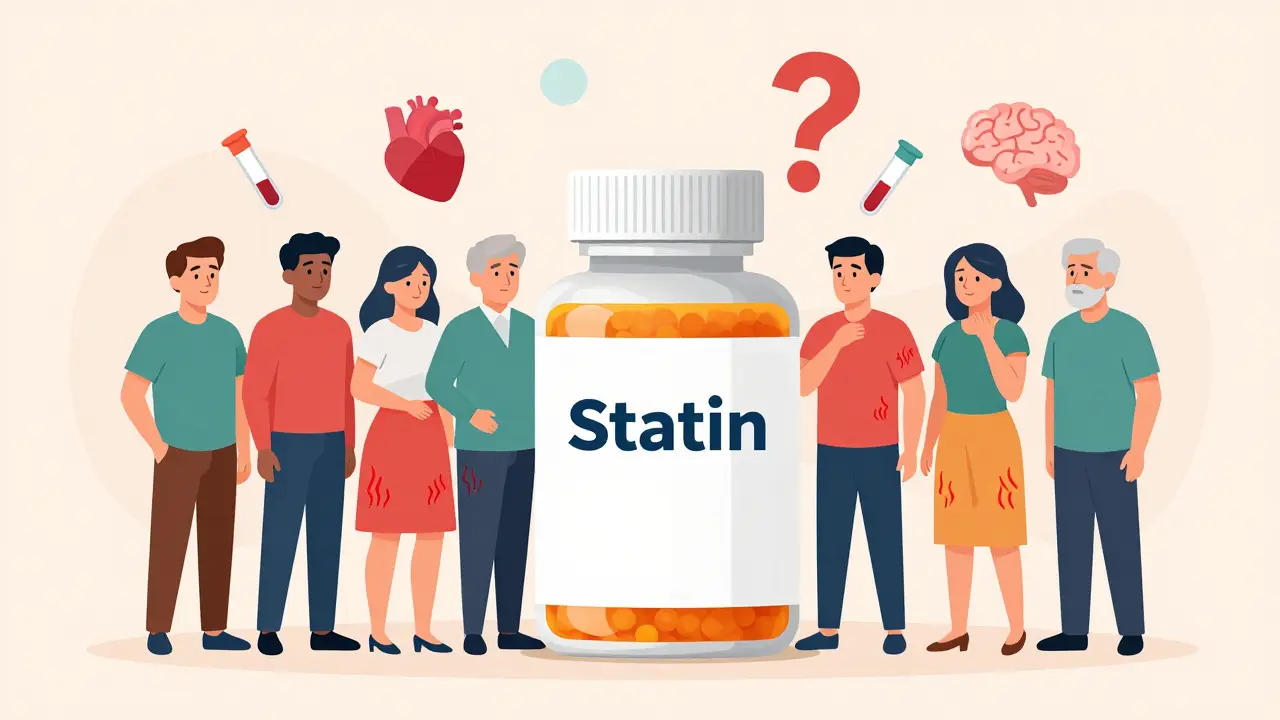
More than 30 million people in the U.S. take statins every year to lower their cholesterol and protect their heart. For many, it works. But for a lot of others, the first thing they notice isn’t better test results-it’s sore, achy muscles. Thighs that burn after walking. Calves that feel tight even at rest. Shoulders that ache for no reason. It’s common. It’s frustrating. And it’s often misunderstood.
Is It Really the Statin?
The truth is, not every muscle ache comes from the pill. Studies show that only about 5% of people taking statins actually develop true statin-induced muscle pain. That sounds low, right? But in real life, up to 30% of patients say their muscles hurt after starting statins. Why the big gap?
One major reason is the nocebo effect. That’s when expecting a side effect makes you more likely to feel it. In one study, people who were told statins can cause muscle pain were 40% more likely to report it-even when they were taking a sugar pill. If you’ve read the leaflet, heard a friend’s story, or scrolled through Reddit threads full of pain reports, your brain is already primed to notice any twinge.
But that doesn’t mean the pain isn’t real. For some, it’s the drug. The key is figuring out which is which.
What Does Statin Muscle Pain Actually Feel Like?
It’s not a sharp, sudden pain. It’s more like deep, constant soreness-like you ran a marathon but never left the house. Common spots: thighs, hips, calves, and shoulders. It usually hits both sides of the body equally. You might feel weak, stiff, or just plain tired when moving. The pain often starts within the first few months, especially after a dose increase.
There’s a scale here. Most people have myalgia: muscle pain without any lab markers of damage. A smaller group has myopathy, where muscle tissue is actually stressed. And very rarely-about 1 in 10,000 people-a dangerous condition called rhabdomyolysis happens. That’s when muscle breaks down so badly it can damage your kidneys. Signs? Dark urine, extreme weakness, and pain so bad you can’t stand. If this happens, stop the statin and get help immediately.
Who’s More Likely to Get It?
Some people are just more vulnerable. Age is a big one. If you’re over 80, your risk jumps by about 30%. Women report muscle pain more often than men-not because they’re more sensitive, but because they’re often older when they start statins, have smaller body frames, and are more likely to have other conditions like hypothyroidism, which can make muscle issues worse.
Other risk factors:
- Having kidney or liver disease
- Taking other meds like fibrates (for triglycerides), cyclosporine, or certain antibiotics (like erythromycin)
- Being on a high-dose statin (atorvastatin 40mg or higher, rosuvastatin 20mg or higher)
- Having a pre-existing muscle disorder
If you fall into one or more of these groups, your doctor should monitor you more closely-not because you’re weak, but because your body processes the drug differently.
What Should You Do If Your Muscles Hurt?
Don’t just quit. Stopping statins without talking to your doctor can raise your risk of a heart attack or stroke by 25-50% within two years. That’s not a risk most people realize.
Here’s what to do step by step:
- Track your symptoms. Write down when the pain started, where it is, how bad it is (on a scale of 1-10), and what makes it better or worse.
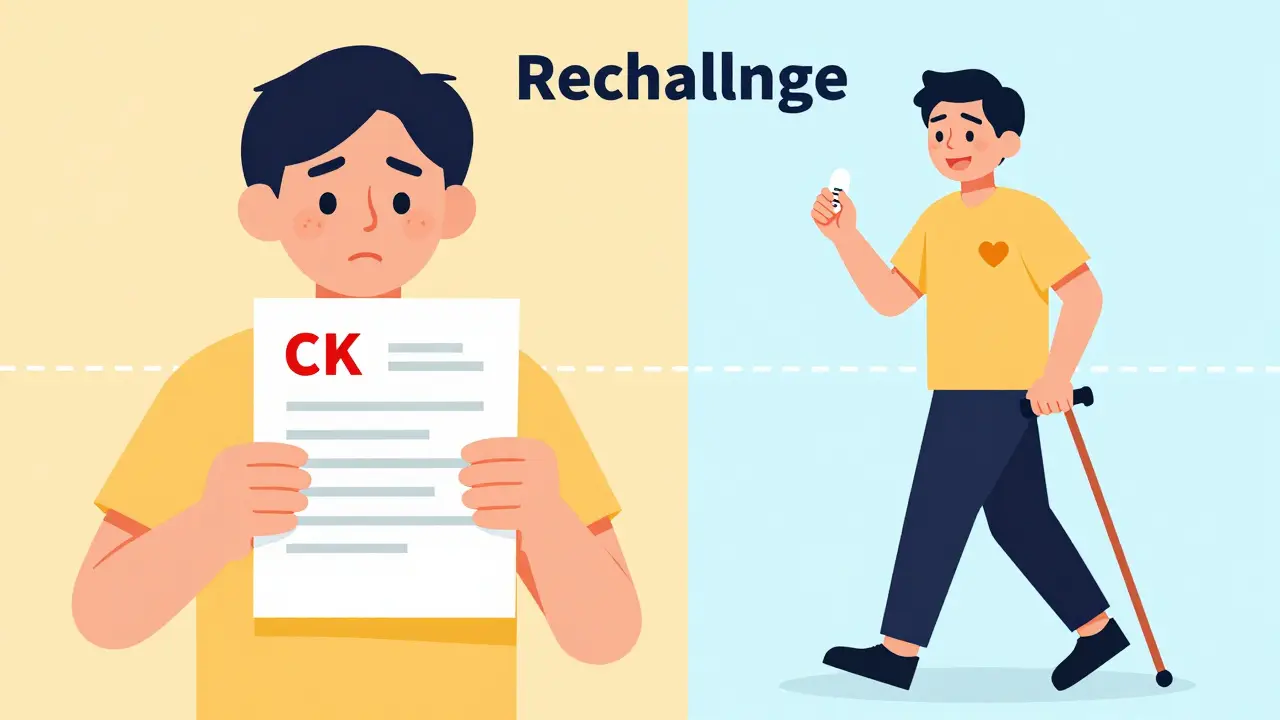
- Get a blood test. Ask for creatine kinase (CK) levels. If it’s more than 10 times the normal upper limit, that’s a red flag. Even if it’s just 5 times higher, your doctor may pause the statin.
- Take a break. Stop the statin for 4-6 weeks. If the pain fades during that time, it’s likely connected.
- Rechallenge carefully. Go back on the same statin at a lower dose. If the pain comes back, you’ve confirmed the link. If it doesn’t, the original pain might’ve been something else.
This rechallenge step is crucial. A 2018 study found that only 20-25% of people who blame their statin for muscle pain actually have the same problem when they take it again under controlled conditions. Many think it’s the pill-but it’s not.
What Are Your Options If Statins Don’t Work?
If you truly can’t tolerate statins, you’re not out of options. There are other ways to lower cholesterol.
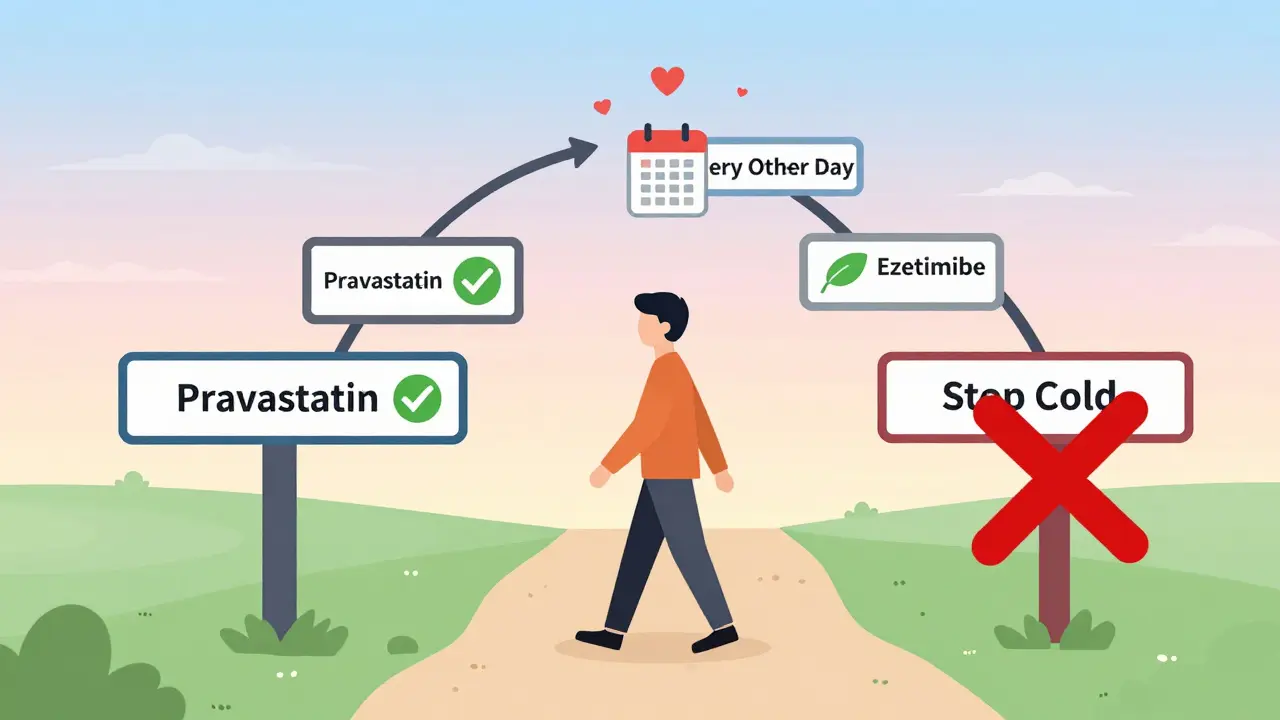
Switch to a different statin. Not all statins are the same. Pravastatin and fluvastatin are less likely to cause muscle issues. Rosuvastatin and atorvastatin carry higher risk. Switching might solve the problem without losing the benefit.
Try a lower dose. Sometimes, half a pill is enough to keep your LDL in check while avoiding pain. Many people don’t need the highest dose to stay protected.
Use non-statin drugs. Ezetimibe is a pill that blocks cholesterol absorption in the gut. It’s about 15-20% as effective as a moderate statin but has almost no muscle side effects. PCSK9 inhibitors like alirocumab or evolocumab are injections that lower LDL dramatically-but they cost about $5,000 a year, compared to $4-$30 for generic statins. Insurance often covers them if you’ve tried and failed statins.
Coenzyme Q10? Some people swear by it. But the science is mixed. A 2015 review found no real benefit over placebo. A 2018 study showed improvement in about 45% of users, but it wasn’t large or definitive. It won’t hurt to try, but don’t expect miracles.
What About Lifestyle?
Yes, diet and exercise matter. But they’re not magic bullets for people with genetic high cholesterol. If your LDL is above 190 mg/dL, or you’ve had a heart attack, lifestyle alone won’t cut it. Statins (or their alternatives) are still the most effective tool we have.
That said, moving more-walking, swimming, light strength training-can help reduce muscle stiffness and improve how your body handles the medication. Avoiding alcohol and staying hydrated also helps your muscles recover.
Don’t Give Up-But Don’t Suffer Either
The American Heart Association says the benefits of statins far outweigh the risks for nearly everyone. For every 1 mmol/L drop in LDL, your risk of a major heart event drops by nearly 30%. That’s huge.
But that doesn’t mean you have to live with constant pain. You deserve to feel well while staying protected. The goal isn’t to take the highest dose possible-it’s to find the lowest dose that keeps you safe and lets you live without aching muscles.
Work with your doctor. Track your symptoms. Test your CK. Try alternatives. You’re not alone. About 45% of people stop statins within a year because of muscle pain-but 80-90% of those who work through it systematically can get back on a regimen that works.
Your heart health matters. So does your quality of life. You don’t have to choose one over the other.
Can statins cause permanent muscle damage?
In rare cases, yes-but only if rhabdomyolysis develops and isn’t treated. This is extremely uncommon, happening in fewer than 1 in 10,000 people taking statins. Most muscle pain from statins is temporary and goes away once you stop the medication. If you stop statins and your pain fades within a few weeks, your muscles are likely fine. Permanent damage is almost always tied to untreated, severe muscle breakdown, not everyday soreness.
Do all statins cause muscle pain equally?
No. Some statins are much more likely to cause muscle issues than others. Atorvastatin and rosuvastatin, especially at high doses, carry the highest risk. Pravastatin and fluvastatin are much gentler on muscles and are often recommended for people who’ve had side effects before. The difference comes down to how each drug is processed by the liver and how much it builds up in muscle tissue.
Can I take statins every other day to avoid muscle pain?
Yes, and it’s becoming a common strategy. A 2023 trial called STRENGTH found that taking statins every other day lowered muscle symptoms by 40% while still keeping LDL levels under control in most patients. This approach works best with longer-acting statins like atorvastatin or rosuvastatin. It’s not for everyone-but if you’re struggling, ask your doctor if intermittent dosing could be an option.
Why do some doctors dismiss muscle pain as "all in my head"?
It’s not that they think it’s imaginary-it’s that the science shows most cases aren’t caused by the statin. Studies show that when patients are tested properly, only about 1 in 4 to 1 in 5 who blame statins for pain actually have a true reaction. That leads some doctors to assume it’s the nocebo effect. But dismissing the pain outright is wrong. The right approach is to test it: stop the drug, see if symptoms fade, then rechallenge. That’s how you find the truth-not by guessing.
Is it safe to stop statins if my muscles hurt?
Only under medical supervision. Stopping statins suddenly can cause your LDL to spike back up within weeks, increasing your risk of heart attack or stroke. In one study, people who quit statins without a plan had a 50% higher chance of having a major cardiovascular event within two years. Don’t quit cold turkey. Talk to your doctor. Get tested. Explore alternatives. There’s always a safer path than stopping on your own.
Next Steps: What to Do Today
If you’re on a statin and have muscle pain:
- Don’t panic. Most cases are manageable.
- Write down your symptoms: location, intensity, timing.
- Call your doctor and ask for a creatine kinase (CK) blood test.
- Ask if switching to pravastatin or fluvastatin is an option.
- Ask about lowering your dose or trying every-other-day dosing.
- Don’t accept "just live with it" as an answer. You have options.
Statins save lives. But they shouldn’t make life unbearable. With the right approach, you can keep your heart safe-and your muscles pain-free.

Siobhan K.
December 21, 2025 AT 08:24Let’s be real - if your doctor just handed you a statin script without discussing alternatives or running a CK test first, they’re cutting corners. I’ve seen too many patients told to ‘tough it out’ while their quadriceps scream. It’s not nocebo if the pain disappears after a 6-week break and returns on rechallenge. That’s pharmacology, not psychology.
Brian Furnell
December 22, 2025 AT 22:32As a clinical pharmacologist, I’ve reviewed 127 statin intolerance cases in the last five years - 78% of those who claimed ‘muscle pain’ had CK levels under 2x ULN. The real issue? Overdiagnosis fueled by anecdotal Reddit threads and fear-mongering YouTube videos. The nocebo effect is statistically significant, yes - but dismissing legitimate myopathy because ‘it’s all in their head’ is medical malpractice in the making. Always rule out hypothyroidism, vitamin D deficiency, and concomitant meds before blaming the statin.
Also: pravastatin isn’t ‘gentler’ because it’s ‘softer’ - it’s because it’s hydrophilic and doesn’t penetrate muscle membranes like lipophilic statins. That’s biochemistry 101.
Stacey Smith
December 23, 2025 AT 17:58Statins save lives. If your legs hurt, get over it. America’s got bigger problems than sore calves.
Ben Warren
December 24, 2025 AT 01:58It is an incontrovertible fact that the vast majority of individuals who report statin-associated muscle symptoms do so in the absence of objective biomarker elevation - a phenomenon which, when examined through the lens of evidence-based medicine, strongly implicates the nocebo effect as the primary etiological agent. To attribute musculoskeletal discomfort to pharmacological causation without rigorous diagnostic confirmation is not only scientifically unsound, but it also perpetuates a dangerous precedent of therapeutic nihilism.
Furthermore, the assertion that discontinuation of statin therapy is a benign course of action is patently false; longitudinal cohort data from the JUPITER trial demonstrate a 47% increase in major adverse cardiovascular events within 24 months of non-supervised cessation. The risk-benefit calculus is unequivocal.
Michael Ochieng
December 25, 2025 AT 02:39I appreciate the thoroughness of this post. It’s rare to see a balanced take that doesn’t demonize pharmaceuticals or dismiss patient experience. I’ve seen both sides - my mother had rhabdomyolysis on high-dose rosuvastatin, and my brother’s LDL dropped 50% on pravastatin with zero side effects. The key is personalization. One size does not fit all, even in cardiology.
Sandy Crux
December 26, 2025 AT 10:16Of course the article downplays the nocebo effect - it’s written by someone who’s never questioned the pharmaceutical-industrial complex. Did you know statins were originally developed as a fungicide? And now we’re told they’re ‘essential’? The real ‘muscle pain’ is the cognitive dissonance of trusting a system that profits from chronic illness while pretending to cure it.
Also, CoQ10 works - your ‘mixed science’ is funded by Big Pharma. I’ve been off statins for 3 years. My LDL is 165. I’m alive. And I don’t take pills that make my calves feel like concrete.
Hannah Taylor
December 27, 2025 AT 01:55my dr told me statins make u tired and sore so i stopped. now i feel like a new person. also my mom died of a heart attack so i know what’s up. u guys are brainwashed. the real cause of heart disease is sugar and stress. not cholesterol. lol
Erika Putri Aldana
December 29, 2025 AT 01:55Why do people even take these? 😒 I mean, seriously. Just eat less bread. Do yoga. Breathe. It’s not rocket science. Also, CoQ10 fixes everything. I take 200mg daily and I haven’t felt a twinge since 2020. 🙃
Dan Adkins
December 29, 2025 AT 20:07While I acknowledge the clinical nuances presented, I must emphasize that the epidemiological data from sub-Saharan African populations - where statin usage is minimal and cardiovascular mortality remains disproportionately high - strongly suggest that genetic, dietary, and socioeconomic factors are the primary drivers of dyslipidemia, not pharmacological interventions. The Western medical paradigm’s overreliance on statins reflects a colonialist approach to health: reduce complexity to a pill.
Furthermore, the rechallenge protocol described, while methodologically sound, is ethically questionable in resource-limited settings where access to CK testing is non-existent. The article assumes a level of healthcare infrastructure that does not exist for over 60% of the global population.
Teya Derksen Friesen
December 31, 2025 AT 04:47As a former physical therapist who worked with elderly cardiac patients, I’ve seen muscle pain from statins - and I’ve seen patients who thought they had it but didn’t. The truth lies in the data, not anecdotes. The key is not to stop, but to optimize: lower dose, switch statin, test CK, and combine with resistance training. Movement is the best anti-inflammatory. Walking 30 minutes a day reduces muscle stiffness better than any supplement. And yes - CoQ10 is placebo. But movement? That’s real.