
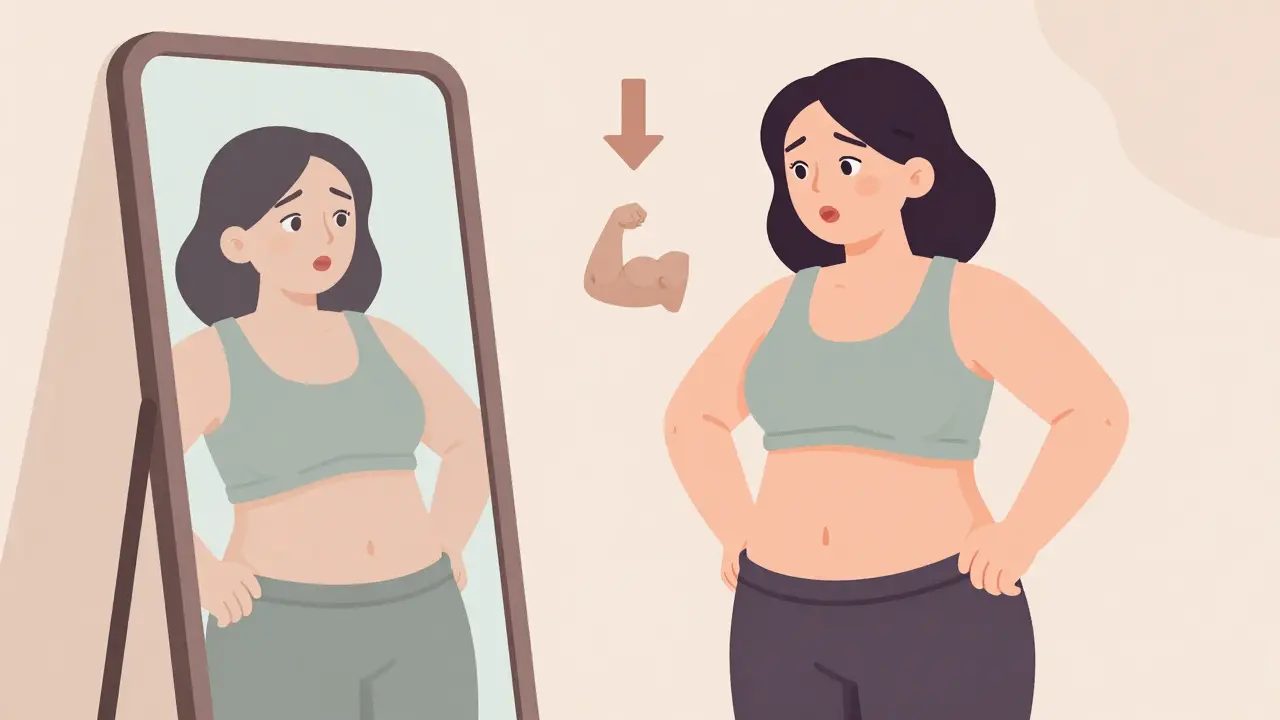
Women in their 40s and 50s often wake up one day to find their clothes don’t fit-no matter how hard they try. They eat the same, exercise the same, even sleep the same. But the scale creeps up, and the waistband tightens. This isn’t laziness. It’s biology. Menopause weight gain isn’t just about eating too much. It’s about hormones shifting, muscle disappearing, and metabolism slowing down-all at once.
Why Your Body Changes During Menopause
Before menopause, estrogen keeps fat stored in the hips, thighs, and buttocks. That’s why many women have a pear-shaped body. But as estrogen drops-by 60 to 70% during the transition-your body starts storing fat differently. Visceral fat, the kind that wraps around your organs, becomes the new default. This isn’t just cosmetic. Visceral fat is metabolically active. It releases inflammatory chemicals that raise your risk of heart disease, diabetes, and high blood pressure. The drop in estrogen also changes your appetite hormones. Leptin, the hormone that tells you you’re full, drops by 20-30%. Ghrelin, the hunger hormone, spikes by 15-25% because of sleep disruptions from night sweats. So even if you’re eating the same amount, your brain is screaming for more food. And your body? It’s holding onto every extra calorie as fat-especially around your middle.The Silent Culprit: Muscle Loss
After 30, you naturally lose 3-8% of your muscle mass every decade. Menopause adds another 1-2% per year. That might sound small, but muscle burns more calories at rest than fat. Lose muscle, and your resting metabolism drops by 2-3% each decade. That means if you burned 1,600 calories a day at 40, you might only burn 1,500 by 50-even if you do nothing differently. This isn’t just about strength. It’s about survival. Your body doesn’t know you’re trying to stay lean. It thinks you’re aging. And aging means conserving energy. So it holds onto fat and lets muscle go. The result? You look heavier, feel weaker, and struggle to lose weight-even when you’re eating clean and walking every day.Why Diets Stop Working
If you’ve tried the same low-calorie diet that worked in your 20s and 30s, you’re not failing. Your body has changed. A 2021 study in Obesity Reviews found that postmenopausal women lose weight 20-30% slower than younger women, even on identical calorie deficits. Why? Because your body is fighting to protect fat stores. Hormonal shifts make your metabolism more resistant to change. The SWAN study followed over 3,300 women for more than 20 years. It found that even women who kept their diet and exercise routines exactly the same gained 4.5-6.8 kg (10-15 pounds) during menopause. That’s not a lack of willpower. That’s biology.
The Real Culprit: It’s Not Just Hormones
Many blame estrogen alone. But experts like Dr. Loeb-Zeitlin and the Mayo Clinic team point to something bigger: aging. Hormones trigger the shift, but the real drivers are muscle loss, reduced physical activity, and a slower metabolism. A 2023 survey from University Hospitals found that 78% of women reported weight gain despite unchanged eating habits. But 67% also admitted they moved less after menopause-whether from joint pain, fatigue, or simply losing motivation. Dr. Alyse Sekzer says the number one reason for belly fat is decreased physical activity. That’s not to say hormones don’t matter. They do. But if you don’t move, your body will store fat-even if your estrogen levels were stable.What Actually Works: The Science-Backed Strategy
Forget crash diets. Forget skipping meals. The only proven strategy for menopause weight gain combines three things: strength training, protein, and sleep. Strength training is non-negotiable. A 2022 clinical trial in Menopause: The Journal of The North American Menopause Society showed that women who lifted weights 2-3 times a week for six months gained 1.8-2.3 kg of muscle and lost 8-12% of abdominal fat. That’s not just weight loss. That’s body recomposition. You’re not just shrinking-you’re rebuilding. Protein intake must increase. After menopause, your body becomes resistant to muscle-building signals. To fight this, you need 25-30 grams of protein per meal. That’s three eggs and a cup of Greek yogurt for breakfast. A chicken breast and lentils for lunch. A salmon fillet and tofu stir-fry for dinner. The British Menopause Society recommends 1.2-1.6 grams of protein per kilogram of body weight daily. For a 70 kg (154 lb) woman, that’s 84-112 grams of protein a day. Sleep is your secret weapon. Poor sleep raises ghrelin and lowers leptin. Hot flashes and night sweats disrupt sleep for 75% of perimenopausal women. Fix sleep, and you fix hunger. Aim for 7-8 hours. Cool your bedroom. Avoid caffeine after 2 p.m. Try magnesium glycinate or black cohosh if hot flashes are keeping you up. A 2023 Mayo Clinic analysis showed that better sleep alone can reduce appetite by 15-25%.What Doesn’t Work
Cardio alone won’t save you. Running or cycling burns calories, but it doesn’t rebuild muscle. You might lose weight, but you’ll lose muscle too-and end up thinner but softer. That’s not health. That’s sarcopenic obesity. Keto and intermittent fasting? They might help some women, but they can backfire. Low-carb diets can worsen sleep and increase cortisol in menopausal women. Skipping meals spikes ghrelin and makes cravings worse. If you’re already tired and stressed, your body doesn’t need another stressor.
When to See a Doctor
If you’ve tried diet and exercise for six months and seen no change, it’s time to get tested. The North American Menopause Society now recommends all women in perimenopause get their abdominal circumference measured. If it’s over 88 cm (35 inches), you’re at higher risk for metabolic syndrome. That’s three times the risk of heart disease and diabetes. New tools are emerging. Mayo Clinic launched a menopause-specific metabolic test in January 2023 that checks 17 hormones and markers to create a personalized plan. The FDA has approved bimagrumab for Phase 3 trials-a drug that increases muscle and reduces fat in just 24 weeks. And the NIH is funding a five-year study to see if early hormone therapy can prevent fat redistribution. But you don’t need to wait for a drug. You need a plan. Talk to a women’s health specialist, a physical therapist who understands menopause, or a registered dietitian who knows about sarcopenia. Don’t settle for generic advice. Your body has changed. Your strategy should too.Real Women, Real Results
On Reddit’s r/menopause community, a user named MidlifeMama wrote: “I’ve maintained the same diet and exercise for 20 years. Then menopause hit. I gained 25 pounds in three years. My jeans won’t zip.” She started lifting weights three times a week, added protein to every meal, and prioritized sleep. Six months later, she lost 12 pounds of fat and gained 5 pounds of muscle. Her waist shrunk by 4 inches. She didn’t do anything extreme. She just did what science says works.What to Do Next
Start today. Not tomorrow. Not after the holidays.- Do two 30-minute strength sessions this week. Bodyweight squats, lunges, push-ups, dumbbell rows. No gym needed.
- Calculate your protein needs: multiply your weight in kilograms by 1.4. Eat that much protein every day.
- Set a sleep alarm. No screens after 9 p.m. Keep your room at 18°C (65°F).
- Measure your waist. Write it down. Check it again in 8 weeks.
Why am I gaining weight even though I eat less?
Your metabolism slows down because you’re losing muscle and estrogen levels drop. Even if you eat the same amount, your body burns fewer calories. Hormones like leptin and ghrelin also change, making you hungrier and less satisfied after meals. This isn’t about willpower-it’s biology.
Is abdominal fat during menopause dangerous?
Yes. Visceral fat around your organs releases inflammatory chemicals that increase insulin resistance, raise blood pressure, and raise your risk of heart disease and type 2 diabetes. Women with waist measurements over 88 cm (35 inches) have nearly three times the risk of metabolic syndrome compared to those with smaller waists.
Should I take hormone therapy to stop weight gain?
Hormone therapy isn’t a weight-loss drug. But early use during perimenopause may help prevent fat redistribution by maintaining estrogen levels. The NIH is currently studying this in the EMPOWER trial. If you’re considering hormone therapy, talk to a menopause specialist-not just your GP. It’s not for everyone, and timing matters.
How much protein do I need daily?
Aim for 1.2-1.6 grams of protein per kilogram of body weight. For a 70 kg (154 lb) woman, that’s 84-112 grams per day. Spread it across meals: 25-30 grams per meal. Good sources include eggs, Greek yogurt, chicken, fish, tofu, lentils, and whey protein.
Can I lose weight without going to the gym?
Yes. You don’t need weights or machines. Bodyweight exercises like squats, lunges, push-ups, and planks build muscle. Do them 3 times a week for 30 minutes. Add walking or stair climbing for cardio. The key is consistency-not intensity. Muscle grows with regular stress, not extreme workouts.
How long until I see results?
Most women see changes in 3-6 months. Muscle takes time to build, and fat loss is slower after menopause. Don’t rely on the scale. Measure your waist, notice how your clothes fit, and track your energy. Strength gains often show up before weight loss.
Why do I feel hungrier since menopause?
Lower estrogen reduces leptin (your fullness hormone) and increases ghrelin (your hunger hormone). Night sweats disrupt sleep, which further raises ghrelin. You’re not just craving snacks-you’re biologically wired to eat more. Protein and sleep help reset this system.
Are there any supplements that help?
No supplement replaces diet and exercise. But vitamin D and calcium support muscle and bone health. Magnesium may improve sleep and reduce cramps. Omega-3s can lower inflammation. Always talk to your doctor before starting anything. Avoid unregulated “menopause weight loss” pills-they’re not backed by science.



Zina Constantin
December 27, 2025 AT 15:02This post is a game-changer. I thought I was just lazy, but now I get it-my body isn’t broken, it’s adapting. I started lifting twice a week and added protein to every meal. Six months later, my jeans fit again. Not because I lost weight on the scale, but because I gained muscle. My energy? Night and day.
Stop blaming yourself. Start lifting.
And yes, sleep matters more than you think. I started using magnesium glycinate and my night sweats cut in half. No magic pills. Just science.
Dan Alatepe
December 27, 2025 AT 21:05OMG I’m not alone?? 😭 I’ve been crying in the mirror at 2am wondering why my ass is now a muffin top AND my brain is screaming for pizza at 11pm. This is the first time I’ve read something that didn’t make me feel like a failure. I’m trying the protein thing tomorrow. No more skipping breakfast. I’m eating eggs like my life depends on it. (Spoiler: it does.)
Angela Spagnolo
December 28, 2025 AT 16:49I… I didn’t realize muscle loss was accelerating… I thought it was just… aging. I’ve been doing yoga and walking. But I’ve been avoiding weights because I thought I’d ‘get bulky.’ Turns out, I’m just getting… softer. And weaker. And tired all the time. I’m going to try bodyweight squats. Just… five a day. That’s… manageable? Right? Please tell me I’m not too late.
Also, thank you for mentioning sleep. I didn’t connect the dots between night sweats and cravings. I’m setting a 9 p.m. screen curfew tonight. I’m scared, but hopeful.
Sarah Holmes
December 30, 2025 AT 13:22How dare you suggest that women are not responsible for their own bodies? This is not biology-it’s a failure of discipline. I’ve maintained a 1,200-calorie diet since I was 25. I don’t have ‘night sweats’-I have willpower. You’re giving women an excuse to be lazy under the guise of science. Hormones don’t make you fat. Bad choices do.
And don’t get me started on protein. Protein powders are processed garbage. Eat a steak. Stop relying on ‘solutions’ and start taking responsibility.
It’s not 2024. It’s 1999 in your brain.
Jay Ara
December 30, 2025 AT 20:56Bro, I’m a guy but I read this and I felt that. My mom went through this and I watched her struggle. She thought she was failing. But she just needed to lift and eat more protein. She started with 2kg dumbbells and now she’s doing push-ups. She’s 58 and stronger than me.
Don’t overthink it. Just move. Eat protein. Sleep. That’s it. No fancy diets. No pills. Just consistency.
You got this.
Michael Bond
December 31, 2025 AT 10:35Protein. Sleep. Strength. That’s it.
Kuldipsinh Rathod
January 1, 2026 AT 09:22I’m 52 and I’ve been doing bodyweight stuff at home for 8 months. Lost 14 lbs of fat, gained muscle. My waist went from 38 to 33. No gym. Just squats, lunges, and push-ups. And I eat eggs for breakfast every day. It’s not sexy. But it works. Don’t wait for a miracle. Just start.
SHAKTI BHARDWAJ
January 2, 2026 AT 13:26Oh please. This is just another corporate wellness scam. Hormones? Muscle? Please. I’ve been on keto for 3 years and I’ve lost 40 lbs. You’re all just scared of real change. Why are you all so obsessed with ‘recomposition’? Just burn the fat. Stop making excuses. And stop telling women they need to eat 112 grams of protein like it’s a cult. Who even measures protein like that? I eat chicken. I eat veggies. I’m fine.
Also, I don’t care about your waist measurement. I care about my freedom. And I’m not being told what to do by some ‘science’ that’s funded by Big Protein.
Matthew Ingersoll
January 3, 2026 AT 07:01I’ve seen this happen with my wife. She started strength training after reading this exact advice. She didn’t lose weight on the scale for two months. But her clothes got looser. She stopped needing naps. She started laughing again. That’s the real win. Not the number. The energy. The confidence. The quiet power of rebuilding yourself.
Keep going. You’re not too late.
carissa projo
January 4, 2026 AT 11:36To the person who said this is about discipline-thank you for being honest. But I’m here to tell you: you’re not wrong. You’re just… not the whole story. I used to be you. I thought willpower was everything. Then I hit 50. And my body stopped listening. I cried for weeks. I felt betrayed. But then I learned: biology isn’t weakness. It’s information.
Strength training isn’t about looking good. It’s about staying independent. About being able to carry groceries. About not falling. About not needing help.
It’s not about fixing your body. It’s about honoring it. And that’s worth more than any scale.
So if you’re tired. If you’re confused. If you’re angry. You’re not failing. You’re becoming.
And you’re not alone.
Jody Kennedy
January 4, 2026 AT 23:18I started this 3 months ago. Two strength sessions. 30g protein per meal. Sleep at 10. No more wine after 7. My waist is down 3 inches. I’m not thinner on the scale. But I’m stronger. I can pick up my grandkid now. And I’m not exhausted by 3pm.
Also-my daughter just told me I look ‘like a superhero now.’ That’s better than any number.