

When you’re diagnosed with cancer, your mind races through a thousand questions. But one that often gets buried under fear and urgency is this: fertility preservation. If you’re someone who might want to have children someday, chemotherapy can threaten that future - fast. And the window to act is narrow. Many people don’t realize they have options until it’s too late. The truth? You have choices. And knowing them before treatment starts can change everything.
Why Chemotherapy Can Hurt Fertility
Chemotherapy doesn’t just target cancer cells. It attacks fast-dividing cells - including those in your ovaries and testes. That’s why up to 80% of chemotherapy regimens carry a high risk of damaging reproductive tissue. For women, this often means early menopause. For men, it can mean low or zero sperm count. Some drugs, especially alkylating agents like cyclophosphamide, are especially harsh. A 2019 study found that 30-80% of women treated with these drugs develop premature ovarian insufficiency, meaning their ovaries stop working years before they should. For men, the damage can be sudden and permanent. Even a single cycle of chemo can reduce sperm production. And if you’re under 35, you might assume you’re safe - but that’s not always true. Fertility loss isn’t always obvious right away. You might still have periods or ejaculate normally, but the quality and quantity of your eggs or sperm could be severely reduced.Options for Women: Egg Freezing and Embryo Freezing
The two most common options for women are egg freezing and embryo freezing. Both start the same way: 10-14 days of hormone injections to stimulate your ovaries to produce multiple eggs. These injections are given daily, usually starting on day 2 or 3 of your menstrual cycle. You’ll have regular ultrasounds and blood tests to track your response. Once the eggs are mature, they’re retrieved in a quick outpatient procedure under light sedation. A thin needle is guided through the vagina to collect the eggs from the ovaries. Then, they’re frozen using a technique called vitrification - a rapid freeze that prevents ice crystals from forming and damaging the cells. Survival rates for frozen eggs are now 90-95%. If you have a partner or plan to use donor sperm, you can fertilize the eggs right away to create embryos. Embryo freezing has slightly higher success rates. For women under 35, each frozen embryo has a 50-60% chance of leading to a live birth. Egg freezing is close behind, with a 45-55% live birth rate per embryo created from frozen eggs. But here’s the catch: you need to freeze a lot of them. Experts say you’ll want at least 15-20 mature eggs to have a good shot at one baby.What If You Don’t Have Time for Hormone Shots?
Not everyone can wait 10-14 days. Some cancers - like leukemia - need treatment right away. That’s where ovarian tissue cryopreservation comes in. This is the only option for prepubertal girls and women who can’t delay chemo. Surgeons remove a small piece of ovarian tissue (about the size of a thumbnail) through a minimally invasive laparoscopic procedure. The tissue, which contains thousands of immature eggs, is frozen and stored. Years later, if you’re in remission and ready to have a child, the tissue can be thawed and re-implanted. In some cases, it starts working again - producing hormones and even releasing eggs naturally. Success rates for restoring ovarian function are 65-75%. There have been over 200 live births worldwide from this method as of 2023. It’s still considered experimental by the FDA, but it’s now widely available in major cancer centers.Can Hormone Shots Help Protect Your Ovaries?
Yes - but not as a replacement. Gonadotropin-releasing hormone agonists (GnRHa), like goserelin (Zoladex), are monthly injections that temporarily shut down your ovaries during chemotherapy. Think of it like hitting pause. This doesn’t guarantee you’ll stay fertile, but it can reduce your risk of early menopause by 15-20%, according to the 2015 POEMS trial. It’s often used alongside egg freezing, not instead of it. The downside? Side effects. Many women report severe hot flashes, night sweats, and vaginal dryness. One survey found 31% of women stopped taking the drug because the symptoms were too hard to live with. It’s not a magic shield - but for some, it’s a helpful layer of protection.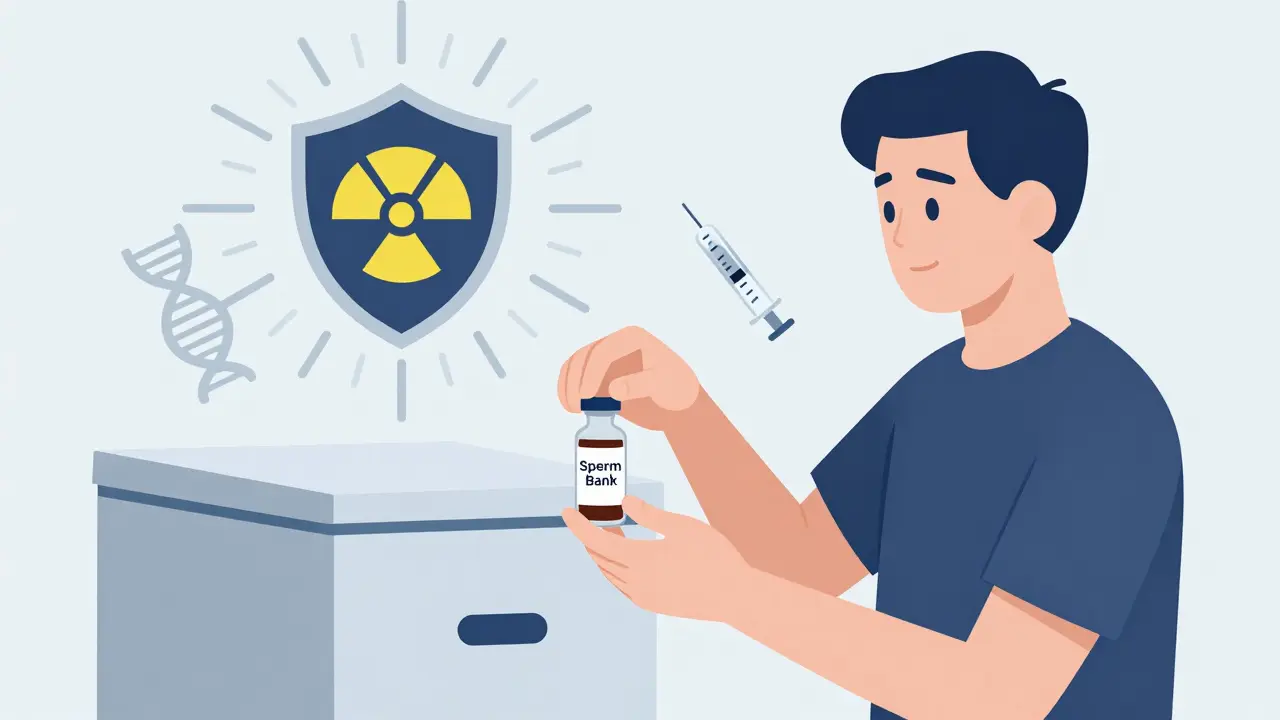
Options for Men: Sperm Banking
For men, the process is simpler and faster. You just need to produce a semen sample - usually after 2-3 days of abstinence. It’s collected in a private room at a fertility clinic or hospital. The sample is processed, mixed with a cryoprotectant solution (usually 7% glycerol), and frozen in liquid nitrogen. Most clinics store multiple samples in case you need more than one round of IVF later. Post-thaw sperm motility averages 40-60%, which is enough for successful IVF or IUI. Even if your count drops after chemo, frozen sperm from before treatment remains viable indefinitely. There’s no time limit. Men who banked sperm 20 years ago have successfully fathered children. The challenge? Many men feel embarrassed or overwhelmed. Some don’t even know it’s an option. Others are too sick to produce a sample on short notice. The key? Do it early. Ideally, within 72 hours of diagnosis. The American Urological Association says sperm quality can decline rapidly once chemo starts.Radiation Shielding: A Hidden Tool
If you’re getting radiation therapy to the pelvic area - common for cervical, rectal, or prostate cancer - there’s a simple way to protect your reproductive organs. Custom-made lead shields can block up to 90% of scattered radiation from reaching your ovaries or testes. This doesn’t help with chemo damage, but it’s a powerful tool when radiation is part of your plan. Radiation oncologists routinely use these shields. But not all patients know to ask. If you’re scheduled for pelvic radiation, ask your care team: “Can you shield my reproductive organs?” It’s a quick, painless step that can make a big difference.What About Kids?
For children and teens, options are limited - but not gone. Girls under 12 can’t freeze eggs because their ovaries aren’t mature enough. But ovarian tissue cryopreservation is the standard of care for them. Boys can’t bank sperm until puberty, but testicular tissue freezing is being studied in clinical trials. It’s still experimental, but promising. In 2023, researchers successfully grew immature sperm cells from frozen testicular tissue in the lab - a major step toward future fertility restoration for young boys.
Ashlee Montgomery
January 10, 2026 AT 15:30Fertility preservation isn't just a medical footnote-it's a right. I watched my sister go through chemo at 29 and she didn't even know egg freezing was an option until it was too late. No one asked her. No one pushed it. It’s systemic neglect wrapped in urgency. If you're diagnosed, demand a referral to a reproductive specialist on day one. Don’t wait for someone to hand you a pamphlet. Take control. It’s not selfish. It’s survival.
And yes, it’s expensive. But so is a lifetime of wondering what could’ve been.
neeraj maor
January 11, 2026 AT 22:37Let’s be real-this whole fertility preservation industry is a scam run by Big Pharma and fertility clinics. They make you think you’re saving your future, but 80% of those frozen eggs never lead to a live birth. And who’s to say the cancer won’t come back anyway? You spend $15K, go through hormone hell, and then die five years later anyway. It’s emotional manipulation disguised as hope. The real solution? Accept mortality. Stop chasing biological legacies. The planet’s overpopulated as it is.
Ritwik Bose
January 12, 2026 AT 00:49Respectfully, this is one of the most compassionate and thorough summaries I’ve ever read on this topic. The inclusion of ovarian tissue cryopreservation for prepubertal girls is especially vital-many still overlook it. I come from a rural community in India where even basic oncology care is a luxury. The fact that this information exists in plain language gives me hope. Thank you for not treating this as a footnote. May your words reach those who need them most.
🙏
Paul Bear
January 12, 2026 AT 16:30There’s a critical statistical misrepresentation here. The 90–95% survival rate for vitrified oocytes refers to post-thaw structural integrity, not clinical viability. Live birth rates per thawed egg are closer to 4–8%, not the implied 45–55%. And the claim that ‘15–20 mature eggs are needed’ is based on outdated 2017 ASRM guidelines-recent meta-analyses suggest 25–30 for optimal cumulative success. Also, gonadotropin-releasing hormone agonists show no statistically significant benefit in ovarian reserve preservation when adjusted for age and chemo type. This article is dangerously oversimplified.
lisa Bajram
January 13, 2026 AT 16:57Okay, I’m crying. Not because it’s sad-because it’s so damn beautiful that people are fighting for their future even while fighting for their lives. I’m a nurse in Phoenix and I’ve seen this play out a hundred times. A 24-year-old girl with Hodgkin’s, terrified, asking if she can still be a mom. We got her eggs frozen in 11 days. She’s now a mom of two. Yes, it’s messy. Yes, it’s expensive. Yes, it’s emotionally brutal. But it’s worth it. Don’t let anyone tell you otherwise. If you’re reading this and you’re about to start chemo-GO. TODAY. Call a fertility clinic. Say ‘I need to freeze my eggs or sperm.’ Don’t wait for permission. You deserve your future. You deserve to choose.
And if you’re a doctor reading this-stop assuming. Ask. Every. Single. Time.
Jaqueline santos bau
January 14, 2026 AT 16:27Ugh, I just read this and I’m already judging everyone who didn’t freeze their eggs. Like, seriously? You get cancer and you don’t think about your future kids? What kind of person does that? I know people who froze their eggs at 22 just in case-and now they’re thriving. You think it’s hard to go through chemo? Try living with the guilt of never holding your own child. And don’t even get me started on men who don’t bank sperm-what’s wrong with you? You’re not just risking your future, you’re risking your partner’s heart. This isn’t just medical-it’s moral.
Kunal Majumder
January 15, 2026 AT 01:51My cousin did sperm banking before chemo. He was scared, didn’t know how, but his oncologist just said, ‘We’ll help you.’ Two days later, it was done. Took 15 minutes. Cost him nothing. Now he’s a dad. Simple. No drama. If you’re male and you’re reading this-just do it. No excuses. You’ll thank yourself later.
Aurora Memo
January 15, 2026 AT 03:58I appreciate the depth here, but I wonder how many people are left out. What about trans men? Nonbinary folks? Those who don’t have access to gender-affirming care? The article assumes a binary framework. Fertility preservation isn’t just about eggs and sperm-it’s about identity, autonomy, and dignity. We need more inclusive language, more research, more funding for queer and trans patients. This isn’t just a medical issue. It’s a human rights issue.
chandra tan
January 15, 2026 AT 13:15In India, we don’t even have enough oncologists, let alone fertility specialists. I know a girl who got diagnosed with lymphoma and had to travel 800 km to Delhi just to freeze her eggs. Took three weeks. Chemo started late. She’s fine now, but barely. This info needs to be in schools, in clinics, in villages. Not just on Reddit. Someone needs to translate this into Hindi, Tamil, Bengali. Knowledge shouldn’t be a privilege of English speakers.
Dwayne Dickson
January 17, 2026 AT 00:44How ironic that we’ve engineered a medical system that saves lives but systematically erodes future ones. We’ll extend your survival by 15 years but leave you sterile. We’ll treat your cancer but ignore your identity as a potential parent. It’s not negligence-it’s structural indifference. And yet, we pat ourselves on the back for ‘advances in oncology.’ Meanwhile, the reproductive oncology pipeline is chronically underfunded. Someone’s profit margin is more important than someone’s future family. Sarcasm doesn’t begin to cover it.
Ted Conerly
January 17, 2026 AT 22:29Just wanted to say-this is the kind of post that makes me believe in humanity. Thank you for writing it. I’m a cancer survivor and I froze my eggs. It was terrifying, expensive, and exhausting. But I did it. And now I’m a mom. To anyone reading this who’s scared, overwhelmed, or thinking ‘it’s too late’-it’s not. Reach out. Call a clinic. Ask your nurse. You’ve already survived the hardest part. Don’t let fear steal your next chapter.
Faith Edwards
January 18, 2026 AT 08:23While I commend the effort, I must point out that this article is shockingly lacking in academic rigor. The references to ‘2019 studies’ and ‘2023 trials’ are vague and unattributed. No citations. No DOIs. No peer-reviewed sources. This is not medical advice-it’s anecdotal fluff dressed in clinical language. Anyone relying on this for life-altering decisions is placing their future in the hands of a poorly sourced blog post. If you’re going to discuss fertility preservation, do so with the precision of a peer-reviewed journal-not a viral Reddit thread. The stakes are too high for amateurism.