

Spinal Epidural Hematoma (SEH) Risk & Symptom Checker
Risk Factor Assessment
Select applicable factors based on your medical history or procedure details.
Critical Symptom Checklist
Check any symptoms experienced within 48 hours of procedure.
Risk Assessment Summary
Imagine you are scheduled for a routine epidural steroid injection to relieve chronic back pain. You are also taking blood thinners, specifically medications like warfarin or apixaban that prevent clot formation to protect your heart from stroke. This combination creates a delicate medical tightrope. On one side is the risk of uncontrolled bleeding leading to a Spinal Epidural Hematoma (SEH), a rare but catastrophic accumulation of blood in the spinal canal that compresses nerves. On the other side is the risk of stopping your medication, which could lead to a life-threatening clot. Understanding this balance is not just about reading labels; it is about knowing specific timing windows and recognizing early warning signs that can save your mobility.
Understanding the Risk: What Is a Spinal Epidural Hematoma?
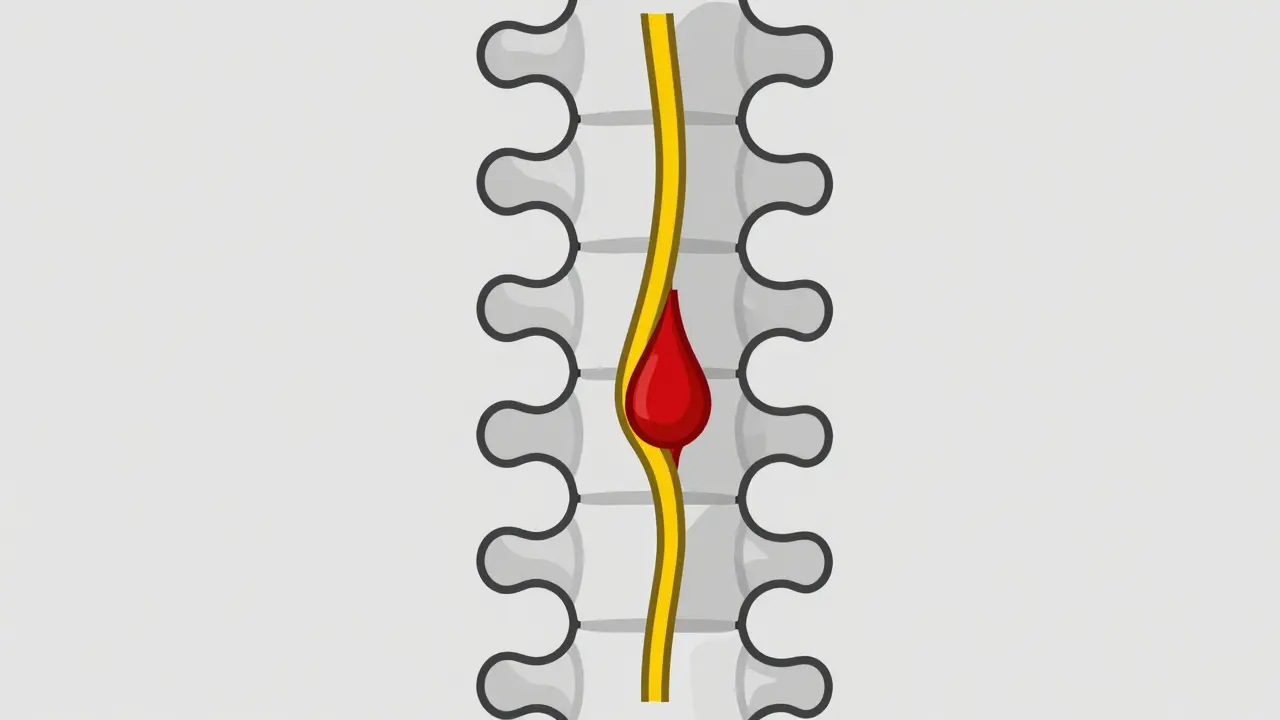
A Spinal Epidural Hematoma occurs when blood accumulates in the potential space between the dura mater (the tough outer membrane covering the spinal cord) and the ligamentum flavum. Because the spinal canal is a confined space, even a small volume of blood-sometimes as little as 1 to 2 milliliters-can exert significant pressure on the spinal cord or nerve roots. This compression cuts off oxygen supply to the nerves, leading to rapid neurological deterioration.
The incidence of SEH varies widely depending on patient factors and procedure type. For standard epidural blocks in healthy patients, the risk is estimated at roughly 1 in 150,000 procedures. However, this number rises significantly in high-risk populations, such as those receiving therapeutic-dose anticoagulation. The condition gained major clinical attention after the FDA reviewed over 170 cases of spinal hematomas associated with enoxaparin (Lovenox) between 1992 and 2013. While rare, the consequences are severe: approximately 24% of untreated cases result in permanent paraplegia, and mortality rates hover between 3% and 5% if treatment is delayed.
Recognizing Early Symptoms: The Critical Window
Time is tissue. The difference between full recovery and permanent disability often comes down to how quickly symptoms are identified and treated. Clinical characteristics of SEH typically manifest within 12 hours of the procedure, though they can appear up to 48 hours later. You must be vigilant for these specific red flags:
- Midline Back Pain: Reported in 93% of cases, this pain is distinct from typical post-procedure soreness. It is often described as severe, sharp, and localized directly over the spine.
- Sensory Deficits: About 89% of patients experience numbness or tingling, often starting in the saddle area (groin and buttocks) or spreading up the legs.
- Motor Weakness: Approximately 76% of cases involve difficulty moving the legs or feet, sometimes presenting as foot drop.
- Bowel/Bladder Dysfunction: Occurring in 34% of cases, loss of control or inability to urinate is a late and serious sign of cord compression.
The critical window for intervention is within 8 hours of symptom onset. A pivotal 2018 study by Afshari et al. demonstrated that 79% of patients who received surgical decompression within this 8-hour window achieved complete neurological recovery. In contrast, only 9% recovered fully when surgery was performed after 24 hours. If you experience any of these symptoms after a spinal procedure, do not wait. Seek emergency care immediately.
Risk Factors: Who Is Most Vulnerable?
Not all patients face the same level of risk. Several factors compound the likelihood of developing an SEH. Coagulopathy is the most significant contributor, accounting for 44.4% of postoperative SEH cases. Specific medications play a huge role here. Warfarin carries an 8.7-fold increased risk if the International Normalized Ratio (INR) exceeds 1.4. Therapeutic-dose Low Molecular Weight Heparin (LMWH) increases relative risk by 4.3 times compared to prophylactic doses.
Procedure-related factors are equally important. Multiple needle passes (three or more attempts) increase the risk 6.2-fold. A traumatic puncture, indicated by blood-tinged cerebrospinal fluid (CSF), raises the risk 11.8-fold. Additionally, placing an epidural catheter carries a 2.3-fold higher risk than a single-shot injection because the catheter remains in place, potentially irritating tissues over time.
Patient-specific attributes also matter. Advanced age (over 70 years) increases the odds ratio by 3.7. Renal impairment (creatinine clearance <30 mL/min) raises the odds ratio to 4.9, likely due to drug accumulation. Anatomical abnormalities like spinal stenosis add another layer of complexity, with an odds ratio of 2.8. Recent data also suggests a sex-based disparity, with women showing a 2.3-fold higher incidence of SEH despite similar anticoagulation parameters.
Anticoagulant Comparison: Timing Is Everything
Different blood thinners require different management strategies. The American Society of Regional Anesthesia and Pain Medicine (ASRA) provides updated guidelines that serve as the gold standard for clinicians. Here is how the risks and timing compare across major classes:
| Medication Class | Specific Drug | Pre-Procedure Wait Time | Post-Procedure Resumption | Relative Risk Profile |
|---|---|---|---|---|
| Vitamin K Antagonist | Warfarin | INR must be <1.4 | 4 hours (single shot) 6 hours (catheter) |
Low if INR controlled High if INR >1.5 |
| Low Molecular Weight Heparin | Enoxaparin (Prophylactic) | 10-12 hours | 2 hours (single shot) 4 hours (catheter) |
Moderate |
| Low Molecular Weight Heparin | Enoxaparin (Therapeutic) | 24 hours | 4-6 hours | High |
| Direct Oral Anticoagulant (DOAC) | Apixaban / Rivaroxaban | 48 hours (normal renal function) | 4-6 hours | Variable (0.05%-0.42%) |
| Antiplatelet | Aspirin | Often continued | N/A | Minimal (0.03% incidence) |
Note that renal function drastically alters DOAC timing. For patients with creatinine clearance under 50 mL/min, the cessation period for drugs like rivaroxaban may need to extend to 72 hours. Newer agents like betrixaban have specific guidance added in recent ASRA updates, emphasizing the need for individualized assessment.
Clinical Guidelines and Controversies
Expert opinion is largely consistent on the dangers of anticoagulation during neuraxial procedures, but debates persist regarding antiplatelet agents. Dr. Terese Horlocker, Chair of the ASRA Anticoagulation Committee, emphasizes that thrombolytic therapy carries the highest risk (estimated 4.5%) and should be absolutely avoided within 10 days of any spinal procedure. Conversely, there is ongoing discussion about aspirin. Some experts, like Dr. Timothy Lubenow, argue that continuing aspirin poses minimal risk based on large studies showing zero complications in over 100 procedures. However, dual antiplatelet therapy (e.g., aspirin plus clopidogrel) is universally considered high-risk, increasing the hazard by 3.8-fold and requiring a 7-day washout period.
The FDA maintains a cautious stance, stating that all anticoagulants carry inherent risks when combined with epidural or spinal anesthesia. This regulatory pressure has led to stricter labeling requirements and the implementation of Risk Evaluation and Mitigation Strategies (REMS) for prescribers. In practice, many anesthesiologists rely on decision-support tools. A 2022 survey revealed that only 58% of pain management physicians correctly identified all timing requirements, highlighting the complexity of these protocols. Mobile apps like 'Neuraxial Anticoag' have become popular aids, though users must ensure they are using versions updated with the latest 2024 ASRA guidelines.

Economic and Legal Implications
The stakes are high not just medically, but financially. The global anticoagulant market was valued at $23.7 billion in 2022, intersecting with the 40 million spinal procedures performed annually in the US. When SEH occurs, the cost is staggering. A 2022 JAMA Surgery study calculated the average cost of managing an SEH case at $287,450. This includes $182,600 for initial hospitalization, $78,300 for rehabilitation, and $26,550 for long-term care if permanent deficits occur. Compare this to the $1,200 cost of a standard epidural steroid injection, and the economic incentive for prevention becomes clear.
Legally, the landscape is unforgiving. In 2022, there were 78 malpractice claims related to SEH, with 62% resulting in settlements averaging $1.2 million. The primary causes cited were failure to follow established timing protocols (41%) and inadequate monitoring (37%). As of January 2025, the Agency for Healthcare Research and Quality designated SEH prevention as a high-priority patient safety indicator, triggering mandatory quality reporting for hospitals performing more than 50 spinal procedures annually. This regulatory shift underscores the industry's move toward zero-tolerance for preventable errors.
Emerging Research and Future Directions
Science is constantly refining our understanding of SEH. Emerging research focuses on biomarkers for early detection. A 2022 study in Nature Medicine identified serum Glial Fibrillary Acidic Protein (GFAP) levels greater than 0.72 ng/mL within two hours post-procedure as being 94% sensitive for impending hematoma. This could revolutionize monitoring, allowing for earlier intervention before irreversible damage occurs.
Additionally, the 2024 ASRA guidelines introduce new risk stratification tools incorporating 12 specific factors with weighted scoring. Scores above 15 indicate 'high risk,' prompting clinicians to consider alternative analgesia methods rather than proceeding with neuraxial techniques. These advancements aim to provide a more nuanced approach than simple timing tables, accounting for the complex interplay of patient physiology and pharmacology.
Can I get an epidural if I am on blood thinners?
Yes, but only after carefully following specific discontinuation protocols. For example, if you take warfarin, your INR must be below 1.4. If you take apixaban or rivaroxaban, you typically need to stop the medication 48 hours before the procedure, provided you have normal kidney function. Always consult your anesthesiologist and prescribing doctor to create a safe plan.
What are the first signs of a spinal hematoma?
The most common early sign is severe midline back pain that feels different from normal post-procedure soreness. Other signs include numbness or tingling in the legs or groin area (saddle anesthesia), weakness in the legs, and difficulty urinating. These symptoms usually appear within 12 hours of the procedure.
How soon should I seek help if I suspect a hematoma?
Immediately. The critical window for effective treatment is within 8 hours of symptom onset. Studies show that 79% of patients recover fully if surgically decompressed within this timeframe, compared to only 9% if treatment is delayed beyond 24 hours. Do not wait to see if symptoms improve on their own.
Is it safe to continue aspirin during spinal procedures?
Current evidence suggests that continuing low-dose aspirin alone poses minimal risk, with incidence rates around 0.03%. Many guidelines allow for its continuation. However, if you are on dual antiplatelet therapy (such as aspirin plus clopidogrel), the risk increases significantly, and you should stop the medications at least 7 days prior to the procedure.
Do kidney problems affect the safety of spinal procedures on blood thinners?
Yes, significantly. Kidney impairment reduces the body's ability to clear certain blood thinners, particularly Direct Oral Anticoagulants (DOACs) like rivaroxaban and apixaban. If your creatinine clearance is below 50 mL/min, you may need to stop these medications for 72 hours instead of the standard 48 hours to ensure safety.



Laura ciotoli
May 9, 2026 AT 18:27Listen up, because I'm only going to say this once and I don't have the patience for repeated questions. The guidelines for stopping anticoagulants before neuraxial procedures are not suggestions, they are strict protocols designed to prevent catastrophic neurological damage. If you are on warfarin, your INR must be below 1.4 before any needle touches your spine. For DOACs like apixaban or rivaroxaban, you need a washout period of at least 24 to 72 hours depending on renal function and dose. Do not rely on anecdotal evidence from forums. Consult your hematologist and anesthesiologist together. Failure to adhere to these timing windows is negligence, plain and simple. The risk of spinal epidural hematoma is real and devastating.
Guy Birtwhistle
May 10, 2026 AT 16:17I appreciate the clarity here, Laura. It's refreshing to see someone cut through the noise with actual facts rather than fear-mongering. Most people just skim these things and think 'oh, blood thinners, scary.' But knowing the specific INR cutoffs makes it manageable. Thanks for laying out the hard numbers so we can actually make informed decisions instead of guessing.
Kenny Pines
May 11, 2026 AT 10:26Whoa there, General Ciotoli 🛑📢 You're sounding a bit intense for a medical advice thread. Maybe take a deep breath? 😅 Not everyone has a hematologist on speed dial. Some of us just want to know if we should skip our morning pill. The sarcasm isn't helping the cause here. Let's keep it friendly, yeah? 🙃
Brian Fibelkorn
May 11, 2026 AT 19:49The epistemic arrogance displayed in this thread is staggering. To suggest that laypeople can adequately assess coagulation parameters without professional oversight is not just incorrect, it is morally bankrupt. The pathophysiology of spinal cord compression requires immediate recognition by trained personnel. Your casual dismissal of protocol adherence contributes to a culture of medical nihilism. We must uphold the highest standards of care regardless of convenience. Ignorance is no excuse for paralysis.
Liz and Nick
May 11, 2026 AT 21:22i mean... who reads all that stuff anyway. its too long and boring. i just had my shot last week and took my meds like normal because the nurse said it was fine. she didnt mention any of this drama. feels like everyone is trying to scare us for clicks or something. why cant doctors just be honest about risks without making it sound like a horror movie?
Chelsea Grdina
May 13, 2026 AT 03:07I completely understand where you're coming from, Liz, because honestly, medical jargon can feel like a foreign language when you're already in pain and worried about your health. It’s really important to remember that every patient’s situation is unique, and what works for one person might not be safe for another due to differences in kidney function or other medications they might be taking. In Canada, we often have pharmacists who spend extra time explaining these interactions, which helps bridge that gap between the complex clinical guidelines and what patients actually need to do day-to-day. It’s about building a partnership with your care team so you feel empowered rather than intimidated by the terminology. Please don’t hesitate to ask your provider to explain things in simpler terms until you feel comfortable.
Jannet Suen
May 13, 2026 AT 14:24Sigh. Here we go again with the 'doctors are hiding secrets' narrative. Look, honey, I get it, back pain sucks and waiting sucks more. But pretending that standard safety protocols are some kind of conspiracy against your comfort is exhausting. Just follow the instructions given to you specifically. If you’re unsure, call the office. They aren’t going to laugh at you. Stop looking for villains where there are just busy professionals trying to keep you walking. 😒
Claire A
May 13, 2026 AT 18:07I went through this exact process last year for my knee surgery and it was stressful but totally manageable once I made a checklist. I wrote down exactly when to stop each med and when to restart them. Having that physical list helped me sleep better knowing I wasn't forgetting anything crucial. You've got this!
andrew iregbayen
May 13, 2026 AT 23:47Hey Claire, that's a great tip. I think writing things down helps a lot because stress makes memory weird. Did you have to wait long after the procedure to start your meds again? I'm curious about the restart window.
Nisha Koshti
May 15, 2026 AT 18:09Wait... did anyone else notice that the FDA data stops in 2013?? 🚩🚩🚩 What happened after that?? Are they hiding new cases?? Big Pharma doesn't want you to know the truth about Lovenox!!! They change the dates to cover up the hematomas!!! Wake up sheeple!!! 💉💊
David Rangkhal
May 17, 2026 AT 02:29Nisha please calm down. The date range cited is likely referring to a specific retrospective study period used to establish baseline incidence rates. It does not imply that data collection stopped or that newer cases are being hidden. Medical literature often uses fixed historical periods for statistical analysis. Jumping to conspiracy theories distracts from the actual actionable advice in the post. Let's focus on the safety guidelines provided.
Sarah O'Donnell
May 17, 2026 AT 23:18Ugh, reading this makes my head hurt lol. Why is everything so complicated?? I just want my pain gone not a physics lesson on blood pressure. Also Sarah O'Donnell here btw 👋😂
Brian LeClercq
May 19, 2026 AT 05:41It is truly lamentable that American healthcare has devolved into such a bureaucratic nightmare where patients must act as their own pharmacists to avoid paralysis. This absurdity is a direct result of litigious society and defensive medicine practices that prioritize liability protection over patient autonomy. One would think that with our superior resources, we could offer clearer guidance, yet we are left deciphering cryptic warnings while European systems handle these nuances with far greater efficiency and transparency. The individual bears the burden of systemic failure.