
When you pick up a prescription, you might not realize that the pill in your hand isn’t the brand-name drug your doctor wrote on the script. It’s probably a generic. And the reason you can swap it without risking your health? The FDA’s therapeutic equivalence codes.
What Are Therapeutic Equivalence Codes?
Therapeutic equivalence codes are the FDA’s way of telling pharmacists and doctors: “This generic is safe to swap for the brand.” They’re not guesses. They’re based on hard science - pharmaceutical equivalence, bioequivalence, and real-world safety data. These codes show up in the FDA’s Orange Book, officially called Approved Drug Products with Therapeutic Equivalence Evaluations. First published in 1980, it’s updated every month. Over 14,000 drug products are listed there. About 90% of them carry an “A” code - meaning they’re approved for automatic substitution. The system exists because of the Hatch-Waxman Act of 1984. Before that, generic drugs were hard to get approved. The law changed that by creating a faster path for generics - as long as they proved they worked just like the brand. The TE code system was born to make sure that promise stayed safe.How the FDA Rates Substitutability: The A and B Codes
The first letter tells you everything. A means the generic is therapeutically equivalent to the brand. You can swap it without asking your doctor. But there’s more to it. The second letter adds detail:- AB - The gold standard. The generic matches the brand in active ingredient, strength, dosage form, and has proven bioequivalence through blood level studies. AB1, AB2, AB3, AB4? Those just mean there are multiple brand versions out there, and this generic matches one of them.
- BC - Extended-release pills or patches. The FDA can’t confirm bioequivalence with standard tests, so it’s flagged. Not unsafe - just needs more scrutiny.
- BD - Known bioequivalence problems. Rare, but happens. Usually because the drug is tricky to absorb.
- BT - Topical creams or gels. Hard to prove skin absorption equals blood levels. Many get this code even if they work fine.
- BN - Inhalers and nebulizers. Delivery matters as much as the drug itself.
- BX - Not enough data. The FDA doesn’t have enough evidence to say yes or no.
Why This Matters for Pharmacists and Patients
In 49 states, pharmacists can swap an “A”-rated generic without calling your doctor. That saves time, money, and hassle. According to the National Association of Boards of Pharmacy, over 90% of generic prescriptions in the U.S. are “A” rated. Pharmacists check the Orange Book weekly. A 2022 survey found 87% of community pharmacists rely on TE codes to make substitution decisions. Each check takes about 2.7 minutes - but that adds up to $1.2 billion in savings a year because generics cost far less. But here’s the problem: “B” codes confuse everyone. A 2022 AMA survey found 42% of doctors don’t understand what “B” means. Some think it means “unsafe.” Others think it means “can’t be swapped.” Neither is true. Take a topical cream with a BT code. It might work just as well as the brand. But because skin absorption is hard to measure, the FDA gives it a “B.” Some pharmacists refuse to substitute it - even though the patient would get the same benefit. That’s a missed opportunity.
How It Compares to the Rest of the World
The U.S. is unique in using a simple code system. In Europe, the EMA doesn’t use letters. Instead, they publish long scientific reviews for each generic. It’s thorough - but not practical for a busy pharmacy. The FDA’s system is designed for speed and clarity. A pharmacist sees “AB” on the label, swaps it, and moves on. No extra paperwork. No calls to the doctor. That’s why 90% of prescriptions in the U.S. are filled with generics - and why the country saves $370 billion a year on drug costs. Other countries rely on doctors to decide substitution. In the U.S., the system lets pharmacists be part of the safety net - not just dispensers.Where the System Falls Short
The TE code system works great for simple pills. But it’s struggling with modern drugs. Topical creams, inhaled medicines, complex injectables - these aren’t like swallowing a tablet. The drug’s behavior in the body depends on how it’s delivered. Standard blood tests don’t always capture that. Dr. Duxin Sun from the University of Michigan says: “Current bioequivalence tests for inhalers and creams might not reflect real-world effectiveness.” The FDA admits this. In 2022, they released a draft guidance to update how they evaluate complex products. They’re now using more real-world data, in vitro testing, and even patient outcomes to judge equivalence - not just blood levels. Between 2018 and 2022, applications for “B”-rated complex generics rose 22%. That’s not because more drugs are flawed. It’s because more complex drugs are being made - and the old system isn’t built for them.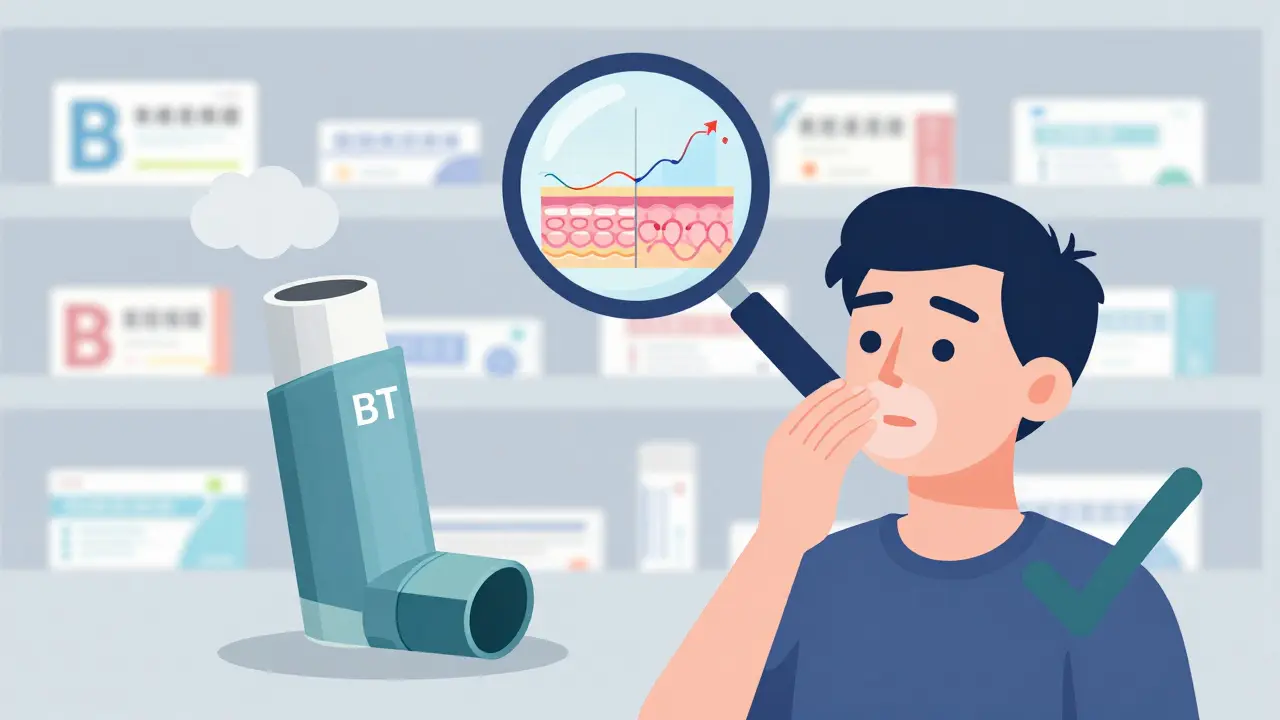
What You Should Do
If you’re a patient:- Ask your pharmacist: “Is this generic an ‘A’ or ‘B’?”
- If it’s “A,” you’re good to go.
- If it’s “B,” ask if it’s been used safely by others. Don’t assume it’s unsafe.
- Never refuse a generic just because it’s not the brand name. Most are just as effective.
- Learn what “B” really means. It’s not a red flag - it’s a caution sign.
- Don’t write “Dispense as written” unless you have a real clinical reason.
- Check the Orange Book yourself. It’s free and searchable online.
- Always verify the TE code before swapping.
- When you substitute a “B”-rated product, document it and notify the prescriber if your state requires it.
- Use the FDA’s Product-Specific Guidances - they’re updated monthly and explain exactly what data is needed for each drug.
The Future of Generic Substitution
The FDA’s 2023-2027 plan aims to reduce “B” ratings for complex generics by 30% by 2027. That means better testing methods, more data, and smarter rules. They’re already using real-world evidence - like patient records from hospitals - to show if a generic works just as well. That’s a big shift. Instead of relying only on lab tests, they’re asking: “Does this drug actually help people?” The goal isn’t to make substitution harder. It’s to make it smarter. More complex drugs are coming. The system has to keep up. For now, the TE code system is still the backbone of safe, affordable medicine in the U.S. It’s not perfect. But for millions of people taking generics every day, it works.What does an AB code mean on a generic drug?
An AB code means the generic drug is therapeutically equivalent to the brand-name version. It has the same active ingredient, strength, dosage form, and has passed FDA bioequivalence testing. Pharmacists can substitute it without asking the prescriber.
Can I trust a generic drug with a B rating?
Yes - but with caution. A B rating means the FDA hasn’t confirmed therapeutic equivalence with current testing methods. It doesn’t mean the drug is unsafe or ineffective. Many B-rated products, like certain inhalers or topical creams, work just as well as the brand. Talk to your pharmacist or doctor before refusing it.
Why do some generic drugs have different AB codes like AB1, AB2, AB3?
When multiple brand-name drugs (called Reference Listed Drugs) exist for the same active ingredient, each generic must match one of them. AB1, AB2, etc., indicate which brand the generic was tested against. You can still substitute within the same AB group - but not across different AB groups without checking.
Are over-the-counter (OTC) drugs assigned therapeutic equivalence codes?
No. The FDA’s therapeutic equivalence system only applies to prescription drugs. OTC medications are not evaluated or coded in the Orange Book, even if they have generic versions.
Where can I look up a drug’s therapeutic equivalence code?
The FDA’s Orange Book is publicly available online at fda.gov/orangebook. You can search by brand name, generic name, or active ingredient. The site is updated monthly and includes detailed explanations of each code.
Jigar shah
December 15, 2025 AT 14:10The FDA's TE code system is elegantly simple, but its limitations with complex drug formulations are becoming increasingly apparent. The reliance on bioequivalence via plasma concentration metrics fails to capture pharmacodynamic nuances in inhalers or topical agents. Real-world outcomes data should be integrated into the evaluation framework - not just as supplementary evidence, but as a primary criterion.
Anna Giakoumakatou
December 16, 2025 AT 19:39Oh great, another post pretending the FDA is some kind of saintly guardian of public health. Meanwhile, the same agency greenlit OxyContin and let Purdue Pharma turn addiction into a business model. If you trust a letter code more than your own doctor’s judgment, you’ve already lost the game.
Marie Mee
December 18, 2025 AT 09:10theyre lying about the codes dont you see it they use the b codes to make you pay more for brand names and the big pharma guys own the fda its all a scam
Kent Peterson
December 20, 2025 AT 08:04Let’s be real - America leads the world in generic drug access, and yet we still have people whining about B codes like they’re some kind of conspiracy. Other countries? They make you beg your doctor for permission to save money. Here? You get a letter. A. B. Whatever. It’s not perfect - but it’s better than Europe’s bureaucratic nightmare. Stop complaining and take the generic.
Josh Potter
December 21, 2025 AT 22:39Bro. I took a generic for my blood pressure for 3 years. Same exact results. Same side effects. Same damn pill shape. The FDA doesn’t lie. If it says AB - you’re golden. Stop overthinking it. Save your cash and your brain cells.
Meghan O'Shaughnessy
December 23, 2025 AT 21:16In India, we don’t have a code system - we just rely on pharmacists’ experience and brand reputation. It’s messy, but it works. The U.S. system is cleaner, but it doesn’t account for how drugs behave in real bodies - especially in patients with comorbidities. Maybe we need both: codes and context.
Kaylee Esdale
December 25, 2025 AT 00:03Generic drugs saved my life. I couldn’t afford the brand. The AB code meant I could breathe again. Don’t let anyone scare you out of saving money - especially when the science says it’s safe. Trust the process. Trust your pharmacist. Trust yourself.
Philippa Skiadopoulou
December 26, 2025 AT 06:44The FDA’s approach prioritizes efficiency over granularity. While suitable for oral solid dosage forms, it is inadequate for complex delivery systems. The European model, though slower, offers greater transparency. A hybrid approach - adopting EMA-style documentation alongside TE codes - could enhance both safety and confidence.
Linda Caldwell
December 28, 2025 AT 04:00Look - I used to be scared of generics too. Then I started reading the Orange Book. Turns out, most B-rated drugs are just fine. My asthma inhaler? B-rated. Works great. My skin cream? BT. No difference. Stop fearing letters. Start asking questions. You’ve got this.
CAROL MUTISO
December 29, 2025 AT 03:39Isn’t it funny how we’re supposed to trust a letter system built by bureaucrats who’ve never held a patient’s hand during a panic attack? The AB code says ‘safe.’ But safety isn’t just chemistry - it’s trust. And right now, that’s in short supply.
Raven C
December 30, 2025 AT 04:40Let’s not pretend this system is transparent - it’s a corporate lobbying masterpiece. The Orange Book is riddled with conflicts of interest. The FDA’s own advisory panels are staffed by pharma consultants. The ‘B’ codes? They’re not scientific - they’re political. You’re being played.
Donna Packard
December 31, 2025 AT 10:11I’ve been a pharmacist for 22 years. I’ve seen generics save families from bankruptcy. I’ve also seen B-rated products work better than the brand. Don’t fear the code. Learn it. Use it. It’s a tool - not a verdict.
Patrick A. Ck. Trip
January 1, 2026 AT 13:52While the TE code system is undeniably effective for many applications, its reliance on traditional pharmacokinetic metrics may not fully capture the therapeutic equivalence of complex formulations. Further research into in vitro-in vivo correlations and patient-reported outcomes may enhance its validity over time.
Sam Clark
January 3, 2026 AT 06:25As a prescriber, I now routinely check the Orange Book before writing prescriptions. I only use ‘Dispense as Written’ when there’s a documented clinical reason - not habit or fear. The TE codes are a gift. Use them wisely.
Jessica Salgado
January 3, 2026 AT 23:51I asked my pharmacist about my BT cream - she said, ‘It’s been used by 300 patients this month. No complaints.’ That’s the real data. Not letters. Not studies. Real people. Real results. Trust the human behind the counter.