
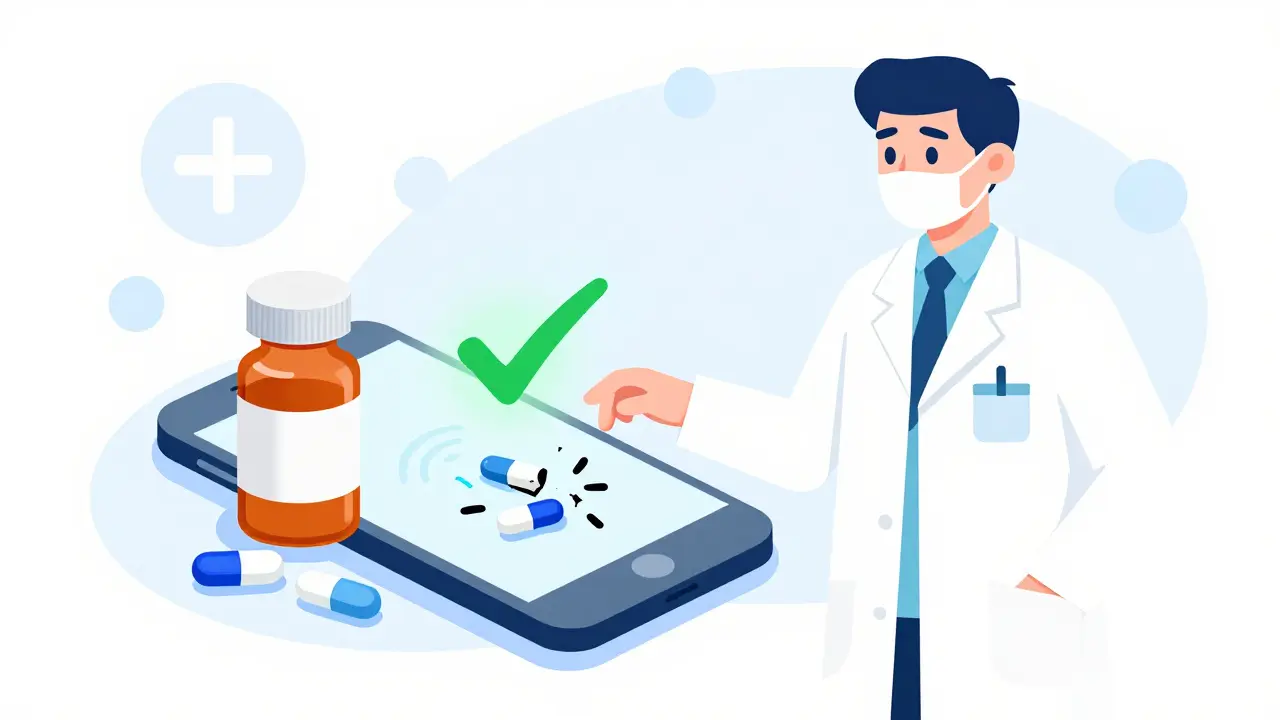
Every year, millions of people around the world take pills that don’t work-or worse, make them sick. These aren’t mistakes. They’re fakes. Counterfeit drugs are flooding global supply chains, and the stakes couldn’t be higher. A single fake antibiotic can kill someone. A fake cancer drug can turn hope into a death sentence. And with more than 1 in 10 medical products in low- and middle-income countries being falsified, this isn’t a distant threat-it’s happening now.
Why Fake Drugs Are Getting Harder to Spot
Counterfeiters aren’t amateurs. They’re using high-resolution printers, AI-generated packaging designs, and even stolen batch numbers to make fakes look real. A QR code on a fake bottle might scan just fine, leading a pharmacist to believe the drug is legitimate. In 2025, a major U.S. company lost $147 million in a recall after fraudsters copied its unsecured QR codes. That’s not a glitch. It’s a design flaw.
Traditional methods like tamper-evident seals and holograms are being replicated. A counterfeit pill might have the same color, shape, and imprint as the real one. The only way to fight back is with technology that can’t be copied easily-technology that speaks to machines, not just eyes.
Serialization: The Foundation of Modern Drug Security
The backbone of today’s anti-counterfeit effort is serialization. This means every single pill bottle, box, or vial gets a unique code-like a digital fingerprint. It’s not just a barcode. It’s a serial number tied to the manufacturer, batch, expiration date, and shipping path.
The U.S. Drug Supply Chain Security Act (DSCSA) and the EU’s Falsified Medicines Directive (FMD) now require this. By November 2025, every prescription drug in these regions must be traceable from factory to pharmacy. This isn’t optional. It’s the law.
Companies that adopted serialization early saw dramatic improvements. Recall times dropped by nearly 60%. When a batch is recalled, they don’t have to pull every product. They pull one code. One batch. One location. That saves lives and money.
But serialization alone isn’t enough. If the code isn’t protected, it’s just a sticker. That’s where the next layer comes in.
NFC: The Smartphone That Verifies Your Medicine
Imagine tapping your phone on a medicine bottle-and instantly knowing if it’s real. That’s NFC technology. Near Field Communication chips are embedded in packaging. When you tap your smartphone (Android 8.0+ or iOS 11+), the chip sends a cryptographically signed signal to a secure server. The phone checks: Is this code valid? Was it issued by the manufacturer? Has it been tampered with?
According to ForgeStop’s 2025 data from CPHI Frankfurt, NFC verification takes under 2 seconds and is 99.98% accurate. That’s better than most barcode scanners. And it’s not copyable. Unlike QR codes, which can be printed and pasted onto fake bottles, NFC chips are physically unique. Each one has a one-time programmable memory that can’t be rewritten.
Pharmacies in Latin America using NFC saw a 98% drop in counterfeit incidents within six months. Pharmacists now verify over 1,200 products daily. Each check adds just 3-5 seconds to the process. Patients don’t even notice-but they’re safer.
Blockchain: The Unbreakable Ledger
Think of blockchain as a public notebook that no one can erase. Every time a drug moves-from factory to warehouse to distributor to pharmacy-it gets logged. Temperature readings. Shipping times. Who handled it. All recorded permanently.
It’s not just about tracking. It’s about trust. If a shipment is delayed, the system shows why. If a box was exposed to heat, the sensors record it. That’s critical for insulin, vaccines, and other temperature-sensitive drugs.
Companies like Pfizer and Novartis are already using blockchain to trace shipments across borders. The EU’s upcoming Digital Product Passport rule, launching in 2027, will require this level of detail on every package. It’s not science fiction. It’s the new standard.
But blockchain isn’t quick to set up. Gartner estimates full integration takes 18-24 months. That’s why many companies pair it with serialization and NFC-they get immediate results now, and long-term security later.
DNA and Forensic Markers: The Unseen Shield
Some of the most advanced defenses are invisible. DNA-based authentication embeds a unique biological signature into the packaging or even the pill coating. It’s not a barcode. It’s a strand of synthetic DNA-designed to be unique to each product line. To verify, a lab uses a portable reader to analyze a tiny sample. The result? A match or no match.
This technology is nearly impossible to replicate. Counterfeiters can’t clone DNA without access to the original sequence. But it’s expensive-$0.15 to $0.25 per unit. That’s why it’s used for high-value drugs like biologics and cancer treatments, not everyday pills.
Other forensic inks change color under UV light, or shift hue when rubbed. These aren’t just for show. They’re used alongside serial numbers to create layers of verification. A pharmacist might check the hologram, then tap the NFC, then shine a UV light. Three checks. Zero false positives.
AI Vision: The Eyes That Never Blink
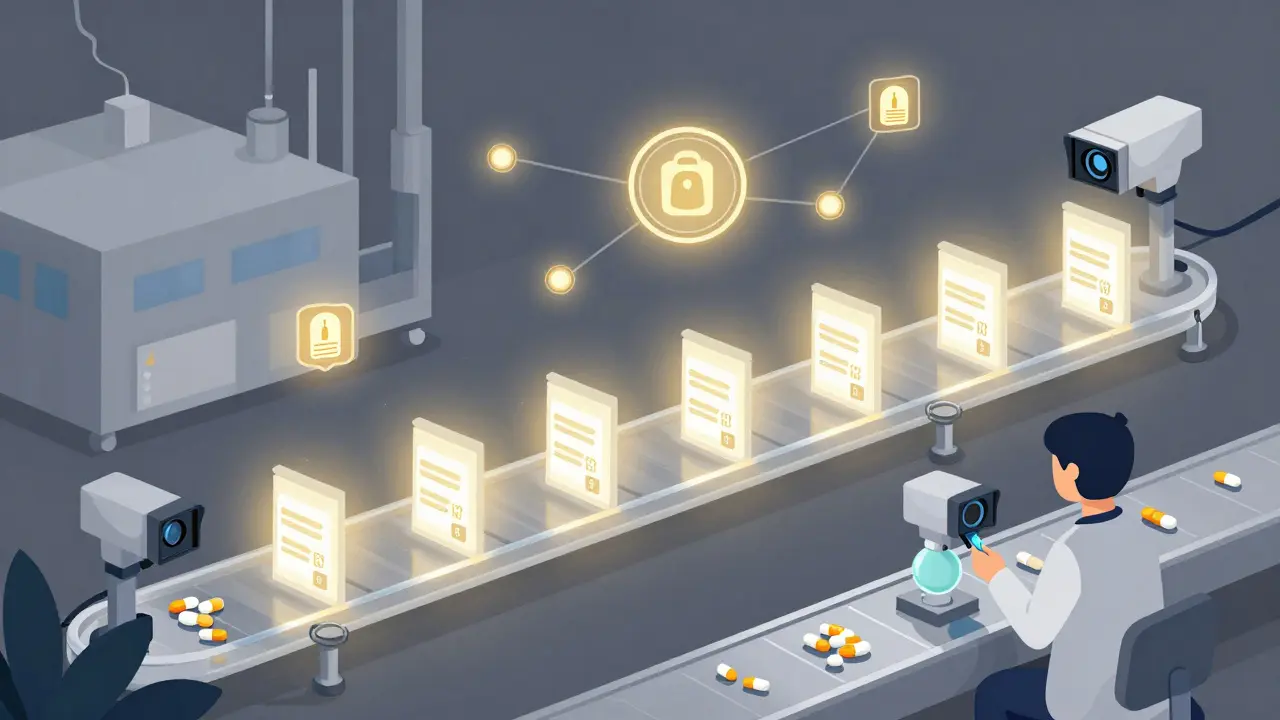
Factories are now using AI-powered cameras to inspect every single package as it rolls off the line. These systems don’t just read barcodes. They analyze texture, ink density, label alignment, and even tiny printing imperfections. In controlled tests, they’ve reached 99.2% accuracy in spotting fakes.
Real-world conditions are harder. Lighting changes. Packaging wrinkles. But AI keeps improving. In Q2 2025, detection accuracy jumped from 89.7% to 94.3% in real factories. The goal? To catch fakes before they leave the plant.
Some companies are even using AI to predict where counterfeits are likely to appear. By analyzing shipping routes, port delays, and regional demand, they’re redirecting resources to high-risk zones.
What’s Working-and What’s Not
Not all tech is created equal. Here’s what’s holding up-and what’s falling apart:
| Technology | Accuracy | Verification Speed | Cost per Unit | Best For |
|---|---|---|---|---|
| Serialization (GS1 Barcodes) | 95% | 5-10 seconds | $0.02-$0.05 | Regulatory compliance, bulk tracking |
| QR Codes (unsecured) | 22% | 3-7 seconds | $0.01-$0.03 | Avoid-easily copied |
| NFC (Cryptographically Secured) | 99.98% | <2 seconds | $0.08-$0.12 | Point-of-sale verification, pharmacies |
| DNA Authentication | 99.99% | 1-3 minutes | $0.15-$0.25 | High-value drugs, biologics |
| Blockchain | 100% (audit trail) | 10-30 seconds | $0.05-$0.10 | Supply chain transparency, cold chain |
QR codes are the biggest failure. They’re cheap. They’re easy. And they’re useless if they’re not encrypted. A 2025 ForgeStop audit found 78% of pharmaceutical QR codes were vulnerable to replication. Don’t use them unless they’re cryptographically signed.
The Big Picture: Multi-Layered Is the Only Way
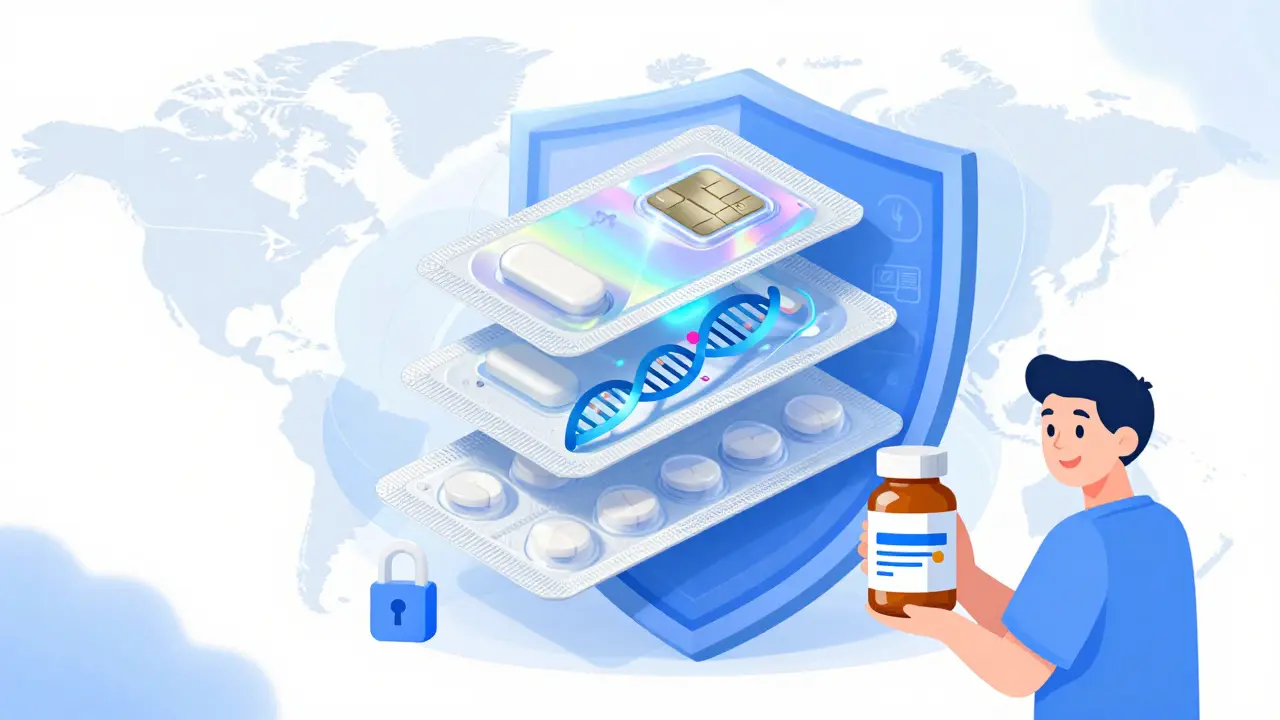
There’s no silver bullet. The most secure drugs today use at least three layers: a visible hologram, an NFC chip, and a blockchain-recorded serial number. The World Intellectual Property Organization calls this the "gold standard." It’s not about one technology. It’s about making counterfeiting too hard, too slow, and too expensive to bother with.
By 2027, 83% of top pharmaceutical companies plan to use this multi-layered approach. That’s not a guess. It’s a forecast based on real adoption.
What’s Next? The Future Is Here
Emerging trends are already reshaping the field:
- Eco-friendly security: 62% of new packaging now uses recyclable materials with embedded traceable markers.
- AI-driven supply chain mapping: Predictive tools are flagging high-risk shipments before they leave port.
- Global regulatory alignment: Brazil and Nigeria launched mandatory serialization in 2025. More countries are following.
- Cost drops: NFC and blockchain integration costs are falling 18% annually as tech scales.
But threats are evolving too. AI is helping counterfeiters generate realistic packaging. New 3D printers can mimic pill shapes down to the microscopic texture. The arms race isn’t over. It’s just getting started.
What You Can Do
If you’re a patient: Always check your meds. Look for tamper seals. Use your phone to scan NFC tags if available. If the packaging feels off-don’t take it. Report it.
If you’re a pharmacist or distributor: Don’t rely on QR codes alone. Push for NFC and blockchain integration. Train your team. Use verified platforms with 24/7 support.
If you’re in pharma: Start with serialization. Add NFC next. Layer in blockchain for cold chain drugs. Don’t wait for a recall to act. The cost of delay is measured in lives.
How common are fake drugs?
The World Health Organization estimates 1 in 10 medical products in low- and middle-income countries are fake or substandard. In high-income countries, the rate is lower-under 1%-but still dangerous. Fake cancer drugs, antibiotics, and insulin are rising fast.
Can I check if my medicine is real with my phone?
Yes-if it has an NFC chip. Just tap your smartphone on the packaging. You’ll get an instant result: genuine or fake. This works with Android 8.0+ and iOS 11+ phones, which cover 89% of devices sold in 2025. QR codes don’t work unless they’re cryptographically secured.
Why are some fake drugs so hard to detect?
Counterfeiters now use the same packaging materials as real manufacturers. They copy labels perfectly, even using the same ink and foil. Without digital verification like NFC or blockchain, your eyes can’t tell the difference. That’s why technology is now the only reliable defense.
Is blockchain necessary for anti-counterfeit efforts?
Not for every drug, but it’s critical for high-value and temperature-sensitive products like vaccines and biologics. Blockchain creates an unchangeable record of every step in the supply chain. It’s required by the EU’s 2027 Digital Product Passport rule and is becoming standard for global shipments.
What’s the biggest mistake companies make?
Using unsecured QR codes. They’re cheap and easy, but 78% fail security audits because they can be copied. A single copy can lead to mass counterfeiting and a $100+ million recall. Always use cryptographically signed codes or NFC.
Will these technologies make drugs more expensive?
Initially, yes. But the long-term cost of counterfeiting is far higher. Fake drugs lead to recalls, lawsuits, lost trust, and patient deaths. NFC and blockchain reduce recall costs by up to 60%. In the end, patients and companies both save money-and lives.
The fight against fake drugs isn’t about one invention. It’s about building systems that are smarter, faster, and more secure than the people trying to break them. The tools are here. The regulations are tightening. The question isn’t whether we can stop fake drugs-it’s whether we’ll act before it’s too late.

Seth Eugenne
March 24, 2026 AT 01:54rebecca klady
March 25, 2026 AT 19:12Blessing Ogboso
March 25, 2026 AT 20:32florence matthews
March 26, 2026 AT 07:20Mihir Patel
March 26, 2026 AT 21:12Marissa Staples
March 28, 2026 AT 07:52Rachele Tycksen
March 30, 2026 AT 01:39Pat Fur
March 31, 2026 AT 01:41