

Every year, hundreds of thousands of patients in the U.S. and Australia suffer harm because their medications weren’t properly reviewed when they moved from one care setting to another. A patient leaves the hospital, goes home, and takes a pill they were never supposed to. Or worse-they stop taking a life-saving drug because no one told them to keep it. These aren’t rare mistakes. They’re systemic failures. And they happen most often during care transitions-when patients move between hospitals, nursing homes, clinics, or back home. The good news? Most of these errors are preventable. The better news? We already know how to stop them.
Why Medication Errors Happen During Transitions
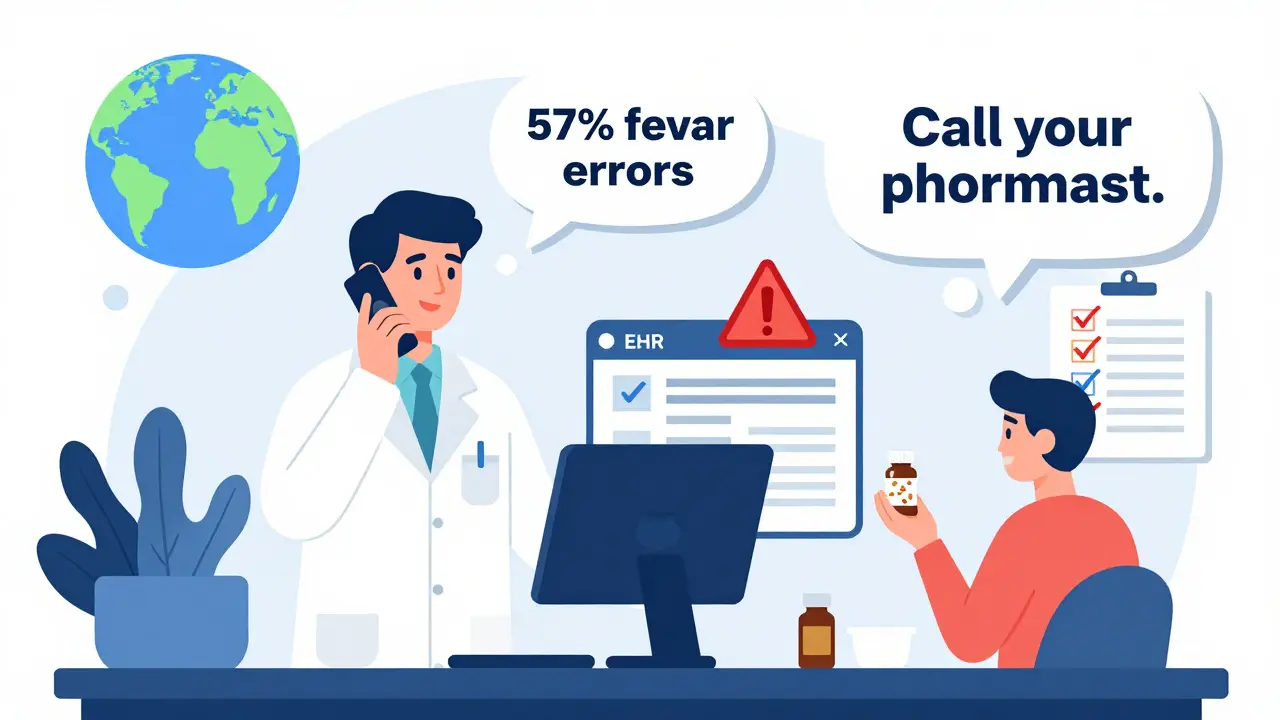
When a patient is discharged, their medication list should be clear, accurate, and communicated to everyone involved. But in reality, it’s often a mess. A patient might be on eight different medications before hospitalization. During their stay, doctors add, remove, or change doses. Then, when it’s time to go home, someone tries to piece together what they’re actually supposed to take. If that someone is overworked, distracted, or using a broken system, mistakes happen. The Agency for Healthcare Research and Quality (AHRQ) found that 60% of all medication errors occur during transitions. That’s not a fluke. It’s a design flaw. The problem isn’t that staff are careless-it’s that the system doesn’t make accuracy easy. A 2023 study in the Journal of the American Pharmacists Association showed that when pharmacists lead the reconciliation process, post-discharge errors drop by 57%. That’s not magic. That’s structure.What Is Medication Reconciliation? (And Why It Matters)
Medication reconciliation isn’t just making a list. It’s a formal, multi-step process to make sure every medication a patient takes is accounted for, understood, and properly adjusted at each point of care. The World Health Organization calls it one of the most critical actions in patient safety. The process has four core steps:- Get the most accurate list possible of what the patient was taking before admission (from the patient, family, pharmacy, or past records).
- Write out what medications are being prescribed during the current stay.
- Compare the two lists side by side.
- Make clinical decisions: which meds to continue, stop, or change-and why.
Technology Helps-But Only If Used Right
Electronic health records (EHRs), computerized order systems, and barcode scanning have cut medication errors by nearly half in hospitals, according to a 2022 Cochrane review. But here’s the catch: when hospitals just slap on an EHR without changing workflows, things get worse. The MARQUIS study in JAMA Internal Medicine found that during the first six months after new EHRs were installed, medication discrepancies actually increased by 18%. Why? Because staff were trying to use a new system without proper training or role clarity. One nurse described it as “typing in meds while running between rooms.” The real solution? The AHRQ’s MATCH toolkit. It’s not software. It’s a detailed guide for how to embed reconciliation into daily work. It covers 11 workflow phases-from how to talk to patients about their meds to how to hand off information to community pharmacies. Hospitals that used the full toolkit saw a 63% reduction in errors. Those relying only on EHRs? Only 41%.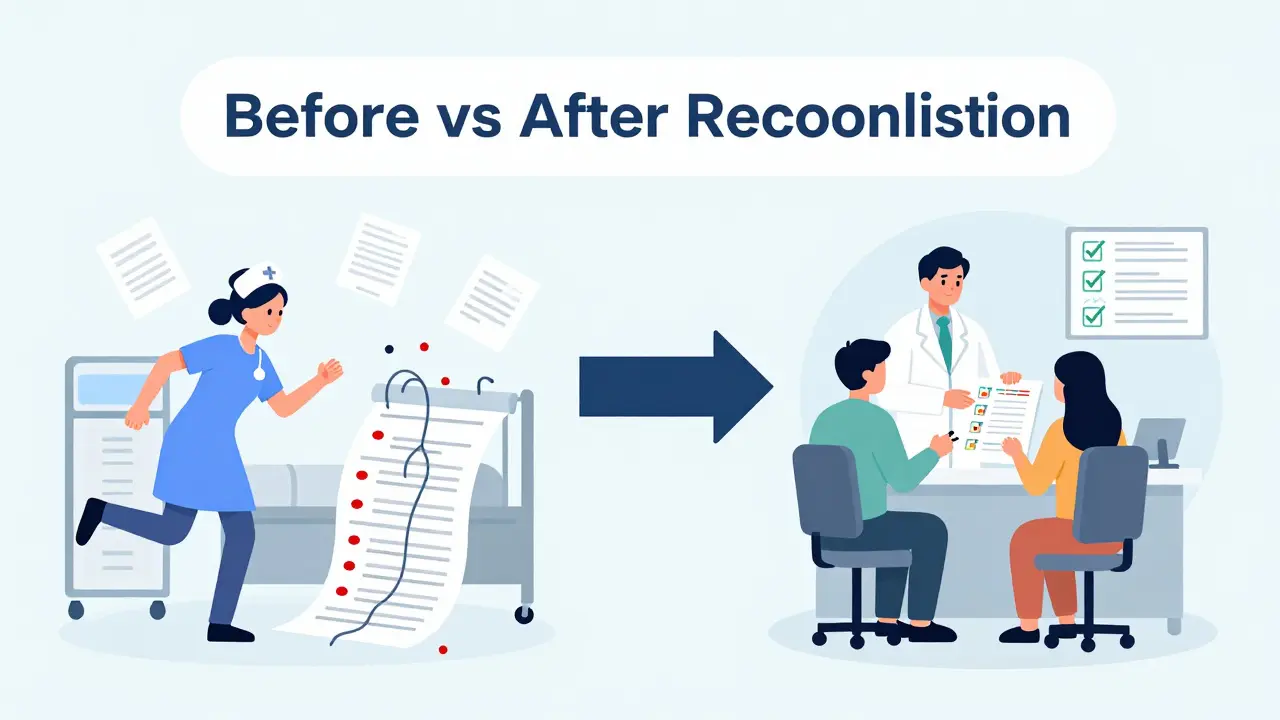
Who Should Do It? The Role of Pharmacists
Doctors don’t have time. Nurses are stretched thin. But pharmacists? They’re trained for this. The American Society of Health-System Pharmacists (ASHP) found that hospitals with dedicated transition pharmacists see 53% fewer adverse drug events. These aren’t just pill counters. They’re clinical detectives. They call community pharmacies. They talk to home care nurses. They check for duplicate drugs, dangerous interactions, and doses that don’t make sense. One pharmacist in Melbourne told me: “Catching a duplicate anticoagulant order during discharge that would have caused a major bleed is why I do this work.” That’s not a story. That’s routine. Yet, only 28% of facilities consistently involve patients in the process. And only 37% of U.S. hospitals can electronically share medication data with community pharmacies. That means pharmacists are still calling offices, leaving voicemails, and hoping someone picks up.What Goes Wrong at Discharge?
Discharge is the riskiest moment. That’s when patients get a new prescription, stop old ones, and are sent home with instructions they don’t fully understand. A 2024 Kaiser Family Foundation survey found that 72% of patients don’t even know why their medication list matters. Common discharge errors include:- Not restarting a chronic medication (like blood pressure or insulin).
- Prescribing a drug that conflicts with an existing one (like adding another NSAID when the patient is already on aspirin).
- Changing the dose without explaining why.
- Not documenting allergies or past reactions.
How to Fix It: 5 Practical Steps
You don’t need a billion-dollar system. You need consistency. Here’s what works:- Assign clear roles. Who is responsible for getting the medication list? Who checks it? Who explains it to the patient? The MARQUIS study found that unclear roles increased harmful errors by 15%.
- Use at least two sources. Don’t rely on what the patient says. Don’t just pull from the EHR. Call the pharmacy. Check with the primary care provider. Use a printed list from the patient’s home.
- Give time. The MATCH toolkit recommends 15-20 minutes per patient. Most hospitals only allow 8-10. If you’re cutting time, you’re cutting safety.
- Involve the patient. Ask them: “Can you show me what pills you take at home?” Have them bring their pill bottles. Use plain language: “This one is for your heart. This one you can stop.”
- Follow up. A 2023 study showed that patients who received a phone call from a pharmacist within 48 hours of discharge had 38% fewer readmissions.
The Bigger Picture: Regulation, Cost, and Future
Medication safety isn’t just a clinical issue-it’s a financial one. The Centers for Medicare & Medicaid Services (CMS) can reduce hospital payments by up to 1.5% if they fail to meet reconciliation standards. The global market for medication safety tech hit $3.27 billion in 2023 and is growing fast. New tools are emerging. AI-powered systems like MedWise Transition, cleared by the FDA in August 2024, cut discrepancies by 41% in a 12-hospital trial. But tech alone won’t fix this. The WHO’s Phase 2 of “Medication Without Harm” (launched October 2024) is clear: Focus on transitions. By 2027, they want to cut harm in high-risk transitions by 30%. In Australia, the Australian Commission on Safety and Quality in Health Care has been pushing for this since 2020. The same rules apply here: accurate lists, clear communication, pharmacist involvement, and patient engagement.What You Can Do-Even If You’re Not a Doctor
If you’re a patient or caregiver:- Bring all your medications (in bottles) to every appointment.
- Ask: “Am I taking any meds I didn’t take before?”
- Get a written list at discharge. Don’t trust memory.
- Call your pharmacist if something doesn’t make sense.
- Push for pharmacist-led reconciliation.
- Use the MATCH toolkit-even if you only adopt half of it.
- Stop treating reconciliation as paperwork. Treat it like surgery: one mistake, one life changed.
Final Thought: It’s Not About Technology. It’s About Trust.
The tools are here. The guidelines are clear. The data proves it works. So why do errors still happen? Because we treat medication reconciliation like a checkbox-not a lifeline. When done right, it doesn’t just prevent harm. It builds trust. Patients who are involved in the process feel more confident. Pharmacists feel proud. Nurses feel supported. And hospitals save millions. The next time a patient walks out the door with a new prescription, ask yourself: Did we really know what they were taking before? If the answer isn’t a confident yes, then we still have work to do.What is medication reconciliation and why is it required during discharge?
Medication reconciliation is the process of comparing a patient’s current medication list with the medications they are prescribed during a hospital stay or at discharge. It’s required because patients often have changes in their meds during hospitalization-some are stopped, others added or changed in dose. Without a formal comparison, patients can be sent home with incorrect or dangerous regimens. The Joint Commission and WHO require it at every care transition to prevent avoidable harm.
Can electronic health records (EHRs) prevent medication errors on their own?
No. While EHRs can reduce errors by up to 32%, studies like the MARQUIS trial found that during initial implementation, discrepancies actually increased by 18%. This happens when staff are forced to use new technology without changes to workflow, training, or clear roles. EHRs are tools-not solutions. They only work when paired with structured processes, like the AHRQ MATCH toolkit.
Why are pharmacists so important in preventing discharge errors?
Pharmacists are trained in drug interactions, dosing, and therapy management. Studies show that when pharmacists lead medication reconciliation at discharge, post-discharge errors drop by 57% and hospital readmissions fall by 38%. They’re the only staff routinely trained to verify medication lists across multiple sources-like calling community pharmacies or checking for duplicate prescriptions. Their role is clinical, not administrative.
How long does it take to implement a successful medication reconciliation program?
Most organizations need 6 to 9 months to fully implement a program using the AHRQ MATCH toolkit. The process includes assessing current workflows, training staff, redesigning roles, integrating with pharmacy systems, and piloting the new process. Rushing it leads to workarounds and increased errors. The most successful programs allocate 15-20 minutes per patient and involve pharmacists from day one.
What are the biggest barriers to preventing medication errors during transitions?
The biggest barriers are: lack of time (most staff get only 8-10 minutes per patient, not the recommended 15-20), poor communication between hospitals and community pharmacies (only 37% can exchange data electronically), unclear roles among staff, and lack of patient involvement. Resistance from physicians (reported by 63% of hospitals) and over-reliance on EHRs without workflow changes also contribute significantly.
What should patients do to help prevent medication errors at discharge?
Patients should bring all their medications (in original bottles) to every appointment, ask for a written list of changes at discharge, and verify each medication with their pharmacist. They should ask: “Which meds should I keep taking? Which ones should I stop? Why?” If they’re unsure, they should call their pharmacist within 48 hours. Studies show patients who do this are 38% less likely to be readmitted.
Natali Shevchenko
March 21, 2026 AT 23:35Bryan Woody
March 23, 2026 AT 07:02shannon kozee
March 24, 2026 AT 12:02Chris Dwyer
March 25, 2026 AT 13:47Thomas Jensen
March 26, 2026 AT 11:52Paul Cuccurullo
March 27, 2026 AT 16:05Shaun Wakashige
March 28, 2026 AT 16:07Johny Prayogi
March 29, 2026 AT 11:55Solomon Kindie
March 31, 2026 AT 00:02Timothy Olcott
April 1, 2026 AT 12:51matthew runcie
April 2, 2026 AT 07:18Nicole James
April 3, 2026 AT 16:23