

When you’re pregnant, your body changes in ways you never expected. One of the most surprising? Your liver can start acting up - not because you did something wrong, but because of hormones your body is making to support your baby. The condition is called intrahepatic cholestasis of pregnancy (ICP), or obstetric cholestasis. It’s not rare, and it’s not your fault. But it’s serious enough that every pregnant person should know the signs, the risks, and what to do next.
What Is Intrahepatic Cholestasis of Pregnancy?
ICP happens when bile - the fluid your liver makes to help digest food - can’t flow properly. Instead of moving out of the liver, it builds up in your bloodstream. This isn’t just a liver issue. It’s a pregnancy-specific condition that only occurs during gestation and goes away within days after delivery. The main symptom? Intense itching, usually on the palms of your hands or soles of your feet. No rash. No bumps. Just relentless, deep itching that gets worse at night. Many women describe it as feeling like ants are crawling under their skin.
It usually shows up in the late second or early third trimester, when estrogen levels peak. That’s not a coincidence. Estrogen interferes with the liver’s ability to move bile out. In women with certain genetic traits - often passed down from mother to daughter - this disruption becomes severe. Studies show that if your mom or sister had ICP, your risk jumps 12 to 15 times higher. It’s not contagious. It’s inherited.
Why Bile Acid Levels Matter More Than Itching
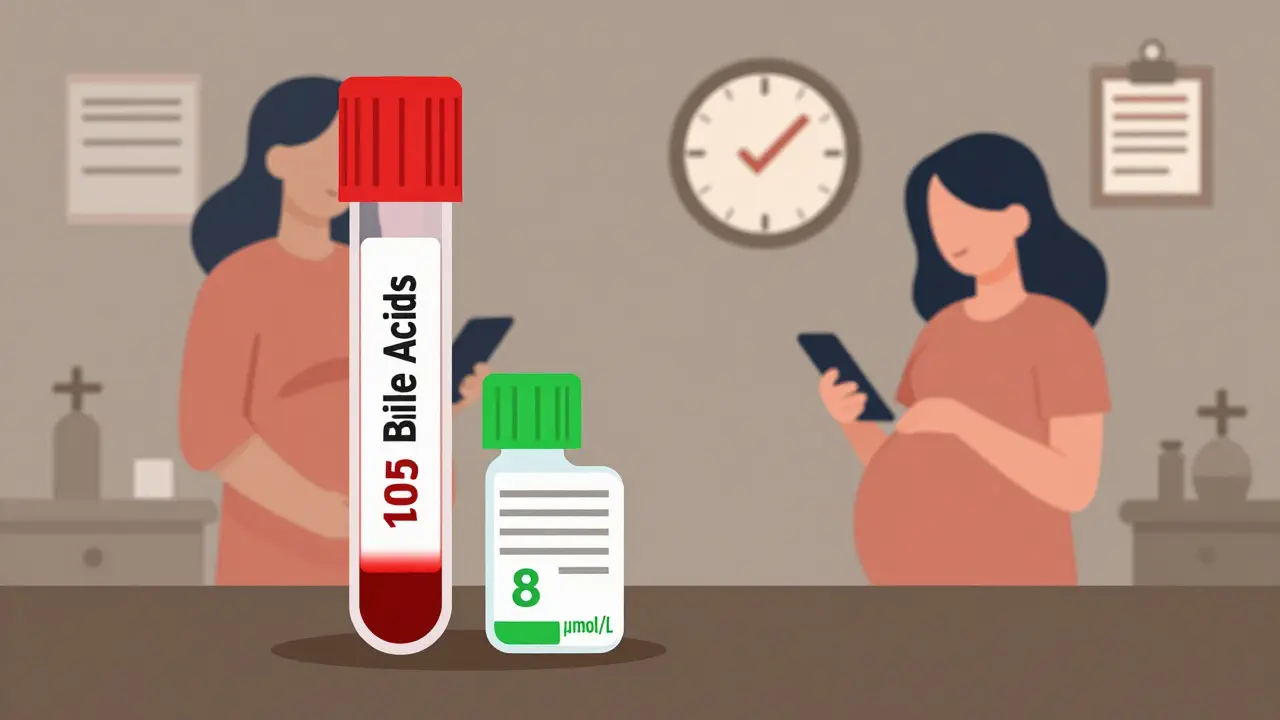
Doctors don’t just diagnose ICP based on itching. That’s too vague. The real diagnostic tool? A blood test that measures serum bile acids. The threshold? Above 10 µmol/L. That’s it. If your level is over 10, you have ICP - even if the itching is mild. And here’s the critical part: the higher the bile acid level, the higher the risk to your baby.
Levels above 40 µmol/L are considered severe. Above 100 µmol/L? That’s when the risk of stillbirth jumps sharply. A 2021 study in the Journal of Hepatology found that babies born to mothers with bile acids over 100 had a 3.4% chance of stillbirth. For those under 100, it was just 0.28%. That’s a 12-fold difference. This isn’t theoretical. It’s why doctors don’t wait. They monitor. They act.
Other liver tests - like ALT and AST - may be elevated in 60-70% of cases. But they’re not reliable on their own. A woman can have normal liver enzymes and still have dangerous bile acid levels. That’s why bile acid testing is the gold standard. And now, with the new CholCheck® point-of-care test approved by the FDA in 2023, results are available in 15 minutes instead of days. Hospitals in the U.S. are rolling it out fast, especially in Level III and IV maternity units.
Who’s at Risk?
ICP doesn’t pick and choose. But it does have patterns.
- Multiple pregnancies: Carrying twins or triplets increases your risk by 300-500%. More hormones. More strain on the liver.
- IVF pregnancies: Women who conceive through in vitro fertilization have double the risk. The hormone treatments likely play a role.
- Family history: If your mother or sister had ICP, your chances go way up.
- Geography: Prevalence varies wildly. In Chile, it affects up to 15.6% of pregnancies. In the U.S., it’s 1-2%. In the UK, 0.7-1.5%. Latina women in the U.S. have a 5.6% rate - nearly triple the national average.
It’s also more common in winter months and in colder climates. Why? No one’s sure. But it’s consistent enough that some countries now screen all pregnant people in the third trimester. Sweden, Finland, and Norway have done this since 2018. The result? A 35% drop in ICP-related stillbirths.
How It’s Different From Other Pregnancy Liver Conditions
ICP isn’t the only liver issue during pregnancy. There’s also acute fatty liver of pregnancy (AFLP) and HELLP syndrome. But they’re very different.
AFLP and HELLP come with nausea, vomiting, abdominal pain, high blood pressure, and sometimes seizures. They’re medical emergencies. ICP? You feel fine otherwise. Just itching. No fever. No swelling. No high blood pressure. That’s why it’s often missed. Women think it’s just dry skin or a rash. They wait. And wait. By the time they see a doctor, bile acids may have climbed dangerously high.
That’s why knowing the difference matters. If you have itching without rash and no other symptoms - especially if it’s worse at night and on your hands/feet - get your bile acids checked. Don’t wait for a rash. Don’t wait for pain. Just get tested.
Safe Treatments: What Actually Works
There’s no cure for ICP except delivery. But there are treatments that help - and they’re proven.
Ursodeoxycholic acid (UDCA) is the first-line treatment. It’s a bile acid you take orally, usually 10-15 mg per kilogram of body weight per day. It works by replacing the toxic bile acids in your system with ones that are safer. It reduces itching by about 70%. It may also lower the chance of preterm labor by 25%. And while some studies debate whether it reduces stillbirth risk, every major guideline - from the Royal College of Obstetricians and Gynaecologists (RCOG) to the American College of Obstetricians and Gynecologists (ACOG) - recommends it.
One study from Cedars-Sinai in 2023 showed that women on UDCA had significantly lower bile acid levels over time. That’s the goal: not just to feel better, but to protect your baby.
If you can’t tolerate UDCA, there’s S-adenosyl methionine (SAMe). It’s taken as a supplement, 800-1600 mg daily. Small studies show it cuts itching by 40-50%. But there’s not enough data to say it protects the baby like UDCA does. It’s a second choice.
What about cholestyramine? It’s an older drug, sometimes used for itching. But it blocks vitamin K absorption. That’s a problem because vitamin K helps your blood clot. One study found 15% of women on cholestyramine had low vitamin K levels - raising the risk of postpartum bleeding. It’s rarely used now.
And don’t try home remedies. Cold baths, lotions, antihistamines - they don’t touch the root cause. They might give you temporary relief, but they won’t lower your bile acids. And that’s what matters.
Monitoring and Delivery Timing
Once diagnosed, you’ll be under close watch. Most hospitals start twice-weekly non-stress tests at 32-34 weeks. These check your baby’s heart rate and movement. If your bile acids are high, you might get them even sooner.
Delivery timing depends on your numbers:
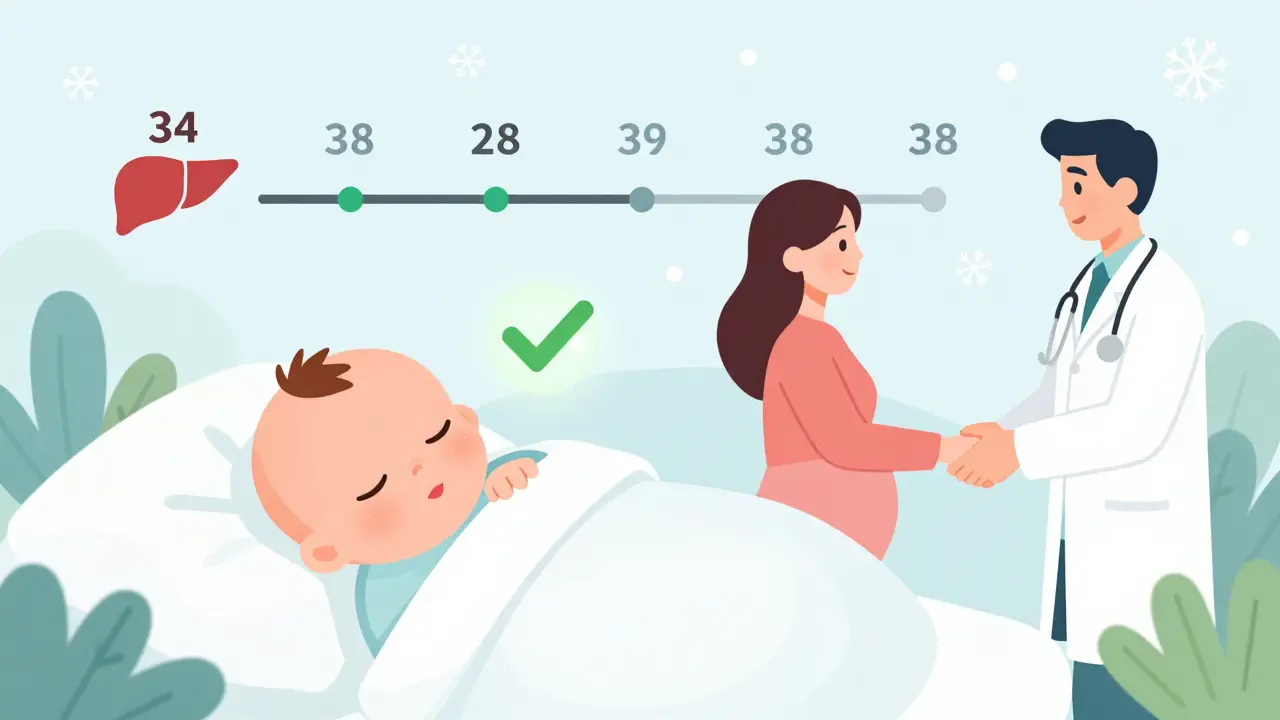
- Mild ICP (bile acids <40 µmol/L): Delivery recommended at 37-38 weeks.
- Severe ICP (bile acids >100 µmol/L): Delivery considered between 34-36 weeks.
Why not wait? Because bile acids can spike fast. One study found 30% of women go from mild to severe in just 14 days. That’s why doctors don’t wait for symptoms to get worse. They test. They track. They plan.
And here’s something new: a 2024 consensus statement expected this spring suggests that with aggressive treatment and weekly monitoring, stillbirth risk stays below 0.5% even at 38 weeks - even if bile acids are mildly elevated. This could mean fewer early deliveries and better outcomes. But it only works if you’re being monitored.
What Happens After Baby Is Born?
Good news: ICP disappears within 1-3 days after delivery. Your itching fades. Your bile acids drop. Your liver returns to normal.
But here’s the catch: ICP doesn’t just go away - it leaves a mark. Women who’ve had ICP have a 3.2 times higher risk of developing liver problems later in life. That includes:
- Gallstones (4.3 times higher risk)
- Chronic hepatitis (3.1 times higher)
- Hepatitis C (2.8 times higher)
That’s why it’s not just a pregnancy issue. It’s a lifelong marker. After delivery, tell your primary doctor. Get your liver checked every 2-3 years. If you ever have unexplained fatigue, jaundice, or abdominal pain - don’t ignore it. Your history with ICP matters.
The Big Picture: Why This Matters Now
In the U.S., only 42% of OB-GYN practices routinely screen for ICP. Most wait until you complain of itching. That’s too late. In places like Sweden, where every pregnant person gets a bile acid test around 28 weeks, stillbirth rates have dropped dramatically.
And here’s the hard truth: if you live in a place without easy access to testing, you’re at higher risk. Dr. Hiroshi Tanaka from Japan warns that in resource-limited areas, doctors have to guess. They treat based on symptoms alone. And that leads to 40% more adverse outcomes.
So if you’re pregnant - especially if you’re at higher risk - ask for the bile acid test. Don’t wait for itching. Don’t wait for your doctor to bring it up. Say: "I’ve heard about ICP. Can I get my bile acids checked?"
It’s simple. It’s safe. It’s life-saving.


Chima Ifeanyi
February 8, 2026 AT 04:42Tori Thenazi
February 9, 2026 AT 20:51Angie Datuin
February 11, 2026 AT 02:10Jonah Mann
February 11, 2026 AT 22:42Brandon Osborne
February 12, 2026 AT 02:21Lyle Whyatt
February 14, 2026 AT 01:49Ken Cooper
February 14, 2026 AT 20:45MANI V
February 15, 2026 AT 06:16Jessica Klaar
February 16, 2026 AT 16:39glenn mendoza
February 17, 2026 AT 07:55Patrick Jarillon
February 17, 2026 AT 16:23Randy Harkins
February 18, 2026 AT 00:37Camille Hall
February 18, 2026 AT 05:43Ritteka Goyal
February 18, 2026 AT 21:10